[2027 CSAT] Mock Exam and Registration Data Helped Balance Difficulty Across Elective Subjects Amid Intensifying Satam Run
- Input
- 2026-11-19 09:20:06
- Updated
- 2026-11-19 09:20:06
[Financial News] The 2027 College Scholastic Ability Test (CSAT) was designed to reflect changes in the characteristics of the test-taking population, including the so-called Satam Run phenomenon, minimize potential advantages or disadvantages among elective subjects, and exclude questions that would favor students who had learned problem-solving techniques and practiced them repeatedly through private tutoring.
According to the CSAT Test-Setting Headquarters and KICE, around 550,000 students are taking the 2027 CSAT simultaneously today, starting at 8:40 a.m., at 1,312 test sites across 85 testing districts nationwide.
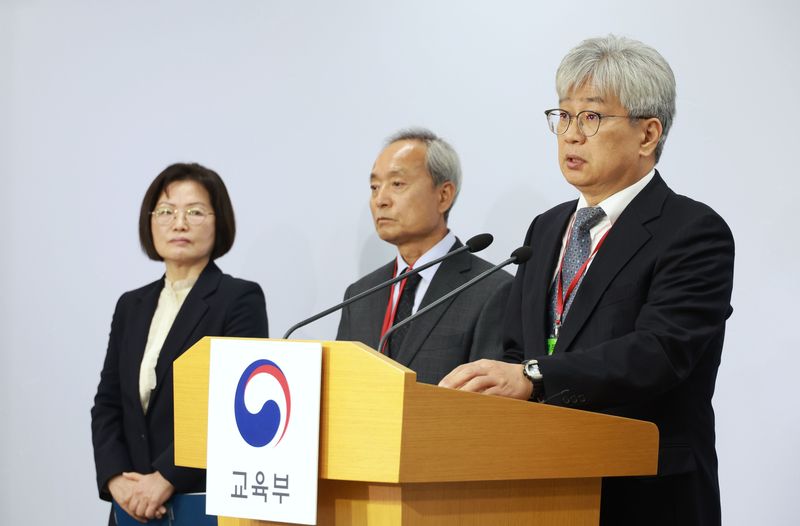
Oh Gi-yeong, chair of the CSAT question-setting committee and a professor at Hankyong National University, said at a briefing on the test-setting approach at Government Complex Sejong this morning, “We analyzed the results of the June and September mock assessments and compared them with last year’s CSAT results to identify the characteristics of the test-taking population.” He added, “We reviewed and analyzed the registration figures for the actual CSAT and tracked trends in how those characteristics were changing.” He went on to explain, “We made every effort to balance the difficulty across subjects by combining these analyses.”
The question-setting committee faithfully reflected the content and level of the 2015 revised high school curriculum across all sections and subjects. Even core curriculum content covered in previous exams was tested with changes to question formats, ideas, and approaches.
Oh said, “We designed the exam to ensure it could sufficiently distinguish among students based solely on material covered in the public education curriculum.”
In the Korean language section, a range of passages and materials in diverse formats were used to focus on measuring comprehension and creative thinking. The mathematics section avoided questions solvable through excessively complex calculations, technical skills or formulas acquired through repetitive practice, or the simple application of formulas, and instead was designed to assess understanding of basic concepts and comprehensive thinking.
The inquiry section included questions designed to measure understanding of concepts and principles, inquiry skills, and problem-solving abilities within the scope of the curriculum. The Korean language, mathematics, and inquiry sections all focused on minimizing potential advantages or disadvantages stemming from elective subject choices. The English section included listening, indirect speaking, reading, and indirect writing questions using basic vocabulary prescribed by the curriculum and frequently used words.
The Korean History section featured straightforward questions focused on key content to assess basic knowledge of Korean history. The second foreign language and classical Chinese section was designed to measure the language skills needed for basic communication and understanding of the culture of the relevant language community. The English, Korean History, and second foreign language and classical Chinese sections are graded on an absolute scale.
The linkage rate for EBS CSAT prep books and lectures was maintained at around 50%, measured by the number of questions in each section and subject. Eligible materials included EBS books published this year for third-year high school students and reviewed by KICE, as well as lecture content based on those books. In particular, all linked questions in the English section used passages different from those in the EBS books but similar in theme, subject matter, and main idea, making the linkage indirect.
There were 551,864 applicants for this year’s CSAT. Of these, 355,391 are current students and 196,473 are graduates and others. A total of 975 test takers eligible for accommodations are also taking the exam with accommodations provided.
The exam proceeds in this order: Korean language in the first session, mathematics in the second, English in the third, Korean History and inquiry in the fourth, and second foreign language and classical Chinese in the fifth. For regular test takers, it ends at 5:45 p.m. Test takers eligible for accommodations finish as late as 9:48 p.m.
Moon Hee Kim, president of KICE, said, “KICE will do its utmost to manage the CSAT fairly and rigorously through the very end.”
Objections to questions and answers can be submitted via the dedicated board on KICE’s website from today until 6 p.m. on the 23rd. The objections received will be reviewed from the 24th through the 1st of next month, and the final answers will be confirmed and announced at 5 p.m. on the 1st of next month. CSAT scores will be reported to test takers on the 11th of next month.
[email protected] Kim Man-gi Reporter