Financial Firms’ Overseas Real Estate Investments at Risk Rise 27% in Six Months
- Input
- 2026-11-19 09:22:38
- Updated
- 2026-11-19 09:22:38

[Financial News] Domestic financial firms’ alternative investments in overseas real estate and other assets edged down from the end of last year, but some investments saw an additional 560 billion won in events of default (EOD), a distress indicator. As a result, the amount exposed to potential losses rose to 2.64 trillion won. Although overseas alternative investments account for a low 0.7% of total financial-sector assets, the possibility of falling overseas real estate values and sluggish transactions remains, prompting calls for risk management.
According to the Financial Supervisory Service’s report, “Status of Financial Companies’ Overseas Real Estate Alternative Investments as of the End of June 2026,” released on the 19th, outstanding overseas real estate alternative investments across the financial sector stood at 55.6 trillion won, down 300 billion won from the end of last year. That is 0.7% of the financial sector’s total assets of 8,453.1 trillion won. Alternative investments are typically investments in infrastructure, real estate and other assets rather than traditional investment products such as stocks or bonds.
By financial subsector, the insurance sector accounted for 30.8 trillion won, or 55.4% of the total. Banks followed with 12.2 trillion won (22.0%), and securities firms with 7.3 trillion won (13.2%). Next came mutual finance institutions at 3.3 trillion won (6.0%), specialized credit finance companies at 1.8 trillion won (3.3%), and savings banks at 100 billion won (0.1%).
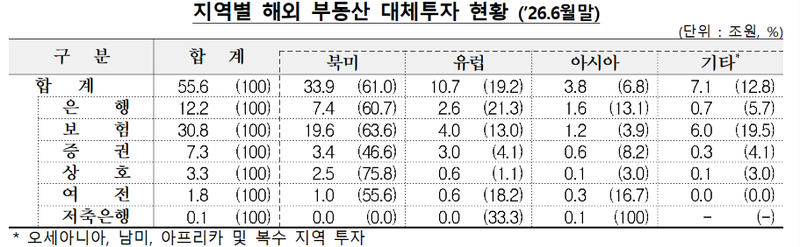
By region, North America accounted for the largest share, at 33.9 trillion won (61.0%). The figures for Europe, Asia, and other or multiple regions were 10.7 trillion won (19.2%), 3.8 trillion won (6.8%), and 7.1 trillion won (12.8%), respectively. By maturity, 6.4 trillion won (11.5%) comes due by 2026, and 35 trillion won (62.9%) by 2030. Responding to maturities—including recovering investments, selling assets to do so, and addressing refinancing conditions—is expected to become increasingly important.
As of the end of June, 2.64 trillion won (8.7%) of the 30.4 trillion won invested by financial companies in individual overseas real estate properties had experienced an EOD event. The amount had risen from the end of last year despite repayments and liquidations at properties that had already experienced EOD. EOD is an indicator of potential losses. It refers to a situation in which a borrower has failed to meet conditions under a loan agreement, giving the lender grounds to demand early repayment. An EOD event does not automatically mean that an investment has suffered a loss or cannot be recovered, but it indicates that a property’s financing and repayment burdens have increased. By asset type, the EOD rate was highest for mixed-use facilities and similar properties, at 50.2%, followed by retail properties (4.9%), offices (4.9%), residential properties (1.8%), industrial facilities (1.3%), and hotels (0.1%).
The FSS said, “Investment conditions could deteriorate, with overseas real estate values falling and transactions declining amid global interest rate hikes and other factors, so ongoing risk management is needed.”
Losses on financial firms’ alternative investments in overseas real estate have been occurring with some frequency recently. The Housing and Urban Fund’s alternative investments have underperformed the benchmark (6.26%) or posted losses for the third consecutive year. All the losses came from overseas real estate. JR Global REIT, South Korea’s first publicly listed REIT specializing in overseas real estate, has filed for rehabilitation proceedings. There are growing calls for stronger risk management of overseas real estate investments amid the high-interest-rate environment.
[email protected] Jo Eun-hyo Reporter