"Transforming Work with AI"... Salesforce Unveils Industry-Specific AX Strategies
- Input
- 2026-11-19 09:01:46
- Updated
- 2026-11-19 09:01:46
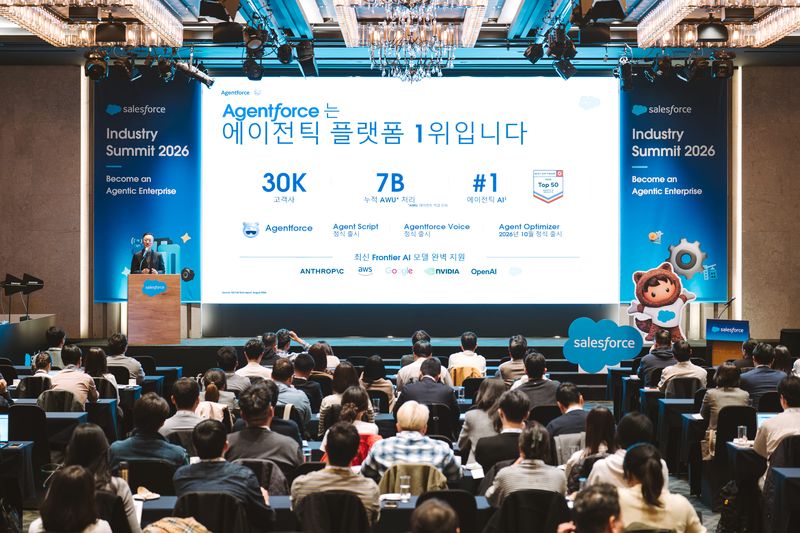
According to industry sources on the 19th, Salesforce held “Industry Summit 2026” for four sectors—finance, retail and consumer goods, manufacturing, and digital-native businesses—from October 27 through the 18th of this month.
At the event, participants shared industry-specific AI adoption strategies and real-world use cases under the theme of the “agentic enterprise,” where people and AI agents work together.
In the financial sector, discussions focused on ways to expand the role of AI agents beyond customer service so they could perform actual tasks based on customer data. Japan’s Fukuoka Financial Group outlined why it adopted Salesforce, its experience using AI agents, and its change management strategy for embedding them across the organization. EY Consulting drew on Korean companies’ experience pursuing AI transformation to present adoption priorities and implementation plans.
In retail and consumer goods, a key topic was how to connect customer data across headquarters, stores and business partners. Lee Jong-hyun, chief business officer (CBO) at Hanssem, shared a case in which Salesforce was used to connect sales activities at headquarters and dealerships. Use cases for AI agents at global brands such as Kiehl’s and Crocs were also presented.
In manufacturing, GS Engineering & Construction’s case study on building an AI-powered smart call center was unveiled. The company shared its experience transforming customer service operations using speech-to-text (STT) technology and Salesforce’s AI agent platform, Agentforce.
In the digital-native sector, Anthropic and Megazone Cloud took part and presented ways to connect companies’ customer data and business information to AI. KiYoung Choi, CEO of Anthropic Korea, explained a strategy for linking data accumulated in Salesforce and Slack with the AI model Claude. Megazone Cloud demonstrated a use case for using customer relationship management (CRM) systems and AI in Slack.
Park Se-jin, CEO of Salesforce Korea Limited, said, “The agentic enterprise is not a vision for the distant future; it is already delivering tangible results across a range of industries. The success of AI innovation depends not so much on the AI model itself as on how the roles of people and AI are designed around data that can be trusted.” He added, “With an integrated platform encompassing data, security and governance, we will support companies in using AI agents reliably in real-world industry settings and scaling their adoption.”
[email protected] Jang Min-kwon Reporter