Deepnoid Applies AI to Cancer Metastasis Assessment... Raises ‘Specialist Accuracy’ to 91.5%
- Input
- 2026-11-19 08:55:47
- Updated
- 2026-11-19 08:55:47
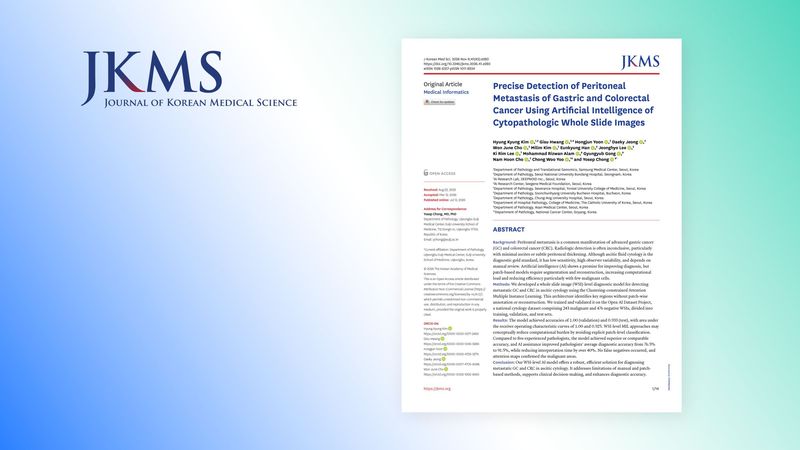
[Financial News] Medical artificial intelligence (AI) company Deepnoid has achieved research results showing that applying AI to the interpretation of cancer metastasis can improve pathologists’ diagnostic accuracy. The company is expanding its medical AI technology, previously focused on chest and brain imaging, into digital pathology.
According to Deepnoid on the 19th, a collaborative AI study with Samsung Medical Center, Asan Medical Center, Severance Hospital and others on identifying peritoneal metastasis from gastric and colorectal cancers was published in the international journal Journal of Korean Medical Science (JKMS).
The key to the study was using AI to analyze cells collected from ascites and determine whether the cancer had spread to the peritoneum. Conventional cytology has been limited by the need to examine a large number of cells and the potential for results to vary depending on the reader.
The research team developed an AI model using 719 slides drawn from cytopathology data submitted by 214 medical institutions nationwide.
In an evaluation involving five pathologists, average reading accuracy rose from 76.5% to 91.5% with AI assistance. Sensitivity for detecting positive cases of cancer metastasis also improved from 66.2% to 92.6%. Average reading time per slide fell from about 100 seconds to 50 seconds.
A notable feature is that the AI was designed to visually highlight areas suspected of containing cancer cells, helping pathologists make their assessments.
Deepnoid recently also presented AI research findings at the Asian Society of Digital Pathology (ASDP 2026), including work analyzing indicators related to predicting genetic mutations in thyroid cancer and response to immuno-oncology drugs.
Deepnoid CEO Woosik Choi said, “We confirmed the potential for AI to improve both the reading accuracy and speed of pathology specialists,” and stressed, “We will expand the technological expertise we have built up in medical imaging into pathology and strengthen the competitiveness of our AI services.”
Meanwhile, the medical AI industry sees the competitiveness of digital pathology as depending on how much it can reduce clinicians’ reading burden, beyond simply identifying cancer cells. One medical AI industry official said, “As medical AI, which had focused on imaging diagnosis, expands to include pathology interpretation, technologies that improve the work efficiency of medical staff in practice are emerging as a new competitive factor.”
[email protected] Kyung-ah Kim Reporter