"SM Entertainment to Benefit Most if K-pop Concerts Resume in China ... Game Companies Also Seen as Beneficiaries"
- Input
- 2026-11-19 09:24:34
- Updated
- 2026-11-19 09:24:34
[Financial News] Shinyoung Securities forecast on the 19th that SM Entertainment would be the biggest beneficiary if K-pop concerts in China resume following the conclusion of follow-up negotiations on services and investment under the Korea-China Free Trade Agreement (FTA). It maintained its “Buy” rating and a target price of 130,000 won for SM Entertainment, as well as its “Overweight” rating on the gaming and entertainment sectors.
Kim Ji-hyun, a researcher at Shinyoung Securities, said, “If approval for concerts is confirmed, SM Entertainment, which has a large portfolio of IPs suitable for live performances, will benefit the most,” adding, “Market attention is likely to focus first on SM Entertainment, which signed an MOU with Tencent.” YG Entertainment and HYBE, which have artists with global fan bases, were also cited as potential beneficiaries.
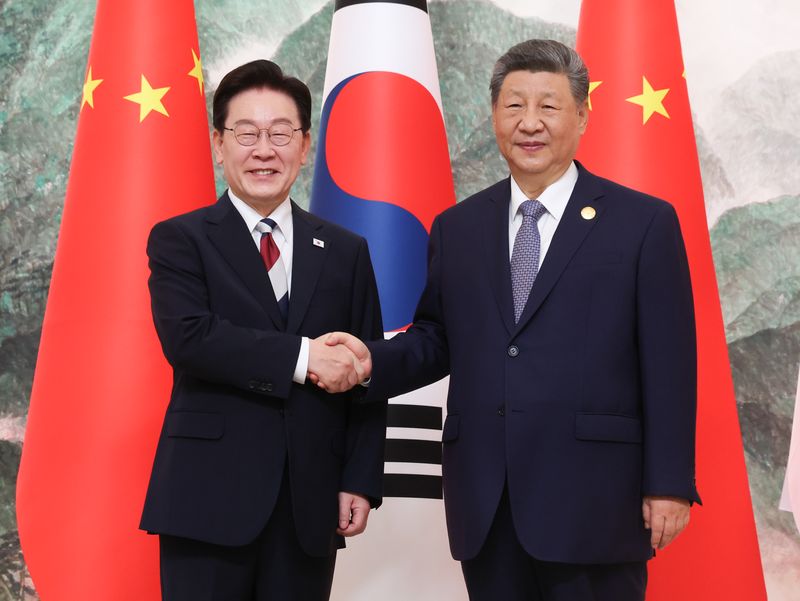
South Korea and China announced the substantial conclusion of follow-up negotiations on services and investment under the FTA, which had continued for eight years and eight months, following their summit the previous day. China agreed to guarantee Korean films and games treatment no less favorable than that given to third countries and to apply the principle of non-discrimination to content pre-screening. The scope of co-productions, previously limited to films, was expanded to include dramas, animation, variety shows and documentaries. This is seen as broadening opportunities for Korean production companies to co-produce content with Chinese companies and use local distribution networks.
Approval for concerts in China is the key factor that will determine entertainment companies’ performance. Consumption of Korean content continued through online and unofficial channels even under the Hallyu ban, but agencies need official activities to resume—including concerts, broadcast appearances and fan meetings by artists under their management—to turn local demand into revenue.
Researcher Kim said, “It is necessary to distinguish diplomatic messages about gradually expanding cultural exchanges from permission for K-pop concerts,” and forecast, “If specific business approvals and the resumption of distribution follow, this could lead to mid- to long-term earnings growth and a valuation re-rating.”
The key question for the gaming industry is how the principle of non-discrimination will apply to reviews of panho, the licenses required to provide games in China. Shinyoung Securities said that greater predictability in the issuance of panho licenses would also put Korean game companies in a better position to negotiate revenue-sharing terms with local distributors.
Researcher Kim said, “This agreement is significant because it establishes trade rules that limit discriminatory reviews of Korean games,” adding, “If the principle is applied in actual reviews in the future, the issuance of panho licenses will become more predictable, and conditions for Korean game companies doing business in China are also expected to improve.”
However, analysts say that establishing an institutional basis for opening the market and actually resuming business approvals and distribution are separate matters. Researcher Kim said, “Rather than viewing this agreement as a full opening of the Chinese market or the lifting of the Hallyu ban, it should be seen as establishing an institutional framework for expanding content exchanges and business activities between the two countries,” adding, “This is a point at which a valuation recovery can be expected, particularly for companies with significant exposure to the Chinese market.”
[email protected] Joo Won-gyu Reporter