U.S. State Department Stresses 'Complete Denuclearization of North Korea' Despite Trump's Moves
- Input
- 2026-11-19 07:39:07
- Updated
- 2026-11-19 07:39:07
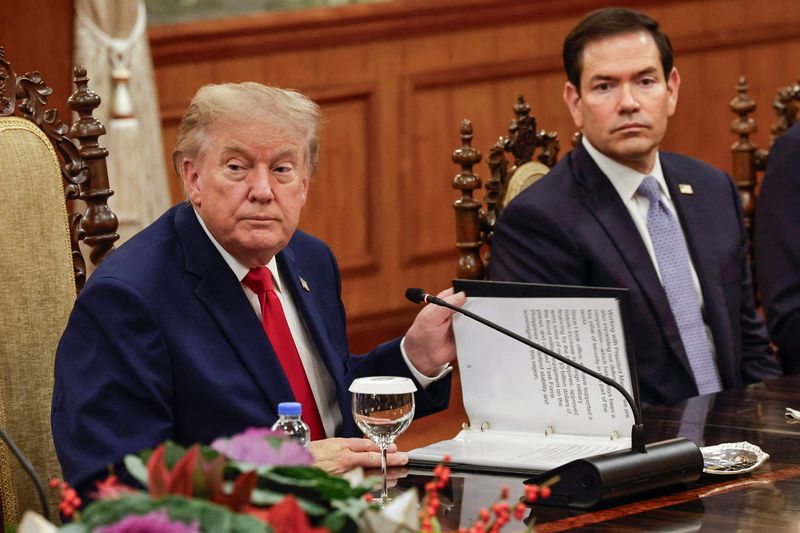
[Financial News] The U.S. government said it continues to pursue the complete denuclearization of North Korea despite recent remarks by U.S. President Donald Trump on North Korea's nuclear program.
The U.S. State Department explained the outcomes of the Association of Southeast Asian Nations (ASEAN) summit, which concluded in the Philippines the previous day, in a fact sheet published on its website on the 18th (local time). After attending the summit, Trump traveled to Shenzhen, China, to attend the Asia-Pacific Economic Cooperation (APEC) summit.
In the fact sheet, the State Department said, “The United States remains committed to the complete denuclearization of North Korea and the full implementation of UN Security Council resolutions on North Korea.” Trump said in January last year, as his second administration began, that North Korea was a “nuclear-weapon state.” He gave specific figures for the number of North Korea's nuclear weapons last August and September, and last month directed a remark at North Korea: “When someone has 112 nuclear missiles, it's best to get along.”
Trump has repeatedly said he is willing to meet with North Korean leader Kim Jong Un. In response, U.S. Secretary of State Marco Rubio said in a statement on the 18th that Trump “does not view dialogue as a concession,” emphasizing that even if Trump meets Kim, that would not mean he views or recognizes North Korea's nuclear and missile development in a positive light.
The State Department also addressed Taiwan in its fact sheet on the 18th. Without singling out any particular country, such as China, it said, “Peace and stability in the Taiwan Strait remain essential to the security and prosperity of the Indo-Pacific, and the United States opposes any unilateral change to the status quo.”
It added, “The United States will continue to exercise leadership in the Indo-Pacific and deter all countries in the region that are tempted to resolve disputes by force,” and said, “It will continue to uphold the right of all countries to exercise freedom of navigation and overflight under international law, as reflected in the United Nations Convention on the Law of the Sea (UNCLOS), including in the South China Sea.”
Meanwhile, the State Department emphasized that it is expanding cooperation on nuclear power generation with Southeast Asian countries. It said, “The United States is expanding civilian nuclear cooperation in Southeast Asia, where energy demand is expected to triple by 2050.” It also said, “This cooperation will help meet the region's growing energy needs, including the need for a stable power supply for superintelligence (SI).”
[email protected] Park Jong-won Reporter