Blue House: “Progress on Hallyu Ban, Most-Favored-Nation Treatment Secured for Content” ... K-pop Concerts Still Not Freely Permitted
- Input
- 2026-11-19 07:00:00
- Updated
- 2026-11-19 07:00:15
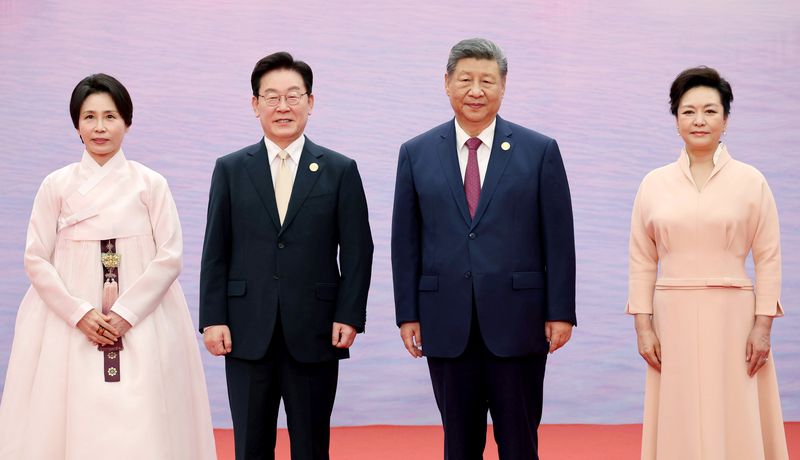
At a briefing in Shenzhen, China, that night, Blue House policy chief Joon-Kyung Ha cited the substantive conclusion of the follow-up negotiations as the biggest economic achievement of the Korea-China summit. “Through these negotiations, the two countries agreed to improve conditions for mutual market access in various service sectors, including content, tourism and law,” Ha said. He added, “We agreed to introduce an obligation to provide ‘most-favored-nation treatment,’ guaranteeing treatment no less favorable than that given to companies from third countries, and to strengthen investment protection and regulatory transparency.”
Asked by reporters that day whether the agreement could effectively be considered an end to the Hallyu ban, a senior Blue House official said, “It is difficult to regard [the Hallyu ban] as any official measure by China.” The official added, “As for content, what we confirmed is that ‘Korean content will not be treated especially less favorably than content from other countries.’” The official assessed that “in terms of Korean culture entering China, there has been considerable progress.”
However, the agreement does not include a clause requiring approval for Korean singers’ performances in China. “At least, with performances excluded, we can say that we have secured access at the same level as other countries,” the official said, adding, “The agreement does not stipulate a mandatory provision requiring either side to approve performances by singers from the other country.”
The official added, “Rather than singers’ performances becoming freely permitted right away, we can say that the channels for consultation have opened up somewhat more, so that we can continue making requests and work toward getting them approved in practice.”
The official also explained that China treats performances that draw large audiences differently from other content. “Because fans gather in one place for singers’ performances, there seem to be aspects of that culture that differ between China and us,” the official said. “Perhaps we can try various approaches, starting at a level that does not cause concern on the Chinese side.”
The official said it could take several more months to sign the agreement. “Overall, we are now in a position to declare that these matters have been concluded,” the official said, adding, “We will do our utmost to bring the signing forward and work to ensure the agreement enters into force quickly.” No specific date for its entry into force was given.
Ha also expressed hope for expanded services trade. In his opening remarks, he said, “China accounts for about 21% of our country’s total goods trade, but only around 12% of total services trade.” He added, “I believe the conclusion of these services and investment negotiations will provide an important foundation for broadening the scope of economic cooperation between the two countries.”
The senior official said services trade with China amounted to $38.8 billion and that China accounted for 12.4% of total services trade. Assuming that share rose to the level of goods trade, the official said, “Even with rough calculations, there may be room for it to increase by another $10 billion or $20 billion.”
The negotiations also provide for improved conditions for market access in tourism, law and distribution. Korean travel agencies established in 23 regions of China will be able to arrange overseas travel for customers throughout the country, while Korean law firms will be able to form business partnerships with Chinese law firms in designated regions. It was also explained that an institutional basis has been established for distribution companies wholly owned by Korean interests to build local distribution networks.
[email protected] Seong Seok-woo Reporter