Ahead of ‘US-China-Russia Talks,’ Blue House Says No Unusual Signs of Kim Jong Un’s China Visit
- Input
- 2026-11-19 07:00:00
- Updated
- 2026-11-19 07:00:09
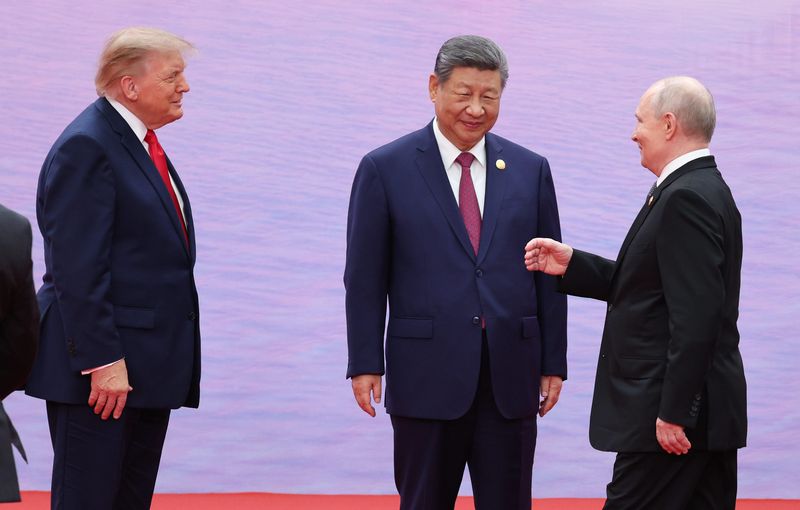
A senior Blue House official met with reporters in Shenzhen, China, that night and said, “We haven’t heard anything in particular in our contacts with China, either. My impression was that China has a similar level of information and understanding to ours.” The official added, “There is no new situation so far.”
At the South Korea-China summit that day, Chinese President Xi Jinping explained high-level exchanges between North Korea and China and Kim’s visit to Dandong, among other things. The possibility of North Korea-U.S. talks was also raised, but no specific information was shared, the official said.
The official said, “Rather than having any specific information, the conversation took place at the level of simply citing President Trump’s remarks or things being said in the United States.” The official added, “What will happen with North Korea-U.S. talks remains uncharted territory, and nothing is certain yet.”
As President Donald Trump mentioned the possibility of meeting Kim during his visit to China, it was also explained that President Lee Jae Myung and Trump did not directly discuss North Korea-U.S. talks during this trip.
In his opening remarks at a briefing, Wi Sung-lac, chief of the Office of National Security (ONS), said Trump attended the APEC welcome dinner in Shenzhen and sat opposite President Lee, adding that they “discussed future diplomatic schedules and issues on the South Korea-U.S. cooperation agenda.”
Asked whether President Lee had directly asked Trump if he would meet Kim, a senior Blue House official replied, “We haven’t had any particular direct discussions with President Trump about North Korea-U.S. talks.” The official added, “We are in frequent contact and have many discussions with U.S. government officials in almost real time.”
Asked whether the Korean Peninsula issue would be discussed at the U.S.-China-Russia meeting on the 19th, the official said it “doesn’t appear likely to be taken up as a major issue.”
The official said, “Our understanding so far is that the possibility of the Korean Peninsula issue being discussed is not zero.” The official continued, “The major issues could probably include nuclear arms reduction, as well as Iran or Ukraine,” and said the Korean Peninsula issue might “also be discussed as part of regional affairs.”
During the trip, President Lee spoke individually with Trump, Xi and Russian President Vladimir Putin. The official said, “On each of those occasions, we put forward our position on the Korean Peninsula issue,” adding, “We can say that we had appropriate opportunities to put forward our position.”
Asked whether South Korea had conveyed its position sufficiently, given that only footage of Lee greeting Trump for about 40 seconds had been released, the official said, “It wasn’t only the scene you saw; there were many other occasions, so we had a variety of opportunities.” The official added, “I think we said everything we needed to say.”
In response to concerns that the U.S.-China-Russia meeting could become a “second Yalta Conference,” discussing the Korean Peninsula issue while excluding South Korea’s interests, the official pointed to differences among the three countries’ positions.
The official said, “Many observers believe a second Yalta is not necessarily likely,” adding, “China is a country that, in a way, considers itself a victim of the decisions made at Yalta.” The official continued, “China, the United States and Russia do not all think alike, so those three countries are not in the same position as the great powers that gathered at Yalta in the past.”
The official also said, “Those countries at the time were part of a kind of alliance fighting Germany, and they had the same goals and tasks.” The official added, “They had a lot in common.” The official continued, “Today, there is not that same degree of common ground.”
The official said, “Because we are not at the table, we are naturally concerned about how our issues will be handled.” The official added, “I think we need to take appropriate steps on our part, and that is what we are doing.”
[email protected] Seong Seok-woo Reporter