Universities in Daegu and Gyeongsangbuk-do on ‘Hacking Alert’... Personal Data Leaks Hit Yeungnam, Daegu Haany, and Kyungil Universities in Succession
- Input
- 2026-11-18 23:13:55
- Updated
- 2026-11-18 23:13:55
[Financial News] Recent hacking attacks targeting universities across the country have continued, and computer systems at universities in Daegu and Gyeongsangbuk-do have also been breached one after another, resulting in personal data leaks and putting the local education community on high alert.
According to the local education community on the 18th, personal information belonging to faculty, staff, and students was confirmed to have been leaked after Kyungil University was hit by a hacking attack on the 12th, followed by Daegu Haany University on the 14th and Yeungnam University on the 16th.
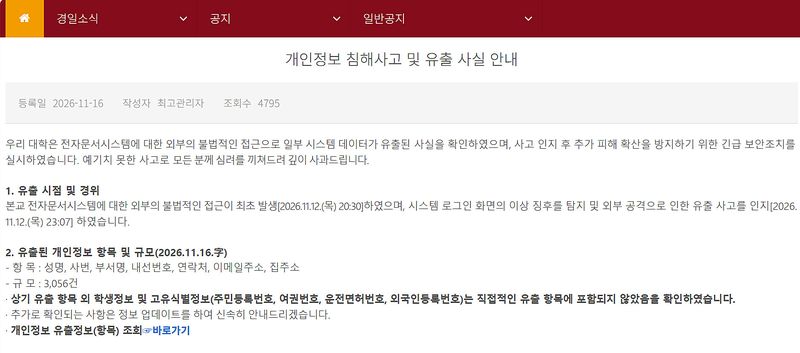
Unauthorized external access to Kyungil University’s electronic document system occurred on the afternoon of the 12th, and 3,056 records of personal information had been leaked as of the 16th. The leaked information included names, employee numbers, department names, extension numbers, contact details, email addresses, and home addresses.
Daegu Haany University’s Research Administration Integrated System (RERP), operated by its Industry-Academic Cooperation Foundation, was hacked on the morning of the 14th, resulting in the leak of 1,281 records of personal information. The leaked information included employee or student ID numbers, names, department names, and registration dates. It was determined that 30 of the records also included dates of birth.
Yeungnam University was also hit by hacking attacks on its library e-book website and employment website between 10 a.m. and around noon on the 16th. The leaked information included student ID numbers (personal identification numbers), names, affiliations, status, and mobile phone numbers. Passwords were also leaked from the e-book website. The university is currently calculating the exact scale of the damage, excluding duplicate records.
However, none of the three universities is believed to have had sensitive unique identifying information—such as resident registration numbers, passport numbers, driver’s license numbers, or alien registration numbers—directly exposed.
The affected universities moved quickly to take defensive measures to prevent further damage. They immediately isolated the hacked systems from external networks (blocked network access) and introduced two-factor authentication for logins to their integrated information systems or made password changes mandatory for portal users. They also advised members of their communities to change passwords on other websites to prevent secondary damage such as voice phishing, smishing, and identity theft, and urged them to report suspected misuse immediately.
Yeungnam University said in an apology statement, “We will fundamentally review and strengthen our personal information protection system to prevent similar incidents from happening again.”
Other universities in the region that escaped hacking damage are also on high alert. Some universities in Gyeongsan are reportedly beginning to review their overall security systems and build defensive systems, including as a stopgap measure blocking external access to internal university servers. A university official voiced concern, saying, “With advances in AI technology, hacking attacks are becoming more frequent, and we cannot afford to feel reassured while watching other universities suffer damage.”
[email protected] Park Ji-hyun Reporter