Korea University Undergraduates Spot a Flaw in Standard Technology Used by 41% of Websites Worldwide
- Input
- 2026-11-18 19:43:23
- Updated
- 2026-11-18 19:43:23
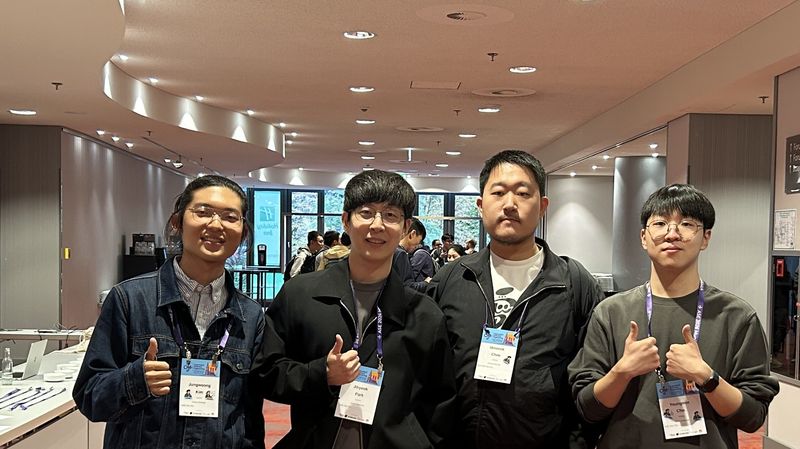
[Financial News] Korea University said on the 18th that a team led by Professor Park Ji-hyeok of its Department of Computer Science had found a flaw in a standard program used by nearly half of websites worldwide and developed an automated technology called MiniPoly to replace it, earning an Outstanding Paper Award at the world's most prestigious software conference.
The research drew particular attention because it was led as a joint first-author effort by undergraduate researchers Kim Jeong-ung and Cho Yeong-min, who entered the university in 2022, rather than by graduate students. The team presented its paper at IEEE/ACM ASE 2026, the most prestigious international conference in software engineering, held last month in Munich, Germany, and received the ACM SIGSOFT Outstanding Paper Award, given to no more than the top 10% of accepted papers.
The technology developed by the research team can significantly improve software development efficiency by reducing the chronic manual work involved in web development. The many features of websites we commonly use are built mainly with a programming language called JavaScript. However, when users visit them with older web browsers, the latest features may not work properly. To prevent this, a kind of “translation code (polyfill)” is essential to help the latest features run in older environments.
Until now, developers had to read through international standards one by one and write this translation code by hand. This took considerable time and effort, and because the work was done manually, errors both large and small were commonplace. MiniPoly, developed by the team, analyzes international standards on its own and automatically generates compatibility code.
Its performance already surpasses technology used as a global standard. Code automatically generated by MiniPoly achieved a 99.8% pass rate on official JavaScript conformance tests. That is higher than the 95.7% pass rate of core-js, a leading collection of compatibility programs currently used by about 41% of websites worldwide.
The team also addressed the issue of execution speed. In general, translating international standards directly into code has the drawback of slowing program execution. By applying its own optimization rules, the team improved accuracy while maintaining fast execution speeds comparable to those of existing core-js.
The team went further, finding a flaw in existing core-js in which key functions, such as data storage and processing, behaved differently from international standards. After the team reported it, some of the flaws in the real-world global-standard program were fixed. In effect, the automated generation technology also helped improve the quality of an existing industry standard.
The research by Professor Park Ji-hyeok's team was conducted with support from the Ministry of Science and ICT and the National Research Foundation of Korea (NRF) through the Excellent Young Researcher Support Program.
[email protected] Kim Man-gi Reporter