NVIDIA's 'Surprise Results' Quell AI Bubble Fears, but Questions Remain Over Circular Financing [Jensen Huang Risk Sweeps Through the AI Ecosystem]
- Input
- 2026-11-18 18:11:23
- Updated
- 2026-11-18 18:11:23
■ Concerns over a 2027 growth slowdown eased
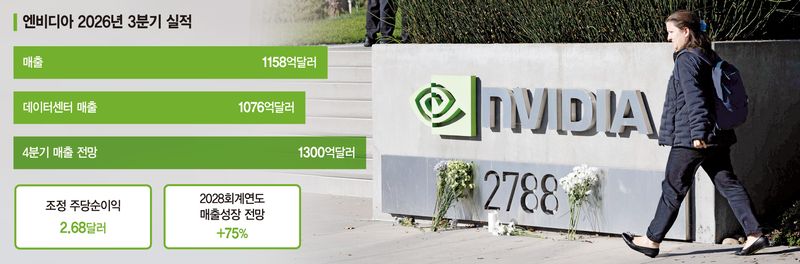
On the 17th local time, NVIDIA reported third-quarter revenue of $115.8 billion, up 103% from a year earlier. That was about 6.1% above the market estimate of $109.11 billion. Adjusted earnings per share (EPS) came in at $2.68, above the market estimate of $2.48. That was a 111% increase from $1.27 in the same period last year.
In particular, revenue from the data center segment, the core of its AI semiconductor business, surged 110% year over year to $107.6 billion. The data center business accounted for about 93% of total revenue.
Its outlook for future results also exceeded market expectations. NVIDIA forecast fourth-quarter revenue of $130 billion (±3%). That is about 3.8% above Wall Street's estimate of $125.25 billion.
The outlook for next year's growth drew even greater attention. At a conference call, NVIDIA interim CEO Colette Kress forecast that revenue would increase 75% in fiscal 2028. That is 5 percentage points higher than the previous forecast of 70%. The forecast indicates that investment in AI infrastructure will maintain strong growth even in NVIDIA's fiscal 2028, which begins in 2027.
Recently, concerns have grown on Wall Street that the astronomical AI investments by big tech companies may fail to generate returns at the levels expected. As enormous sums have gone into building data centers and buying advanced semiconductors, debate has continued over how long the expansion of AI investment can last. But NVIDIA's results and outlook showed that demand for AI infrastructure remains strong, at least for now.
The outlook does not include revenue from data center semiconductors in the Chinese market. This signals confidence that growth can continue in markets outside China even as U.S. restrictions on semiconductor exports to China remain in place.
■ Continuing its role as AI's “central bank” ... while investing cautiously
Another focus of NVIDIA's earnings announcement was its investment strategy for the AI ecosystem. Beyond being a semiconductor company that simply sells graphics processing units (GPUs), NVIDIA has established itself as a key investor in the AI industry by providing substantial funding to cloud service providers, data center operators and AI startups.
According to financial materials NVIDIA released that day, its holdings of equity stakes in private companies totaled $61.65 billion as of the end of October. It also had about $20 billion in commitments for future equity investments. In addition, it had $28 billion in payment commitments under cloud service contracts and $74 billion in data center lease commitments.
That is why NVIDIA is called the AI industry's “central bank.” NVIDIA has built an ecosystem in which it invests in AI companies, which then buy NVIDIA's semiconductors. But this structure is both a catalyst for growth in the AI industry and a source of controversy over “circular investment,” with investments and revenue propping each other up.
Interim CEO Kress said, “As the market matures and additional sources of funding emerge, we are rigorously evaluating future investments, commitments and guarantees.” She also said, “As we pursue these ventures, we will carefully determine how we participate and apply strict principles to capital deployment,” adding that the company would continue working with AI infrastructure investment partners. She emphasized that, when it came to emerging cloud service providers, too, “we will maintain strict and selective principles in providing support.”
The AI industry expects these changes at NVIDIA to affect the structure of AI infrastructure investment going forward. Some companies that have grown by relying on NVIDIA's funding may need to secure new investors or demonstrate more clearly that their businesses are profitable.
[email protected] Reporter