[Exclusive] A Greenbelt Parcel Split Among 31 People Doubles in Price in a Week
- Input
- 2026-11-18 18:05:44
- Updated
- 2026-11-18 18:32:50
■ Prices Double in a Week ... ‘Collective Land Holdout’ Takes Hold
On the 18th, Financial News reported that a comprehensive survey of transactions over the past three years (from 2024 through November 11 this year), conducted with ValueMap, a platform for actual land and building transaction prices, found cases of this kind of “fractional ownership splitting” in several areas. The survey covered four regions where the possibility of lifting greenbelt restrictions has been discussed: Seoul’s Seocho and Gangnam districts, and Gwacheon and Uiwang-si in Gyeonggi Province.
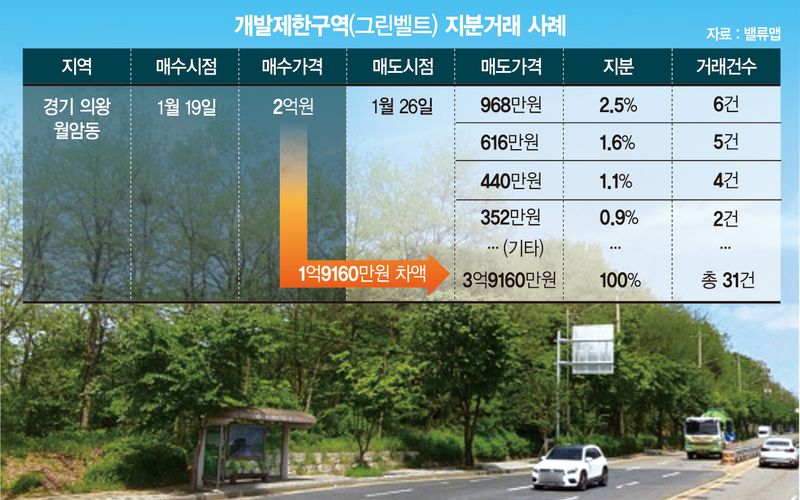
The fractional-ownership transactions in Uiwang in January involved a parcel measuring 1,493 square meters. Six new owners each bought a share of about 2.5% (37–39 square meters) for 9.68 million won, while five people each bought a 1.6% share (24 square meters) for 6.16 million won. Four buyers paid 4.4 million won for a 1.1% share (about 17 square meters), and two paid 3.52 million won for a 0.9% share (14 square meters). In all, 31 share transactions were completed directly, all at the same time on the same day. With the entire 100% ownership split into shares within a week of the purchase, the original buyer appears to have pulled off a quick in-and-out, making a profit close to the original investment.
Fractional ownership splitting involves buying a large parcel and selling ownership to multiple people in separate shares, without physically subdividing the land. If the area is later incorporated into a development project, the project operator will have to negotiate compensation with all 31 owners rather than just one. Buyers who paid high prices for their shares are likely to demand substantial compensation. The price per 3.3 square meters, about 440,000 won on January 19, doubled to 860,000 won a week later, potentially affecting the per-unit compensation amount set during the appraisal process.
Under the Land Compensation Act currently in force, compensation for expropriated land is calculated based on the publicly announced price of standard lots, not actual transaction prices. But if speculators create multiple records of high-priced direct transactions, this could prompt appraisers to apply a larger adjustment for “other factors” to reflect nearby market prices, pushing up compensation rates. It could also be exploited as leverage by buyers seeking collective complaints or increased compensation on the grounds that they paid high prices.
■ 95% of Share Transactions Were Direct Deals
Alongside small-scale share splitting in the several-million-won range, joint purchases of fractional interests involving large sums have also emerged. In Yeomgok-dong, Seocho District, Seoul, a 14,074-square-meter wooded parcel inside a development-restricted area was sold directly on September 18 in shares to nine people: one person acquired 50%, three acquired 8.33% each, and five acquired 5% each. The total sale price came to 4.10258 billion won.
Earlier, at a Cabinet meeting on the 10th, President Lee Jae-myung ordered a comprehensive investigation into land-holdout tactics at development sites, saying, “If they get caught, they should be ruined.”
Listings for small fractional interests, promoted on the strength of hopes that greenbelt restrictions will be lifted, are still appearing online. A licensed realtor in Gwacheon said, “Development has been talked about for years in the Munwon-dong area,” adding, “Transactions could become even more active once revisions to farmland-related legislation are completed.” Another realtor said, “Many owners are putting their properties up for sale,” but added, “Some people think it’s too late to buy now because benefits go first to those who bought two years before the development announcement.”
Most fractional-ownership transactions are conducted directly, without going through licensed real estate agents. Of 768 such transactions, 729 (94.9%) were direct deals, suggesting that organized land speculation has evolved into person-to-person trading.
Ko Jun-seok, a professor at Yonsei University’s Sangnam Institute of Management, said, “These days, individuals are splitting ownership into shares through direct deals in ways that keep them from standing out,” adding, “Trading aimed at getting in early before an announcement lifting greenbelt restrictions is rampant.” However, some say there are limits to tightening regulations. Professor Ko said, “Expanding and strengthening the designation of land transaction permit zones has been proposed as an alternative, but that would also block local residents and older landowners from exercising their property rights normally and selling their land, inevitably provoking opposition.”
[email protected] Jeon Min-kyung, Choi A-young Reporter