“No Products to Fill the Token Securities Market Even After It Opens”... Call to Amend the Capital Markets Act
- Input
- 2026-11-18 17:10:50
- Updated
- 2026-11-18 17:10:50
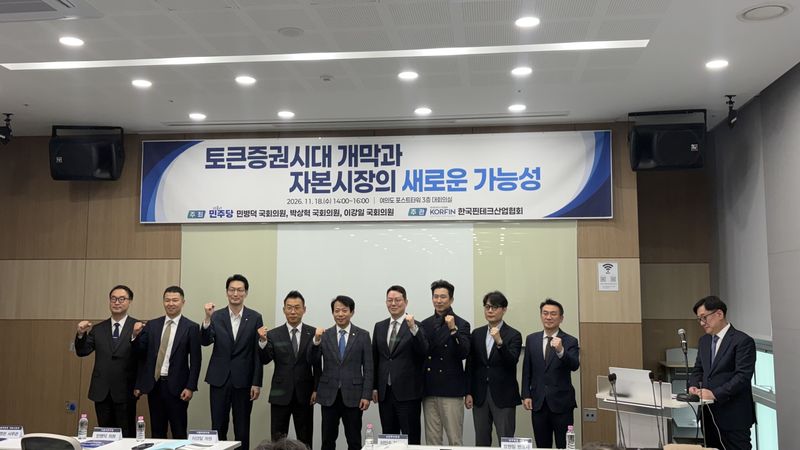
[Financial News] “The token securities market will open next February, but the legal basis for formally issuing non-monetary trust beneficiary certificates, which will be central to the market, is still pending before the National Assembly. I hope the amendment is passed during this regular session of the National Assembly, without fail.”
Beomjun Shin, chair of the Token Securities Council of the Korea Fintech Industry Association (KFIA) and CEO of Baisell Standard, made the remarks at the seminar “The Opening of the Token Securities Era and New Possibilities for Capital Markets,” held on the 18th at Post Tower in Yeouido, Seoul. The seminar was co-hosted by Democratic Party of Korea lawmakers Lee Kang-il, Min Byeong-deok and Park Sang-hyuk, and organized by the KFIA.
In his congratulatory remarks, Chairman Shin noted, “The Token Securities Act was passed last January with agreement between the ruling and opposition parties, but the legal basis for issuing non-monetary trust beneficiary certificates that can supply products to the actual market remains inadequate.”
Non-monetary trust beneficiary certificates are products that securitize the right to receive returns from non-cash assets, such as real estate, stocks and bonds, entrusted to a financial company. With the token securities market set to open next year, Chairman Shin stressed that the relevant laws need to be amended to allow beneficiary certificates to be issued directly on the basis of non-monetary trusts, in order to make the market substantively active.
He said, “Under the current Financial Investment Services and Capital Markets Act, trust companies can issue beneficiary certificates only when they have been entrusted with money. As a result, patents, copyrights and real estate have to be tokenized through a workaround under the Asset-Backed Securitization Act. This route comes with constraints, such as requiring the underlying assets to be purchased first, which can limit the participation of small and medium-sized enterprises and small business owners in need of funding.”
The need to amend the law governing non-monetary trust beneficiary certificates was also emphasized in a subsequent presentation. Choi In-su, head of the Digital Assets Division at Shinhan Investment & Securities, explained, “At the outset of the new framework, institution-focused products such as privately placed bonds and private money market funds (MMFs) are likely to predominate. But to activate the market, we need a system and an ecosystem that allow ordinary companies to participate. This could also help expand the public offering market to include retail investors.”
He also predicted that it may be difficult for products to be issued immediately after the framework takes effect on February 4 next year. Financial institutions still need to be consulted in advance about issuance, the eligibility of distributed ledgers needs to be reviewed, and an account management system needs to be established, among other outstanding tasks.
Hyunil Hwang, a lawyer at Shin & Kim LLC, stressed, “Under the current Financial Investment Services and Capital Markets Act, non-monetary trust beneficiary certificates cannot be formally issued, so issuers have to use a workaround under the Asset-Backed Securitization Act. To resolve this bottleneck, it is essential to amend the Capital Markets Act to allow the direct issuance of non-monetary trust beneficiary certificates.”
Industry calls for improvements to the regulatory framework continued during the ensuing panel discussion. Han Sang-hyeong, head of legal affairs at Baisell Standard, said, “If the Token Securities Act is a law that builds the infrastructure of a market, this amendment to the Capital Markets Act is a law that fills that market with products. If the bill passes, the range of underlying asset holders will expand, and a wider variety of underlying assets will be able to enter the token securities market.”
He also noted that under the current framework, universities, research institutes, and small and medium-sized or venture companies may find it difficult to place assets directly in trust, even if they hold high-quality patents or copyrights. If the amendment passes, they will be able to put those assets in trust without a separate intermediary purchase, reducing issuance costs and time.
KDX CEO Jeong Jung-rak pointed to structural costs involved in issuing token securities products. “Of the approximately 25 securities firms in talks with KDX, 14 have entered the stage of preparing or considering issuance,” he said. “But the process of getting a single product to investors involves many organizations, including trust companies, issuance platforms, evaluation agencies and securities firms, which creates costs.” He went on to stress the need to simplify evaluation and disclosure procedures for small-scale products and provide tax support.
Lee Jeong-chan, an assistant director in the Capital Markets Division of the Financial Services Commission, said, “It is true that without an amendment to the current Capital Markets Act, there are significant limitations on issuing a wide range of assets as non-monetary trust beneficiary certificates. Ahead of a full review of the bill in November, the relevant department is explaining it to the National Assembly and working to get it passed within this year if at all possible.”
[email protected] Im Sang-hyeok Reporter