Court Rejects High School Senior's Bid to Suspend CSAT, Citing Risks to Test-Taking Opportunities and College Admissions
- Input
- 2026-11-18 17:32:11
- Updated
- 2026-11-18 17:32:11
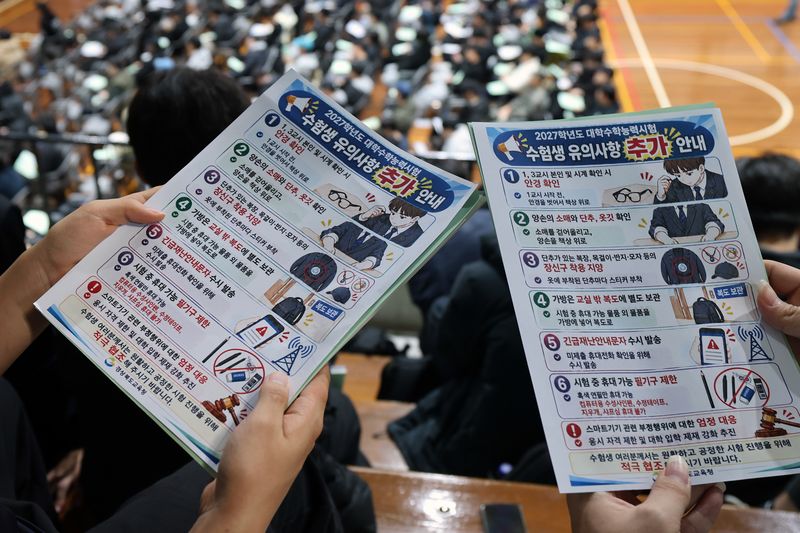
[Financial News] A court has dismissed an application by a high school senior to suspend the 2027 College Scholastic Ability Test (CSAT), filed over concerns about cheating using artificial intelligence (AI). This year's CSAT will be held on November 19 as originally scheduled.
On the 18th, the Seoul Administrative Court's Administrative Division 7, led by Presiding Judge Kang Woo-chan, dismissed an application filed by 18-year-old examinee An Min-jun against the Minister of Education and the president of the Korea Institute for Curriculum and Evaluation to suspend the administrative disposition designating the date of the 2027 CSAT.
The panel dismissed the application without a separate hearing. It found that, although an urgent decision was needed with the exam just one day away, it would be difficult to schedule a hearing before the exam because the applicant lived outside the capital area and had not retained legal counsel.
An had earlier cited a recent case in which the top scorer on the tax accountant exam cheated using an AI device. On the 18th, alongside a lawsuit seeking to have the disposition designating the exam date declared invalid, he applied to suspend the CSAT until midnight on the 25th. The previous day, An had also filed a constitutional complaint and an application for an injunction suspending the effect of the relevant measures with the Constitutional Court of Korea, seeking the same outcome.
The panel found, however, that An's claims alone did not sufficiently substantiate either the risk of irreparable harm if the exam proceeded or an urgent need to prevent such harm. It instead concluded that suspending the disposition could seriously affect the public welfare.
In its written ruling, the panel said, “Cheating using ultra-small cameras and AI constitutes a serious crime and can undermine legitimate examinees' fair opportunity to be evaluated and the credibility of national examinations, so the need to prevent it is recognized.” It nevertheless stated, “For the 2027 CSAT, measures to prevent cheating, including a ban on bringing electronic devices into the exam and test proctoring, are planned, and there is insufficient specific substantiation that the exam date must be postponed to address cheating using disguised electronic devices.”
The panel further ruled, “The CSAT is an exam administered nationwide to examinees according to the same schedule. If its administration were suspended when less than a day remained before the exam, many examinees' opportunity to take it under stable conditions and their confidence would be seriously undermined, and there would be a risk of considerable disruption to preparations for the exam that have already been completed and to the subsequent university admissions schedule.”
It added that there was also no concrete evidence to support the claim that holding the exam on its scheduled date would result in a substantial number of cheating incidents and actual harm.
[email protected] Lee Chang-hun Reporter