Japan Says Cho Kuk Was Denied Entry Over Criminal Record, Not Dokdo
- Input
- 2026-11-18 17:13:24
- Updated
- 2026-11-18 17:20:06
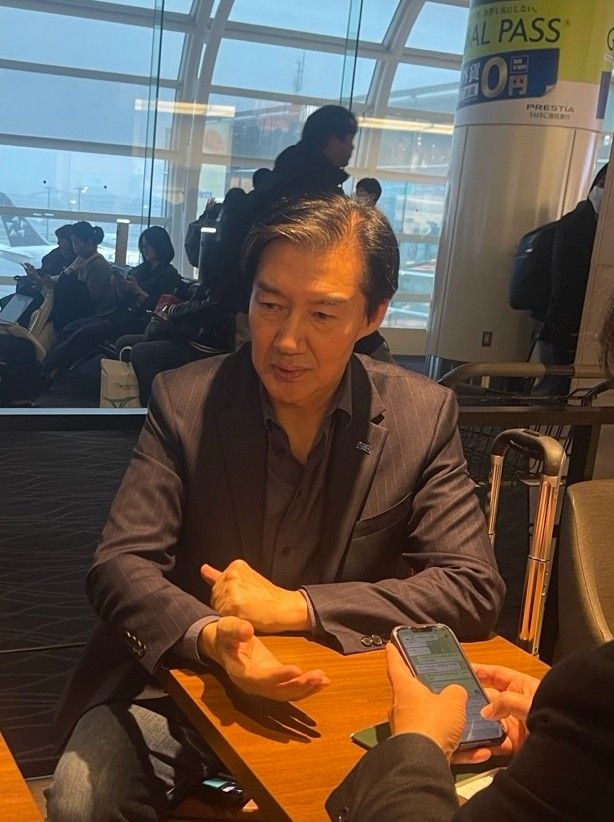
【Financial News | Tokyo—Correspondent Seo Hye-jin】The Japanese government said on the 18th that Cho Kuk, head of the Institute for Innovation Policy Studies, was denied entry because of his criminal record, not his past visit to Dokdo. Cho’s side countered that he had visited Japan before despite having a criminal record, raised the possibility that the measure was retaliatory, and said they had not been given advance guidance to apply for a visa.
According to the Nihon Keizai Shimbun (The Nikkei), Kyodo News and other outlets, Chief Cabinet Secretary Minoru Kihara told a news conference that “the Immigration Services Agency is making its decision under the Immigration Control Act,” declining to provide specific reasons.
The Immigration Services Agency said Cho was subject to denial of entry under the Immigration Control Act and that no circumstances warranting special permission to enter had been presented. Another senior Japanese government official told The Nikkei that the response was “mechanical, based on the Immigration Control Act,” and said it was “not at all a sanction” for his visit to Dokdo.
Cho traveled to Japan the previous day for a three-day, two-night trip that included a lecture at a Japanese university and meetings with academic figures.
According to the Rebuilding Korea Party, Cho arrived at Haneda Airport at around 11:05 a.m. but was interviewed twice in a separate office before being notified at around 1:19 p.m. that he was denied entry. As a result, all of his scheduled events in Japan fell through, including a keynote lecture titled “Solutions for an Age of Inequality: A Country Advanced in Social Rights” at Meiji Gakuin University that day and a discussion with Japanese academics.
Cho questioned the measure, saying that although he had a past conviction for violating the National Security Act, he had visited Japan several times since then. DPK lawmaker Jung Chung-rae also wrote on Facebook that day that he, too, had a criminal record related to the pro-democracy movement and had visited Dokdo, but had faced no restrictions on traveling to Japan. “Is this what they call a special measure by the Takaichi government?” he asked rhetorically.
Article 5, Paragraph 1, Item 4 of Japan’s Immigration Control Act stipulates that, in principle, foreign nationals sentenced in Japan or abroad to at least one year in prison or an equivalent punishment are subject to denial of entry. Those convicted of political crimes are exempt.
In addition to his record of violating the National Security Act, Cho was sentenced to two years in prison for matters including corruption in his children’s college admissions and the suppression of an inspection at Cheong Wa Dae; the sentence was finalized in December 2024. He was released in August last year under a special pardon while serving his sentence.
South Koreans are exempt from visas for short-term visits to Japan, but must still undergo entry screening. Visa-free travel waives the process of obtaining a visa before departure; it does not waive grounds for denying entry. Even having a visa does not guarantee admission.
Cho returned to South Korea via Gimpo Airport the previous day and told reporters that he had not applied for a visa in advance. “You know Japan is visa-free, right?” he said, adding that he had not been told to apply separately for a visa because of his criminal record.
He went on to claim that the Japanese government’s explanation to our consul general that it had advised the Rebuilding Korea Party or the Institute for Innovation Policy Studies to apply for a visa in advance was “completely untrue,” adding, “I believe they made up an alibi after the fact.”
The Institute for Innovation Policy Studies said it would jointly hold the canceled academic seminar with Japanese academics in Seoul early next year. It also announced plans to revisit Dokdo with party members and the public after checking maritime conditions. If the plan goes ahead, it will be Cho’s third visit to Dokdo.
[email protected] Seo Hye-jin Reporter