Chey Tae-won: “Reward Companies in Proportion to the Social Problems They Solve” ... Cut Costs With AI and Spur New Markets
- Input
- 2026-11-18 16:35:48
- Updated
- 2026-11-18 16:35:48
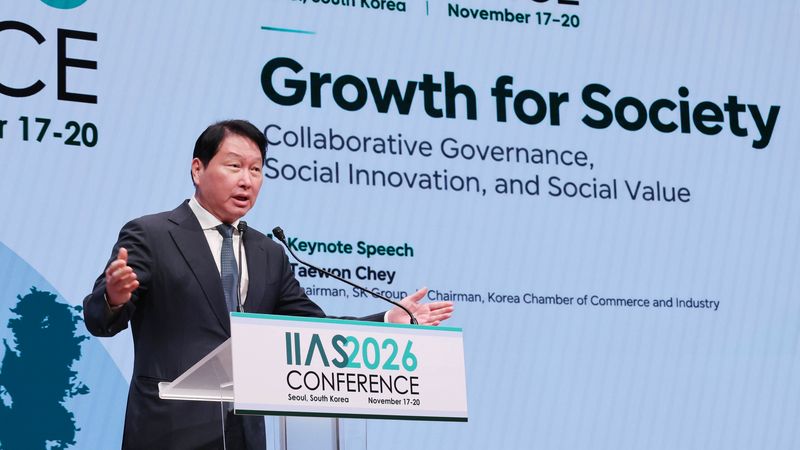
[Financial News] Chey Tae-won, chairman of the Korea Chamber of Commerce and Industry, proposed offering companies that solve social problems economic rewards commensurate with their results to attract talent and capital. His idea is to use artificial intelligence (AI) in areas such as care and education to lower the cost of solving problems and create new markets by linking those results to rewards.
In his keynote address at the opening ceremony of the 2026 IIAS Seoul Conference, held at the Korea Chamber of Commerce and Industry building in Jung District, Seoul, on the 18th, Chey pointed to the “paradox of growth,” in which social costs accumulate even as the economy grows.
Chey pointed out that “if the balance between capitalism, which drives competition and innovation, and democracy, which mediates conflict, breaks down, accumulated social costs will ultimately hamper economic growth.” He said that approaches relying mainly on government funding and corporate social contributions have limits in addressing increasingly complex social problems.
“It is difficult to solve complex social problems by relying only on government support, corporate social contributions or individual goodwill,” Chey said. “We should make active use of capitalism’s own incentive system to solve social problems, providing reliable economic rewards commensurate with the problems solved so that talented people and capital are drawn in on their own.”
Chey cited SK’s Social Progress Credit (SPC), which SK has operated for more than a decade. An analysis of 468 companies that participated in SPC—a program that converts the social value companies create into monetary terms and pays cash in proportion to their results—found that companies receiving incentives generated about three times as much social value as those that did not, and had 34% higher average revenue.
The effects in generating employment and production were also 1.5 to 2 times those of existing subsidy-based approaches. This demonstrated that a corporate-style reward system that pays incentives based on results actually achieved—not donations or simple outlays—can drive both social-value creation and growth.
Chey expressed confidence that AI could reduce costs in care and education settings while improving the accuracy and reliability of social-impact measurement.
“The core of a new capitalism is to incorporate into economic rewards and resource allocation the social value that existing capitalism has not fully captured,” Chey said. “AI will be an effective tool for this.”
He went on to say that “the efforts of a single company or country alone have limits in solving complex social problems,” and proposed “collaborative governance” involving government, businesses, civil society and academia to develop such innovative experiments into a sustainable global system.
[email protected] Kim Hak-jae Reporter