Hyundai Rotem Company Steps Up Hypersonic Engine Efforts, Expands Seosan Test Center
- Input
- 2026-11-18 16:23:00
- Updated
- 2026-11-18 16:23:00
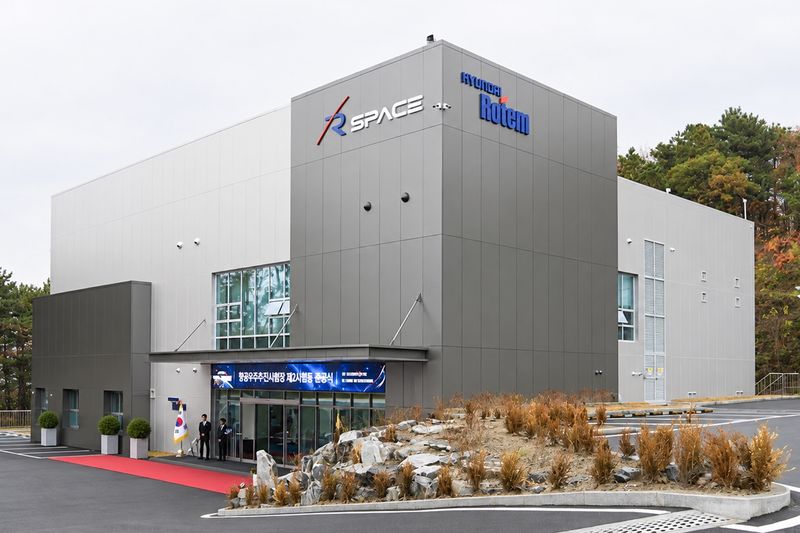
[Financial News] Hyundai Rotem Company is expanding its Aerospace Propulsion Test Center in Seosan, South Chungcheong Province, and accelerating development of next-generation engines for hypersonic vehicles and reusable space launch vehicles.
Hyundai Rotem Company said on the 18th that it held a completion ceremony for the No. 2 test building at its Seosan Aerospace Propulsion Test Center on the 17th. Established in 1998 on a site of about 7,000 pyeong, the center is the only facility in South Korea equipped to test hypersonic and supersonic engines. It is where everything from the engine for KSR-III, Korea's first liquid-propellant rocket, to the propulsion system test facilities for the Nuri (KSLV-II), Korea's launch vehicle, was developed.
The No. 2 test building, which will come into full use starting next year, is set to serve alongside the existing No. 1 building as a research base for developing hypersonic engines, 35-ton- and 10-ton-class methane engines for reusable space launch vehicles, and key engine components. The building houses propulsion test facilities for conducting combustion tests on aerospace engines, as well as performance test laboratories for evaluating individual components. Hyundai Rotem Company plans to use the new building to accelerate the development of in-house aerospace engine technology.
Hyundai Rotem Company is currently researching solid-fuel scramjet engines and dual-mode ramjet engines. A scramjet is an engine fitted to missiles that fly at speeds at least five times the speed of sound, and is said to offer advantages for high-speed, long-range flight and maintaining maneuverability. A dual-mode ramjet engine can switch between ramjet and scramjet modes depending on speed.
Hyundai Rotem Company previously took part in the Hycore program, a South Korean hypersonic vehicle project led by the Agency for Defense Development (ADD). For the project, Hyundai Rotem Company applied scramjet engine technology and was responsible for the design, manufacture and assembly of the combustor assembly, operating components and ancillary equipment.
Hyundai Rotem Company is also pursuing the development of methane engines for reusable launch vehicles. In 2006, it became the first company in South Korea to successfully conduct a methane engine combustion test, and last year it won a contract for a project to develop methane engine technology for reusable launch vehicles, led by the Korea Research Institute for Defense Technology Planning and Advancement (KRIT). Methane is considered a suitable fuel for reusable launch vehicles because it produces little soot during combustion and is cost-effective.
Hyundai Rotem Company plans to advance its propulsion technology through the construction and operation of test facilities for Korean launch vehicles, as well as research and development on methane engines and supersonic and hypersonic technologies.
Lee Yong-bae, president and CEO of Hyundai Rotem Company, said at the completion ceremony, "For some 30 years, Hyundai Rotem Company's Seosan Aerospace Propulsion Test Center has been a cradle shaped by the blood and sweat of researchers working to localize guided weapons and launch vehicle engines, as well as a place that holds Hyundai Motor Group's history of working toward a prosperous and strong nation and reaching for space. I am confident that the newly opened No. 2 test building will make a major contribution to the Republic of Korea's self-reliant national defense and its rise as a space power in the future."
[email protected] Jung Won-il Reporter