Collective Agreement After 8 Years... Jeju Special Self-Governing Provincial Office of Education Seeks to Expand Learning Leave to 7 Days
- Input
- 2026-11-18 16:24:15
- Updated
- 2026-11-18 16:24:15
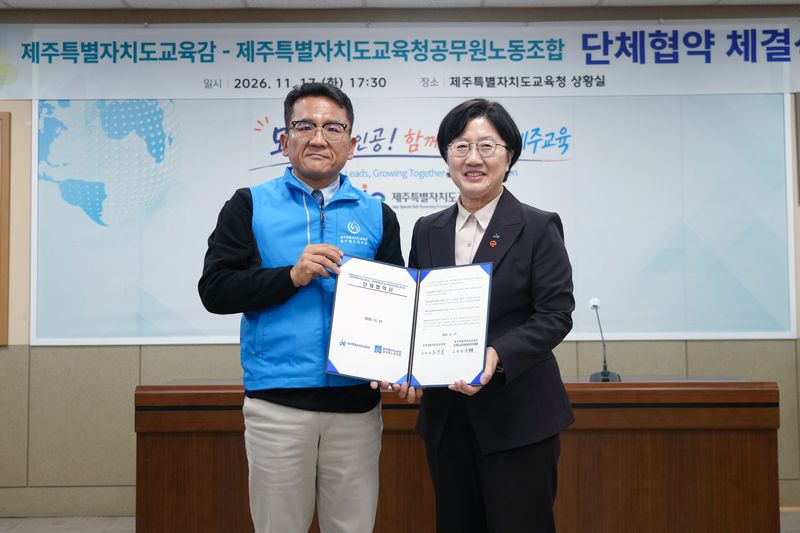
【Financial News, Jeju = Jeong Yong-bok, reporter】 The Jeju Special Self-Governing Provincial Office of Education and the local civil servants' union have signed a collective agreement for the first time in eight years, agreeing to prevent work from being shifted to school administrative offices and to expand civil servants' leave. They also plan to increase annual learning leave to seven days and introduce three days of special leave for civil servants with short service, though implementation will require an ordinance amendment.
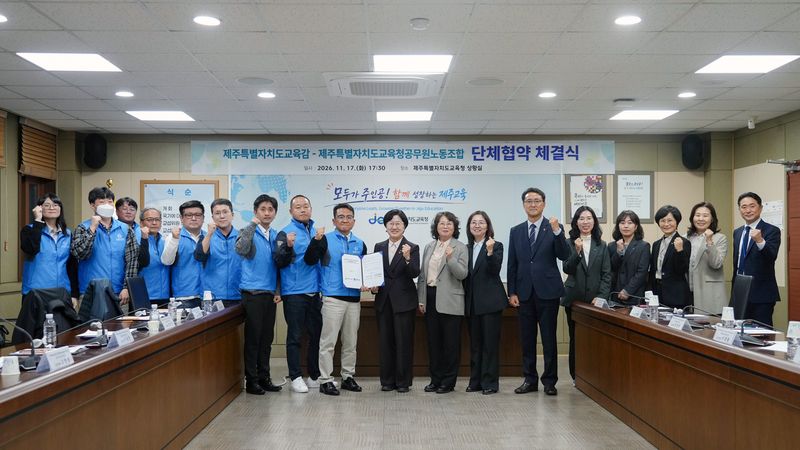
According to the Jeju Special Self-Governing Provincial Office of Education on the 18th, Superintendent Ko Ui-suk and Ko Yeong-myeong, acting chair of the Jeju Special Self-Governing Provincial Office of Education Civil Servants' Union, signed a collective agreement covering local civil servants' working conditions and protection of their rights the previous afternoon in the situation room at the office's main building.
This is the first agreement in eight years, following the one signed on October 31, 2018. At the time, the parties agreed on 106 items across 66 articles; this time, they expanded the agreement to 130 items across 69 articles.
The union called for collective bargaining in September 2024, and the first formal negotiations began in January last year. The two sides reached a final agreement after 35 rounds of working-level negotiations, through the 2nd.
The key issues are expanding leave for local civil servants and improving the division of work at schools. Management and labor agreed to pursue an amendment to the service ordinance to expand annual learning leave from the current four days to seven and introduce three days of “Newcomer Leap Leave” for civil servants with fewer than five years of service. The agreement also stipulates that school-based employees must use three days of learning leave on school closure days.
However, signing the agreement alone will not immediately increase the number of leave days. It can take effect only after the Jeju Special Self-Governing Provincial Council passes the relevant ordinance amendment.
The agreement also includes measures to reduce the workload of school administrative offices. The education office will ensure that specialized duties belonging to other professions, such as teachers, are not unfairly shifted to local civil servants, and will support efforts to prevent and resolve disputes over the division of work within schools.
In particular, even when a school is opened early, administrative office staff who are not responsible for student guidance will not be assigned related duties or held responsible for them. The agreement also states that duties related to opening school facilities on weekends or holidays should not be concentrated in any particular job category.
The agreement guarantees union counseling and assistance when workplace harassment or other human rights violations are reported, as well as union accompaniment during the guidance process. It also specifies procedures for informing the person who filed the report and the affected party of the investigation results and protecting personal information.
The parties will also work to improve conditions for different job categories. They will encourage changes to the practice of assigning facilities-management civil servants work that should be handled by outside contractors, and will operate a pool of temporary replacement staff to cover driving civil servants' annual or sick leave.
They will also develop administrative and financial support measures for assigning accompanying guardians to school buses for children. To monitor implementation of the agreement, management and labor will hold a labor-management council meeting and a regular roundtable, each twice a year. They will petition the relevant agencies to increase the special-duty allowance for general-service civil servants working at schools and to introduce a technical-duty allowance for employees in facilities, industrial, and facilities-management job categories.
This agreement applies to local civil servants under the superintendent. Its coverage differs from that of the collective agreement, covering 593 items, signed with the education workers' union last September.
Superintendent Ko Ui-suk said, “This collective agreement is a valuable outcome achieved through understanding each other’s positions and sustained dialogue and consultation during negotiations,” adding, “We will continue to improve local civil servants’ working conditions and protect their rights, and build cooperative labor-management relations based on mutual respect and trust so that we can support the education community together.”
[email protected] Jeong Yong-bok Reporter