“You Have to Eat Big Yellowtail for It to Be Winter” ... Even If It Tastes Bad or Is Expensive, We Eat It Anyway: What Is “Seasonal-core”? [Koreans Who Queue 3]
- Input
- 2026-11-22 07:00:00
- Updated
- 2026-11-22 07:00:02
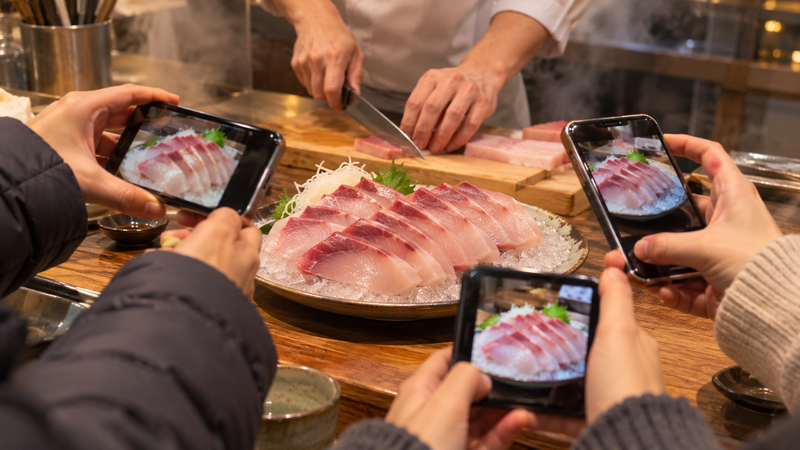
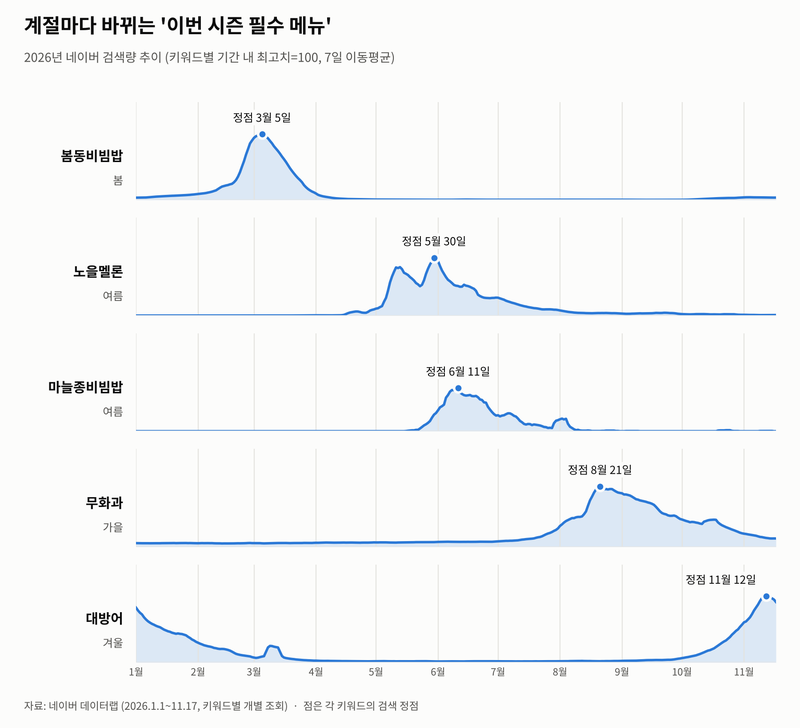
[Financial News] 'Something you can eat only at this time of year,' 'If you don't eat it now, you'll have to wait a year,' 'Seasonal foods you must try in November,' 'The weather's gotten colder—it's time to go eat in-season yellowtail'This is the 'Seasonal-core' scene flooding social media (SNS). Seasonal-core refers to a pattern of consumption in which people seek out, enjoy and share foods and experiences available only in a particular season. The list of 'foods you must eat this season' changes at a dizzying pace each year, from bomdong bibimbap—which quelled the craze for 'Dubai chewy cookie (Dubai Chewy Cookie)' that had swept social media and offline spaces early this year—to summer's sunset melon, autumn's gizzard shad and figs, and winter's big yellowtail and strawberries.
The faster the list changes, the more demand concentrates on a single dish over a short period. The shorter the season, the rarer the opportunities and places to try the food become, and concentrated demand makes it scarcer still. As scarcity grows, people keep lining up. That's why the queues of Koreans return every time the seasons change.
Mentions of bomdong surge 888%... SNS's 'seasonal calendar'
Bomdong was the starting point of this year's 'Seasonal-core' trend. A scene of people eating bomdong bibimbap on the 2008 KBS variety show 2 Days & 1 Night (1N2D) went viral again as a short-form video. Trend analysis firm SomeTrend said last February that mentions of 'bomdong bibimbap' had surged 888% year over year.
At the time, bomdong bibimbap became a hot topic through short-form videos on social media platforms such as Instagram and YouTube, and interest in bomdong, a seasonal ingredient, also surged. According to the Korea Price Information Association, the price of bomdong (1 kg) rose 33.3% from 4,500 won to the 6,000-won range.
In summer, melons and garlic scapes quickly became popular 'Seasonal-core' items. Last June, from the 1st to the 15th, Lotte Mart's melon sales rose 49% compared with the same weekdays a year earlier, while Emart's increased 42% from the same period the previous year. The increase is thought to reflect the buzz on social media around the orange-fleshed 'sunset melon.'
Garlic scapes also became a major talking point after 'garlic scape bibimbap' caught on through social media. According to Naver Data Lab, the search index soared from 0 to 100 over the month from May to June. In autumn, more consumers sought out gizzard shad (Konosirus punctatus), a quintessential 'fall fish,' as well as fresh shrimp and figs. When winter arrived, big yellowtail took their place.
One notable point is that social media is increasingly taking the lead in spreading this kind of trend. A 2024 study published in the international journal Foods, titled 'The Impact of SNS Use on the Segmentation of Dining-Out Behaviors Among Young Generations: A Korean Case Study,' found that the number of people in South Korea using social media to find restaurants is growing rapidly.
The researchers explained that consumers use social media to explore restaurants in order to check quality, enjoy trending flavors and reduce the risk of making a poor choice. Keumjoo Kwak, a professor of psychology at Seoul National University, said, “There’s a tendency to buy something and eat it even if it doesn’t taste good when you hear that other people have tried it,” adding that this mindset spreads extremely quickly through social media.
86.6% of 1,000 consumers have made an 'in-season' purchase
A survey by consumer data platform Pickple of 1,000 consumers in their 20s to 50s across the country, conducted from the 3rd to the 5th of last month, found that 86.6% had made a purchase because something was in season. As many as 94.6% had made a purchase at least once in the past year because they felt they 'wouldn't be able to do it unless they did it now,' while 80.5% said they viewed in-season consumption positively.
The most common reason for in-season consumption was the 'experience and feeling of fully enjoying the season' (32.9%), followed by 'freshness and quality' (28.4%) and 'scarcity' (26.8%), stemming from the feeling that 'you can't do it unless it's now.'
Pickple explained, “The name Seasonal-core didn't create the trend; it was attached to an existing habit (of in-season consumption).” It added that food and beverages fall under 'everyday in-season consumption,' which is repeated frequently, while travel and lodging are categorized as 'experiential in-season consumption,' which is less frequent but leaves a lasting impression.
It's also worth noting that the generations embracing Seasonal-core are not limited to people in their 20s. In the same survey, 74.9% said they knew the term 'Seasonal-core.' Responses saying they knew the term well, actual experience with in-season consumption and spending levels were all higher or similar among people in their 40s and 50s compared with those in their 20s.
The difference lay in how they consumed. Among people in their 20s, 46.5% shared their in-season purchases on social media, the highest proportion of any age group. They treat not only eating the food but also photographing and sharing it as part of a single consumption experience. By contrast, 52.7% of people in their 50s said, “I tend to buy in-season items even if I don't know about the trend.”
“Spreads Quickly and Disappears Quickly” ... Lines Form Again Every Season
Professor Kwak noted, “With the advent of a social media society, people are exposed to trends more often and have become more sensitive to them.” She added, “In the past, following other people's behavior or consumption spread more slowly and lasted longer, but recently trends spread quickly and disappear quickly.”
Professor Kwak said South Korea is particularly prone to quickly consuming a new issue and moving on. Like fast fashion, where products change from week to week, trends in seasonal foods also flare up and fade quickly.
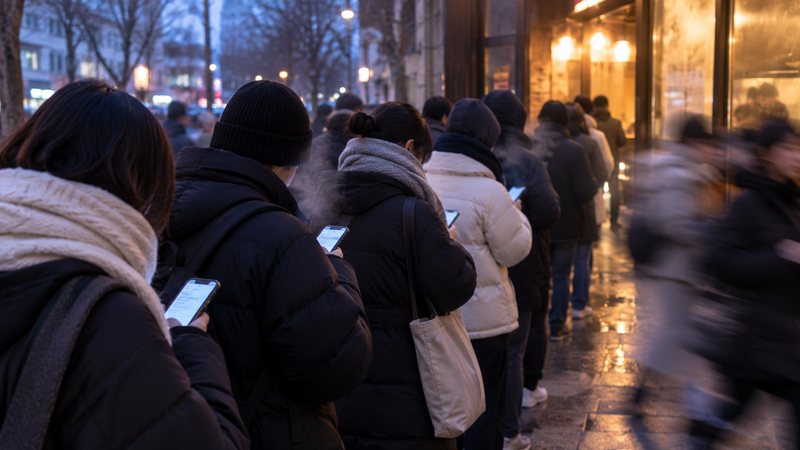
The long lines for big yellowtail, the queue numbers on waiting apps and the changing menu of 'foods you must eat' each season are all part of the same picture of Koreans lining up. The seasonal scarcity of 'you can't eat it unless it's now,' the conformity of 'everyone else is lining up too' and social media posts showing they've tried it all combine to turn a plate of food into an experience that marks the season and signals belonging to a group.
Kim Siwol, a professor of consumer studies at Konkuk University, said, “Consumption is about spending money to feel satisfied, then finding enjoyment in letting others know what satisfied you.” She predicted, “Because people are motivated to express their inner symbolism outwardly, this kind of consumption will continue to some extent, even if the way people line up changes.”
[email protected] Kim Hee-sun, Kim Su-yeon Reporter