Ruling and Opposition Parties to Quietly Persuade U.S. Democrats Holding the Key to Nuclear-Powered Submarines Before Year-End
- Input
- 2026-11-18 16:22:37
- Updated
- 2026-11-18 16:22:37
At a public hearing on a special bill for the nuclear-powered submarine program held by the National Defense Committee of the National Assembly on the 18th, the diplomatic challenge of securing nuclear fuel emerged as a key issue. When Kang Sun-young, a People Power Party lawmaker, asked whether military-use nuclear material could be obtained under the current U.S.–Republic of Korea Agreement for Peaceful Nuclear Cooperation, a government official explained that the government was pursuing a separate agreement to allow the use of nuclear energy for military purposes. This means that even if special domestic legislation is enacted, nuclear fuel supplies cannot be guaranteed without negotiations with the United States.
Securing nuclear fuel has long been a challenge for South Korea’s nuclear-powered submarine program. According to Moon Geun-sik, a special professor at Hanyang University, development of a nuclear-powered submarine was pursued under the Roh Moo-hyun government in 2003 but was halted after running into difficulties securing nuclear fuel. Research and technology development continued under successive administrations, and an agreement between the leaders of South Korea and the United States to cooperate on nuclear-powered submarines gave the effort renewed momentum. Moon emphasized that negotiations with the United States on the terms of nuclear fuel supply must proceed alongside consultations with the International Atomic Energy Agency (IAEA) on safeguards. More than two decades later, efforts to enact a special bill have gathered pace, but the fundamental hurdle of securing nuclear fuel remains.
Even as ruling and opposition parties agree on the need to build nuclear-powered submarines, they differ over the framework for carrying out the program under the special bill and which bodies should oversee safety regulation. The external factor of a reshuffling of power in the U.S. Congress has added to the challenge. If a separate agreement for future nuclear fuel supplies leads to review by the U.S. Congress or related legislation, cooperation from Democratic Party leaders could become important. To turn the agreement with the Trump administration into actual nuclear fuel supplies, South Korea will also have to persuade the U.S. Congress.
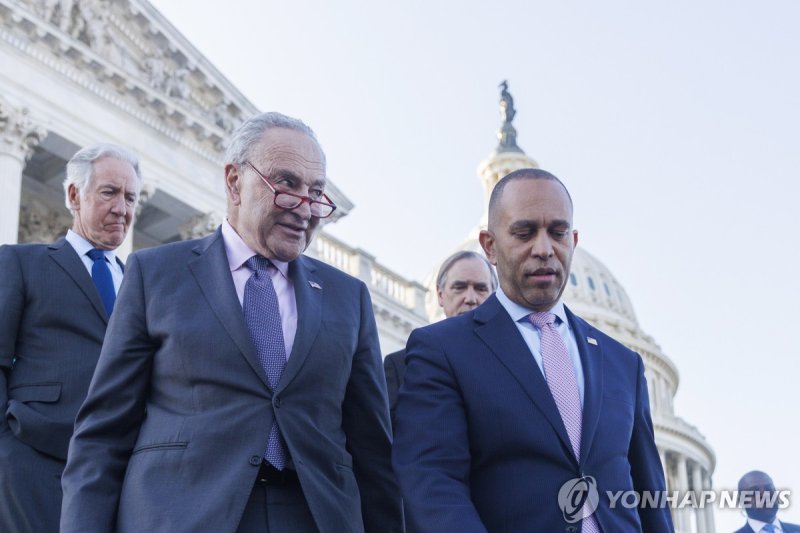
Lawmakers from both ruling and opposition parties who belong to the Korea-U.S. Parliamentary Association are planning a visit to the United States after the regular session of the National Assembly ends in December. The delegation, which will include Democratic Party of Korea (DPK) lawmaker Kim Young-bae and others, plans to meet contacts with whom they have existing ties, including Korean-American Democratic Senator Andy Kim, while also seeking cooperation from incoming leaders such as Senate Democratic Leader Chuck Schumer and House Democratic Leader Hakeem Jeffries. If Schumer wins reelection in his party’s leadership election on December 1, he will become Senate majority leader, while Jeffries is also a leading contender to become the next speaker of the House.
At a discussion on the ROK-U.S. Alliance on the 10th, Kim emphasized the need to take into account the Democratic Party’s opposition to nuclear proliferation. Referring to Schumer and Jeffries, he said, “I’ll mobilize all the connections we’ve built up over the years so that we can talk with them. Their terms begin in January, but they have effectively already begun preparing.”
Intensifying partisan conflict in the United States is also a concern. If the Democratic Party focuses on investigations into allegations involving President Trump and his family, as well as impeachment battles, after the new Congress convenes, legislative and policy discussions needed for cooperation on nuclear-powered submarines could take a back seat. During the lame-duck session between the midterm elections and the start of the new Congress, lawmakers return to their districts, making it difficult to secure meeting dates. Kim has also said that the timing of a visit to the United States should be carefully coordinated, citing these circumstances. The challenge is to solve a complex diplomatic equation involving domestic legislation, stalled nuclear fuel negotiations and efforts to persuade the incoming Democratic leadership.
[email protected] Jiwon Song Reporter