"Funding AI Used in the Field"... Government Plays Matchmaker for Medical AI
- Input
- 2026-11-18 15:05:19
- Updated
- 2026-11-18 15:05:19
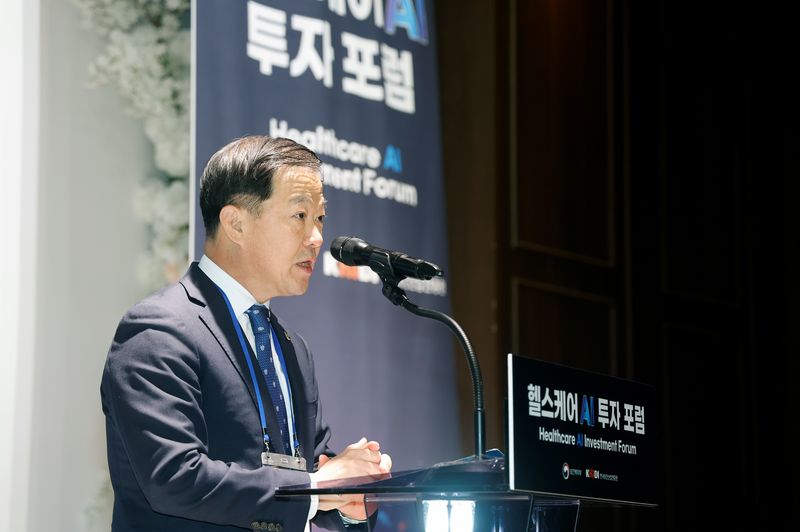
[Financial News] Seoul National University Hospital and investment firm Premier Partners have joined forces to drive AI transformation (AX) in regional, essential and public healthcare and to identify and invest in promising medical AI companies. The aim is to nurture medical AI that is actually used in the field, through a model in which hospitals identify on-the-ground needs and investors provide funding.
The Ministry of Health and Welfare held the Healthcare AI Investment Forum on the 18th at Grand Hill Convention in Seoul’s Gangnam District. Around 150 people attended, including Second Vice Minister Lee Hyung-hoon; representatives of five government-backed policy fund managers, including the K-Bio Vaccine Fund; medical AI companies; and officials from the Korea Health Industry Development Institute and the Health Insurance Review and Assessment Service.
Last August, the government announced its AI Basic Healthcare Strategy and began pursuing AX across the entire healthcare cycle, from primary care in underserved areas to care coordination among regional public hospitals. On the 11th, it also opened the Public Healthcare AI Expressway on a pilot basis. The forum was organized to broaden the foundation for private investment to support implementation of the strategy.
The agreement ceremony was held at the forum that day in the presence of Vice Minister Lee. Under a memorandum of understanding to accelerate AX in regional, essential and public healthcare and foster the medical AI ecosystem, Seoul National University Hospital and Premier Partners will work together to identify AX needs in regional, essential and public healthcare settings and develop investment strategies for each stage of growth; jointly identify promising medical AI companies and support their efforts to attract investment and grow; and support implementation of the AI Basic Healthcare Strategy and the global expansion of domestic medical AI companies.
The Ministry of Health and Welfare said the agreement is significant because it directly connects needs in healthcare settings with private investment, creating a virtuous cycle that leads to the discovery, investment in and wider adoption of medical AI.
In a policy presentation that followed, the ministry outlined the direction of the AI Basic Healthcare Strategy and the need for an appropriate compensation system for medical AI. Specifically, it shared a three-stage medical AX framework centered on agent technologies linked to electronic medical records (EMRs) to improve effectiveness in clinical settings; plans to reform National Health Insurance reimbursement rates and establish an appropriate compensation system to fairly assess the value of medical AI technologies; and plans to provide real-world validation and seed funding in connection with the Public Healthcare AI Expressway infrastructure.
At a panel discussion, participants from the Ministry of Health and Welfare, the Health Insurance Review and Assessment Service, investment firms and companies discussed ways to build a sustainable medical AI ecosystem. The session was chaired by Professor Seo Jun-beom of Asan Medical Center, who heads the medical subcommittee of the National AI Strategy Committee. Yuanta Investment Co., Ltd., Daily Partners and Korea Investment Partners then presented their investment strategies for medical AI, while five medical AI companies held investor relations (IR) presentations to expand their connections with investment firms.
The ministry plans to make the Healthcare AI Investment Forum a regular event so hospitals and investment firms can maintain ongoing exchanges, and to gradually expand links between ministry-funded funds and investments in the medical AI sector. It also plans to develop appropriate compensation measures for health insurance AX without setbacks. The pilot Public Healthcare AI Expressway will be expanded in stages to 35 hospitals next year and 72 hospitals in 2029, helping build an ecosystem in which private AI companies can actively validate their technologies and grow.
Vice Minister Lee said, "Successful AX in healthcare requires the government’s commitment, the creative efforts of medical AI companies, and an investment ecosystem to support them. We hope the agreement between Seoul National University Hospital and Premier Partners will become a touchstone for revitalizing the AX investment ecosystem. The government will also provide strong support by establishing a reasonable compensation system and strengthening the foundations for linking real-world validation with investment."
Go Sang-baek, president of the Korea Health Industry Development Institute, said, "For the medical AI industry to grow sustainably, it is important to create a virtuous cycle in which excellent technologies earn trust in healthcare settings and those results lead to business growth and new investment. The institute will strengthen cooperation among companies, healthcare institutions and investors, support the commercialization of promising technologies and their access to investment, and help ensure that the results of technological innovation lead to better healthcare services that people can experience."
[email protected] Jung Myung-jin, Medical Correspondent Reporter