“Bank Closed, So Off to the Post Office” ... No Customers Even With Loan Counters Open
- Input
- 2026-11-23 06:00:00
- Updated
- 2026-11-23 06:00:01
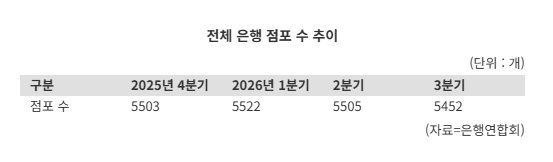
The Korea Federation of Banks (KFB) reported on the 23rd that there were 5,452 bank outlets at the end of September, including branches and subbranches, as of the 23rd. That was 53 fewer than the 5,505 at the end of June.
The total number of bank outlets nationwide rose by 19 in the first quarter of this year, but fell by 17 in the second quarter, with the decline widening in the third quarter. Compared with the 5,503 at the end of last year, the number has fallen by 51 so far this year.
The Big Four banks (KB Kookmin, Shinhan, Hana and Woori) led the decline in branches in the third quarter. Their outlets fell by 37, from 2,702 at the end of June to 2,665 at the end of September, accounting for 69.8% of the banking sector’s net decline of 53. Compared with the 2,685 at the end of last year, the number was down by 20 (0.74%).
Branch reductions continued at regional banks as well. The number of outlets at five regional banks—Busan, Gyeongnam, Gwangju, Jeonbuk and Jeju—fell for the fourth consecutive quarter, from 585 at the end of September last year to 566 at the end of September this year.
This trend is at odds with the financial authorities’ policy stance. To prevent older people who have difficulty using non-face-to-face financial services from being excluded, the authorities tightened branch-closure procedures starting in March, requiring banks to conduct preliminary impact assessments, among other steps, even when consolidating or closing branches within a 1-kilometer radius. They have also increased the deduction in the Regional Reinvestment Evaluation for branch closures outside metropolitan cities.
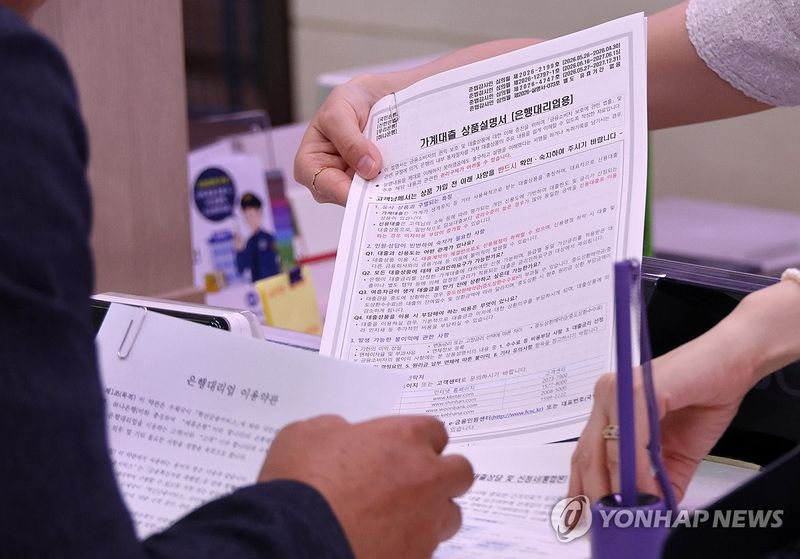
In addition, to address gaps in financial services caused by the decline in bank branches, the financial authorities launched a pilot post office banking agency program in the second half of this year. Starting July 20, customers have been able to receive advice on and apply for products such as credit loans from KB Kookmin, Shinhan, Hana and Woori through counters at 20 post offices nationwide.
The problem is that, contrary to expectations, the banking agency service has yet to produce clear results. People working in banks say that simply setting up loan counters is unlikely to increase demand. They explain that even in pilot areas without branches of large commercial banks, existing financial institutions such as local agricultural cooperatives are already established, leaving residents with little incentive to switch financial institutions.
Limited demand for loans among older people is also cited as a factor holding back the service. Observers say the pilot program’s locations and the products it offers need to be adjusted to reflect actual demand in order to reduce inconvenience for customers who need in-person financial services.
A bank official said, “Town and township centers with post offices also have local agricultural cooperatives, and residents have been banking there for a long time, so the arrival of a banking agency service will not suddenly change their existing financial dealings. Older people in the area are sometimes not very active in their financial transactions and tend to keep using institutions they are familiar with, so without a particular catalyst or incentive, it will be difficult to significantly increase usage.”
[email protected] Ye Byung-jung Reporter