Democratic Party, Government Step Up Push for '10-Year Bar on Taking Exams' Over AI Cheating ... Also Seek to Require AI Firms to Submit Data
- Input
- 2026-11-18 14:37:30
- Updated
- 2026-11-18 14:37:30
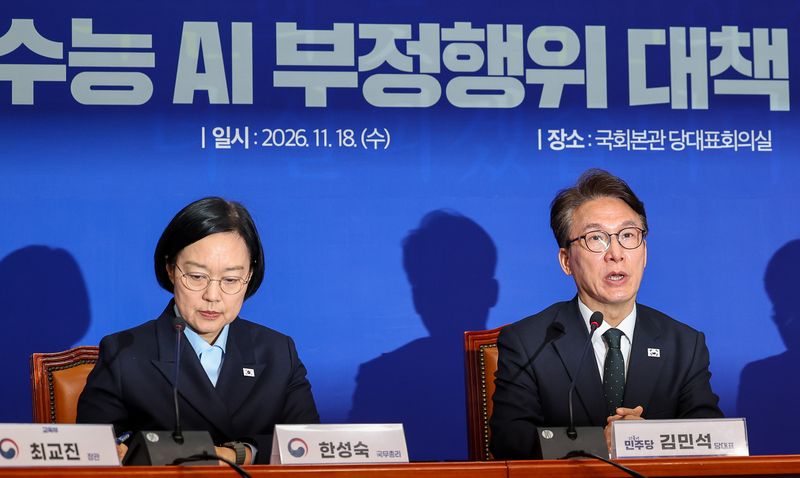
The party and government held a consultation that day at the National Assembly to discuss these measures to address AI cheating on the 2027 CSAT. Their meeting just one day before the exam, as public anxiety mounted, is seen as an effort to deter cheating through a tough-punishment stance and allay the concerns of test takers and their parents.
Park Sung-joon, the Democratic Party’s chief spokesperson, told reporters after a high-level party-government meeting that day, “We decided to actively pursue revisions to the Higher Education Act to extend the period during which CSAT cheaters are barred from taking the exam from the current one year to 10 years, and to apply the change retroactively to this year’s CSAT.” The move puts a tough-on-cheating stance front and center. The party and government will also legislate expulsion and readmission restrictions for enrolled university students to make penalties for cheating more effective. The aim is also to close a gap in sanctions for so-called college students retaking the exam, who may return to their current university even if they are barred from taking the CSAT because of cheating.
After the party and government said they would use legal revisions to apply these penalties to people caught cheating on this year’s CSAT, some raised constitutional concerns, saying this would violate the constitutional “principle of non-retroactivity of laws.” The Ministry of Education said it was reviewing whether much of the constitutional concern could be addressed by establishing a legal basis in the Higher Education Act and specifying the people subject to sanctions.
The party and government are also pursuing a plan to require AI companies to submit data related to cheating on the CSAT. The move follows President Lee Jae-myung’s mention of the measure, prompting the party and government to step up work on related countermeasures. The government plans to strengthen the detection of cheating and subsequent investigations with the cooperation of four major global AI companies and telecom carriers. It did not disclose the names of the companies it plans to work with.
Cheating will also be detected through a reporting center and follow-up investigations after the exam, and the government will pursue criminal penalties, including the filing of complaints and accusations, as well as the cancellation of university admissions. The introduction of a reward of up to 100 million won for reporting cheating, proposed by President Lee, is also under consideration. In addition, the government will operate a pan-government task force to ensure fairness across all national exams, including the CSAT. The Democratic Party will also form a “Special Committee on Measures to Eradicate Cheating in Exams Using AI” to support related legislation.
Democratic Party leader Kim Min-seok stressed, “We will overhaul the system so that strong sanctions, including cancellation of admission and criminal penalties, can be imposed if cheating is confirmed even after an exam has ended,” adding, “We will respond forcefully so that the one-strike-out principle can be applied to cheating on exams.”
[email protected] Kim Hyeong-gu Reporter