Satya Nadella: “AI Advances Must Lead to Tangible Results”
- Input
- 2026-11-18 14:35:40
- Updated
- 2026-11-18 14:35:40
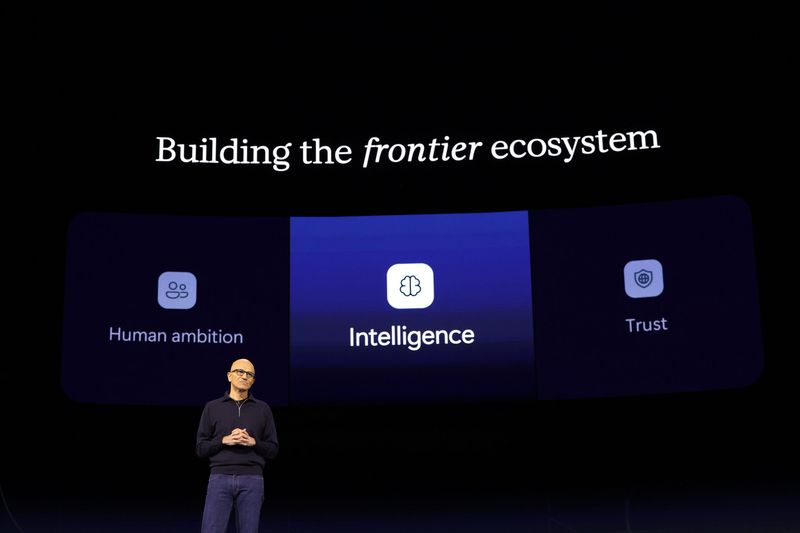
Satya Nadella, chairman of the board and CEO of Microsoft (MS), stressed that advances in artificial intelligence (AI) technology must be translated into tangible business results. As companies introduce AI across their operations, they need to secure control over their own data and intelligence and build a trustworthy operating environment.
In his keynote at the annual technology conference Microsoft Ignite 2026, held in San Francisco, United States, on the 17th (local time), CEO Nadella presented three core principles for building a “frontier ecosystem,” saying, “To do so, it is important to put human aspirations at the center, ensure that each organization has control over its own intelligence and learning, and build trust.”
CEO Nadella introduced Copilot, an AI work tool, as a new operating system for work. Copilot brings together a range of capabilities, including conversation, coding, and task automation, in a single environment, enabling employees and AI agents to collaborate.
The newly introduced Copilot Workspace is a space where multiple employees and AI agents work toward shared goals. The autonomous agent Autopilot carries out tasks continuously without repeated instructions from the user. Copilot Code can also be used to create customized applications and dashboards using natural language.
Microsoft is also enhancing capabilities that use companies' own knowledge to help them take control of AI. CEO Nadella introduced Microsoft IQ as a platform that enables organizations to continuously build and control their unique intelligence.
Microsoft IQ links information accumulated across companies' documents, emails, meetings, and business systems, allowing AI agents to use it. Microsoft plans to provide hundreds of new connectors so companies can put data spread across multiple systems to work.
In the field of AI models, Microsoft is offering a range of options to suit different work requirements and costs. It officially launched Microsoft Decision 1.1, a decision-making model for businesses, and unveiled Code 2, which supports complex development work, and Code 2 Flash, specialized in repetitive coding tasks.
CEO Nadella also noted that the more deeply AI agents become involved in corporate work, the more necessary it is to have systems in place to manage and control them.
Microsoft is strengthening Agent 365, which manages AI agents' access rights, security, and operational status within organizations. Its newly unveiled business analytics feature analyzes the costs of using AI and the results achieved, helping companies assess the returns on their investments.
In security, Microsoft officially launched Perception, in which autonomous AI agents detect and respond to threats. It involves Red Team agents simulating attacks, Blue Team agents detecting attacks, and Green Team agents fixing vulnerabilities, all working together. The system is designed to ensure that users retain final control even when AI automatically performs security tasks.
CEO Nadella also stressed the need for a framework to independently verify and control AI models' activities. To that end, Microsoft announced the AI Transparency Initiative and will work to develop open industry standards that strengthen the security, accountability, and transparency of AI systems.
Microsoft plans to expand its collaboration with the U.S. National Institute of Standards and Technology (NIST) Agent Standards Initiative and develop standards with 40 organizations to improve AI accountability and verifiability. The standards will also apply to Microsoft's own AI models and Copilot, among others.
CEO Nadella said that we are entering an era in which intelligence is everywhere, and that technological progress should help realize human goals and enable companies to retain control over their own intelligence.
[email protected] Jang Min-kwon Reporter