K-water to Expand Floating Solar Through Public-Private Cooperation, Lowering Regulatory and Cost Barriers
- Input
- 2026-11-18 14:21:01
- Updated
- 2026-11-18 14:21:01
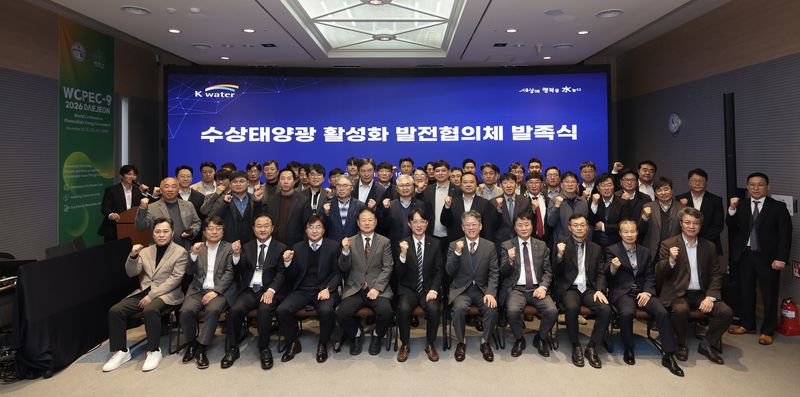
K-water said it held the launch ceremony for the Floating Solar Power Promotion Council on the 18th at the Daejeon Convention Center in Yuseong District, Daejeon, with representatives from around 50 public, private, academic, and research organizations in attendance. K-water will oversee the council’s operations.
Floating solar power is a renewable energy source that uses the surfaces of dams and reservoirs, helping reduce damage to land. A cross-transmission approach linked to the existing hydropower transmission system can also reduce the burden of building new transmission networks.
The council consists of three subcommittees: policy recommendations, technical design and construction, and equipment.
The policy recommendations subcommittee will work to rationalize permitting regulations and improve the institutional framework, while the technical design and construction subcommittee will pursue cost reductions, standardized design and construction, and improved safety. The equipment subcommittee will be responsible for developing and localizing high-efficiency modules and new mooring methods.
The council plans to discuss areas for cooperation at regular semiannual meetings and additional meetings as needed.
After finalizing its operating regulations and appointing subcommittee chairs, the council discussed with Korea Conformity Laboratories (KCL) ways to establish performance and evaluation standards for floating structures.
Since installing a 500-kW floating solar facility at Hapcheon Multipurpose Dam in 2012, K-water has been operating a total of 105.6 MW at seven sites. Last September, it announced a plan to develop 500 MW at 10 sites by 2030, starting with a 95-MW facility at Soyang Dam.
Oh Bong-geun, head of K-water’s Renewable Energy Division, said, “Through this council, we will foster close cooperation among the government, public sector, industry, and academia to improve regulations and drive technological innovation, creating an opportunity for Korea’s floating solar industry ecosystem to take a step forward.”
[email protected] Choi Ga-young Reporter