KOSPI Operating Profit Surges 264%, but Growth Slows Sharply Without Semiconductors [Q3 Results]
- Input
- 2026-11-18 14:21:10
- Updated
- 2026-11-18 14:24:54
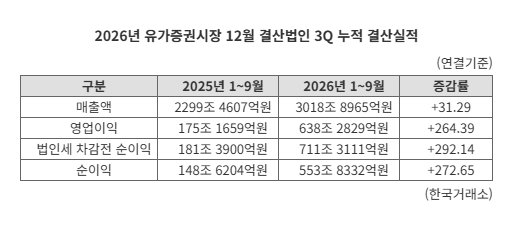
[Financial News] Cumulative operating profit at KOSPI-listed companies surged by more than 260% year on year in the first three quarters of this year, posting record-high results.
However, with performance improvements concentrated in major semiconductor stocks such as Samsung Electronics and SK hynix, and net income falling sharply in the third quarter, questions are also being raised about whether the growth can be sustained.
Analysts say earnings polarization among listed companies is becoming more pronounced, as profitability shows signs of slowing despite top-line growth and weakness in domestic-demand sectors continues.
According to the cumulative third-quarter results for December fiscal year-end companies on the KOSPI Market, released by the Korea Exchange on the 18th, listed companies that submitted consolidated financial statements recorded a 31.29% year-on-year increase in cumulative revenue for the first three quarters of this year.
Operating profit and net income surged by 264.39% and 272.65%, respectively. Based on the figures alone, this means that listed companies in Korea have significantly improved their ability to generate profits.
However, much of the earnings growth depended on major semiconductor stocks. Excluding Samsung Electronics and SK hynix, the revenue growth rate for all listed companies falls from 31.29% to 14.35%. The operating profit growth rate contracts from 264.39% to 63.94%, while the net income growth rate falls from 272.65% to 94.86%.
Given that the two companies account for 24.42% of total revenue, this means it is difficult to interpret this year's improvement in KOSPI performance separately from the recovery in the semiconductor industry. Of course, the broader trend of improving corporate performance is not negated by the fact that operating profit increased by at least 60% even excluding the two companies.
However, the fact that overall market earnings growth is heavily driven by the performance of a handful of large companies shows that domestic stock market earnings momentum could also fluctuate significantly as the semiconductor industry changes.
The quarterly earnings trend is even more noteworthy. While cumulative results showed steep growth, signs of slowing profitability emerged in the third-quarter results alone. On a consolidated basis, third-quarter revenue and operating profit rose 2.32% and 10.55%, respectively, from the previous quarter. Net income, by contrast, fell 30.41% over the same period.
The net profit margin also declined. The consolidated net profit margin, which stood at 23.31% in the second quarter, fell 7.46 percentage points to 15.85% in the third quarter. As companies continued to grow their top lines, their profitability in converting that growth into actual bottom-line earnings weakened.
Earnings polarization across sectors was also pronounced. The electrical and electronics sector’s consolidated operating profit surged 656.44% year on year, driving overall market earnings growth. Operating profit in the general services sector also rose 184.98%.
By contrast, sectors closely tied to domestic demand performed relatively poorly. The construction industry’s consolidated revenue fell 10.29% year on year, while the real estate sector swung to a loss. The performance gap is widening between export-oriented and high-tech industries, led by semiconductors, and domestic-demand sectors.
The financial sector also showed a marked difference between cumulative and quarterly results. The securities industry posted a solid 80.53% year-on-year increase in cumulative net income through the third quarter. However, net income for the third quarter alone plunged 88.15% from the previous quarter. Quarterly volatility, which is difficult to discern from cumulative results alone, has widened significantly.
Positive changes were also evident in financial soundness. As of the end of September, total equity at listed companies covered by consolidated financial statements had increased 22.79% from the end of last year.
Over the same period, total liabilities rose by just 6.54%. As a result, the debt ratio fell 13.57 percentage points, from 102.56% at the end of last year to 88.99%. The increase in earnings and expansion of capital are seen as having generally eased companies’ financial burden.
[email protected] Kang Jung-mo Reporter