KRISS Exports Equipment to U.S. for 100 Times More Precise Measurement of Trace-Gas Masses
- Input
- 2026-11-18 14:27:46
- Updated
- 2026-11-18 14:27:46
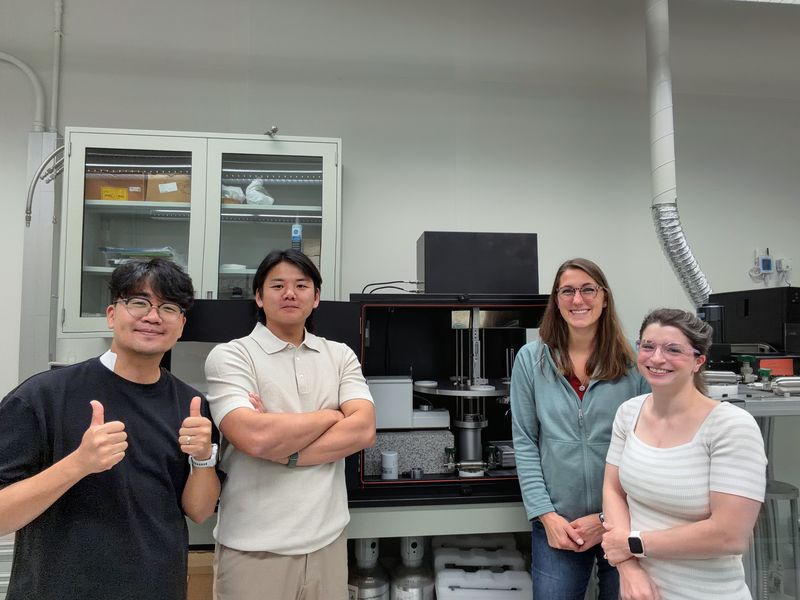
[Financial News] The Korea Research Institute of Standards and Science (KRISS) said on the 18th that it had exported a third-generation “mini-cylinder automatic weighing system (mini-AWS)” to the U.S. National Institute of Standards and Technology (NIST). The system measures the mass of trace gases 100 times more precisely than previous equipment.
NIST, a U.S. Department of Commerce national laboratory established in 1901 and a world-leading measurement standards institution, had purchased KRISS’s second-generation equipment three times since 2009. With this purchase, it became the first overseas institution to adopt the third-generation equipment.
Standard gases are reference materials used to verify the accuracy of gas-measuring instruments and are used in monitoring greenhouse gases and air pollution, as well as in semiconductor process control. How precisely the mass of a gas can be measured is key to determining the accuracy of a standard gas.
Recently, new gas-measurement technologies using isotope ratios have been required in areas such as tracking greenhouse gas pollution sources, semiconductor and display processes—national strategic industries—and quantum computers and quantum materials. However, existing technology, which weighs 10 L cylinders in 1 mg increments, had limitations for developing these technologies.
To overcome these limitations, KRISS researchers independently developed the mini-AWS, which measures the mass of a 75 mL mini cylinder down to 0.01 mg, one-hundredth of the previous level. When measuring 5 g of gas with this equipment, the measurement uncertainty is about 0.001%—just one-hundredth of that of the existing second-generation equipment (about 0.1%).
This improved precision provides a foundation for accurately measuring the mass of trace gases and developing isotope-ratio gas measurement standards traceable to the International System of Units (SI). In particular, because only a tiny amount of source gas needs to be weighed, it can dramatically reduce the manufacturing cost of “isotope-ratio standard gases,” which use isotopes such as helium-3 as source material—an isotope that can cost tens of millions of won even in small quantities.
The equipment for export further improves on the existing mini-AWS, with a design that places the rotary-table motor outside the measurement chamber to reduce thermal effects, as well as a newly developed integrated control unit and software. KRISS moved the equipment, built and performance-tested in Korea, to NIST’s site in September this year, where it was assembled and installed. After equipment inspections, KRISS plans to complete final performance verification and transfer of operational know-how by the first half of 2027.
Earlier, KRISS first exported a second-generation automatic weighing system (AWS) to NIST in the U.S. in 2009, then expanded its customer base to national measurement standards institutions in countries around the world, including the U.K., Singapore and South Africa. To date, it has exported 10 units to seven countries. NIST has purchased two additional units since its initial adoption and now operates three in total.
The development of this mini-AWS was supported by KRISS’s basic research program, and the findings were published in 2022 in Metrologia, an international journal in the field of measurement science (IF 3.2).
[email protected] Yeon Ji-an Reporter