The Man Who Built AI Took on AI—and Won... The 'Power of Thought' That Decided a 10-Hour Battle [Hong Chae-wan's Global Profile]
- Input
- 2026-11-21 05:00:00
- Updated
- 2026-11-21 05:05:32
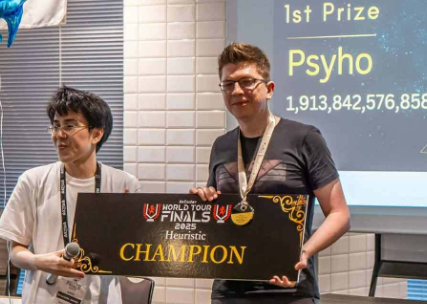
[Financial News] “Humanity won. For now!”
That was what a man said after a 10-hour programming contest against artificial intelligence (AI). Just after the competition, he posted the provisional results on X and admitted he was exhausted, having slept only about 10 hours over three days. Sam Altman, OpenAI’s chief executive officer (CEO), also sent a brief congratulatory message: “Great job, Psyho.”
The man at the center of the story is Polish programmer Przemysław Dębiak, better known online as “Psyho.” After winning the heuristic division of the AtCoder World Tour Finals 2025, held in Tokyo, Japan, on July 16 last year, he was the only human contestant to score higher than an OpenAI model that solved the same task in an exhibition match. In an era when AI generates answers for people, he solved the problem himself and beat AI.
Finding a “better answer” is harder than finding the right answer
The contest that day was unlike an exam in which contestants race to find a predetermined answer. They were given a complex problem and had to come up with the best solution they could within a limited time. It was not enough to write a program that worked; they had to keep deciding what to change and how to improve its performance.
The task was to get robots on a grid to their respective destinations using as few commands as possible. The robots could be grouped and moved together or moved individually, and walls could be added and groups assigned before the robots began moving. Since the robots could block one another, choosing to move just one robot could reduce the efficiency of the whole operation.
Dębiak’s breakthrough was “simplification.” He judged that it would be difficult to implement a complex design for robot groups, routes and wall positions within 10 hours. Instead, he narrowed the problem down by putting the robots in one group, making them follow a fixed route, and improving the result by changing the arrangement of the walls. Robots that did not reach their destinations were moved individually at the end.
In the solution he published after the contest, he also explained why he prefers simple approaches. An approach that is easy to implement can be tested and revised quickly, and even if it turns out to be wrong, it helps reduce wasted time. Rather than countering a complex problem with complex code, the ability to decide what to leave out was the starting point for winning.
A developer who built AI to compete against humans
Dębiak had not merely watched AI develop from the sidelines. He took part in developing and training OpenAI Five, an AI that plays the game Dota 2. In effect, a developer who had helped build AI to compete against humans faced an OpenAI model at the contest as a human competitor.
His competitive edge came from years of contest experience. He stood out in international competitions from his days studying computer science at the University of Warsaw. He won the algorithm category of the 2007 Imagine Cup and the marathon category of the 2008 Topcoder Open, and continued to achieve success in contests focused on optimization problems.
His interest in solving problems extended beyond programming. In a post about one of his contests, he said he enjoyed logic puzzles, escape rooms and puzzle exploration games. He built an escape room himself and also tried his hand at making games. Competitive programming, which he had pursued as a hobby for about 20 years, was one of the ways he tackled problems in different forms.
In an interview with Poland’s PAP news agency, he described his way of thinking as “intuition.” That intuition was the product of all the time he had spent solving problems. As experience accumulates, he said, it becomes possible to think of promising directions without consciously calculating every step. He recalled that at the Tokyo contest, while other contestants filled several pages with calculations, he had only one sheet of paper with a few doodles on it.
The question left by the caveat “for now”
Dębiak did not interpret his win as proof of permanent human superiority. In his analysis after the contest, he cautioned that it was difficult to draw a definitive conclusion from a single competition. He also cited AI’s ability to try modifications in multiple directions at once as a strength. He celebrated the win while also considering his opponent’s capabilities and the limits of what the result showed.
The human capabilities he values are judging which approaches have promise and developing untested ideas all the way through. In an interview with PAP, he predicted that even if AI wrote all the code, people would still have the role of defining what to create and what tasks it should perform. He also said that rather than fixating on stopping AI’s development, people should focus on how to use it wisely.
The question raised by Dębiak’s contest lies here, too: as tools that generate answers grow more powerful, how can people develop the judgment to recognize a good answer? His intuition was shaped by years of grappling with problems himself, failing and revising his approach. The ranking of AI and humans in a contest may change, but the value of the process of building that judgment remains. The “for now” he added after celebrating his victory leaves us with a challenge: even in the age of AI, people must cultivate the ability to think for themselves.
[email protected] Hong Chae-wan Reporter