“A Death Sentence for the Current Admissions System Will Soon Be Handed Down”... Tae-Sung Choi Warns a Day Before the CSAT
- Input
- 2026-11-18 13:36:33
- Updated
- 2026-11-18 13:36:33
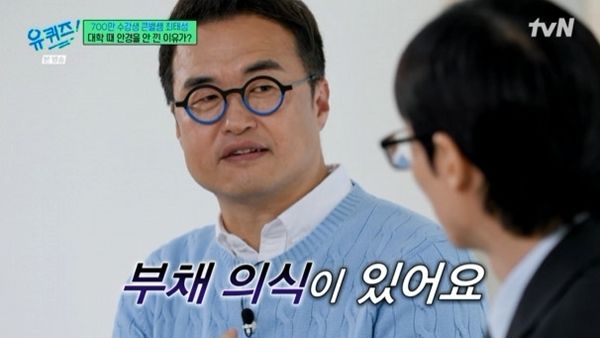
[Financial News] Korean history instructor Tae-Sung Choi argued that the current admissions system needs a sweeping overhaul in light of controversy over cheating on exams using artificial intelligence (AI). While sharing the account of the youngest person to pass the 5th-grade civil service exam, he voiced concern that even people who earn excellent scores are now viewed with suspicion, and apologized to students preparing for the College Scholastic Ability Test (CSAT).
On the 18th, Tae-Sung Choi shared on his social media (SNS) an article from Legal Journal about the account of Jang Jin-hyeok, the youngest person to pass the 2026 5th-grade civil service exam in the science and technology track.
According to Legal Journal on the 17th, Jang, who is enrolled in Seoul National University’s School of Liberal Studies, passed this year’s 5th-grade civil service exam in the science and technology track at age 20, making him the youngest passer.
In his account, Jang said, “I took the Korean history exam in February 2025,” and added, “I prepared by taking teacher Tae-Sung Choi’s ‘7-Day Miracle’ course on YouTube, solving past exam questions around seven times, and then watching the same teacher’s live broadcast on the eve of the exam.”
After seeing this, Tae-Sung Choi lamented that even high scorers are now viewed with suspicion amid recent controversies over cheating on exams, saying, “What a world, where people should be congratulated for good scores but suspicion comes first. What are we supposed to do?” He added, “Congratulations to Jang Jin-hyeok, the youngest passer—you star!” and wrote, “‘7-Day Miracle,’ the eve-of-the-exam livestream, all those technical terms—they’re all there. The real deal. Hahaha.”
That day, Tae-Sung Choi also spoke about the 2027 College Scholastic Ability Test (CSAT), which was just one day away.
“The CSAT is tomorrow. How anxious must our students be?” he said, expressing concern for those about to take the exam. Citing the abolition of the civil service examination system during the 1894 Kabo Reform, he argued that the current admissions system also needs to change.
“During the 1894 Kabo Reform, the gwageo, an examination system that had been in place for 1,000 years, was forcibly brought to an end,” Tae-Sung Choi said. “People looked only to the gwageo even in the face of the change called modernization, so the measure ultimately taken was to end it by force.”
He said that advances in AI technology could make it increasingly difficult to maintain existing testing and evaluation methods.
“In 2026, we are facing that kind of situation again. A death sentence for the current admissions system will soon be handed down,” Tae-Sung Choi argued. He added, “I sincerely hope we respond quickly to this change so that such anti-educational words as anxiety, suspicion, and mutual surveillance do not arise,” and stressed, “I hope our society’s process of deep deliberation on the admissions system as a whole can begin right away.”
The argument is that, rather than merely stepping up efforts to catch cheating at exam venues, the university admissions evaluation methods and the admissions system as a whole should be reconsidered in light of advances in AI technology.
Tae-Sung Choi, who called for changes to the admissions system, also expressed his regret to students preparing for the CSAT.
“Students taking the exam, I’m sorry. I’m sorry for how adults, myself included, only act once something goes wrong. I’m sorry, and sorry again,” Tae-Sung Choi said. He encouraged the students, adding, “I’ll pray that you get through tomorrow’s exam without incident.”
[email protected] Han Seung-gon Reporter