Yeosu Mayor Seo Young-hak: 2027 Is the First Year of 'Citizen Sovereignty' and 'Preparing for the Future'
- Input
- 2026-11-18 13:04:30
- Updated
- 2026-11-18 13:04:30
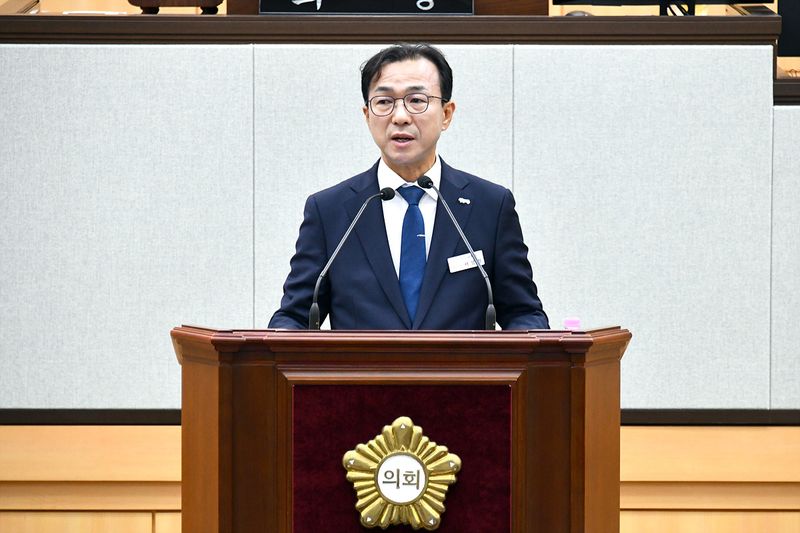
【Financial News, Yeosu = Reporter Hwang Tae-jong】Yeosu Mayor Seo Young-hak identified 'citizen sovereignty' and 'preparing for the future' as key themes, saying, "2027 is the substantive first year of the ninth elected term and a very important time to lay the groundwork for realizing the city's vision."
Mayor Seo made the remarks on the 17th at the plenary session of the second regular meeting of the 259th Yeosu City Council, where he delivered his first state-of-the-city address of the ninth elected term and announced the direction of city administration and key projects for 2027. In particular, he declared a sweeping reform of city administration centered on citizens, moving away from government-led administration.
Earlier, Yeosu drew up next year's main budget, guided by 'change' and 'innovation,' at a total of 1.4293 trillion won—52.1 billion won less than this year's budget. This includes 1.3026 trillion won for the general account and 126.7 billion won for special accounts. By sector, the allocations are 535.7 billion won for education, welfare and health; 170.3 billion won for transport and regional development; 129 billion won for the environment, industry and energy; 94.2 billion won for agriculture, forestry, maritime affairs and fisheries; 94.1 billion won for general administration and safety; and 72.8 billion won for culture and tourism.
In his address, Mayor Seo said he intended to fully implement 'citizen-sovereignty administration, in which citizens are the owners.' Starting next year, the city will operate a Citizen Sovereignty Committee of up to 30 citizens to discuss major policies and local issues together; introduce an 'online resident e-participatory budgeting system' to expand public participation in the budgeting process; and establish a 'Citizen Sovereignty Climate Conference' to incorporate citizens' voices throughout the development and implementation of climate policies.
The city also plans to use the 'resident tax return initiative' to direct a portion of resident tax revenue to village projects chosen directly by residents. It will expand and reorganize the existing Citizen Ombudsman system into a Citizen Grievance Redress Committee, a five-member collegial body, to improve the expertise and fairness of grievance handling.
The city will further upgrade the 'Citizen Communication Phone' and '48-hour on-site response system,' introduced in the first official decision of the ninth elected term, by building an AI-based system for handling public complaints. It will consolidate the currently dispersed complaint channels and establish a seamless response system operating 24 hours a day, 365 days a year, improving convenience for citizens and speeding up complaint handling.
To overcome the crisis in petrochemicals, the region's mainstay industry, and shift the industrial ecosystem toward future-oriented advanced industries, the city plans to establish a new Future Strategy Office reporting directly to the mayor. By operating a Future Strategy Policy Meeting involving experts from various fields, it will flesh out Yeosu's medium- and long-term development strategy and identify key growth projects.
In particular, the city will expand the chemical-materials capabilities of the Yeosu National Industrial Complex into supply chains for advanced industries such as semiconductors, upgrading the industrial structure and fostering new industries. It will also move quickly to attract an AI data center—one of the government's '3 Major Mega-Projects'—and related industries to build a new industrial ecosystem in the region.
The city also plans to establish the Yeosu Future Fund No. 1, worth a total of 30 billion won, by next year, using a 4.5 billion won municipal investment as seed money to attract policy funding and private capital. The fund will support focused investment in youth-led startups and companies relocating to the region, helping create quality jobs and diversify the local industrial ecosystem.
Mayor Seo also unveiled a plan to lead a major shift toward longer-stay tourism, from a one-night stopover to a three-night stay.
The city plans to build an integrated tourism belt that draws on the distinctive features of six areas: the Yeosu World Expo Site, Yi Sun-sin Square, Ungcheon and Soho, Gukdong Port, Hwayang and Eleven Bridge, and Dolsan. By increasing how long tourists stay and how much they spend, it aims to make tourism a key growth engine of the local economy once again.
The city is pursuing a mobile-based 'real-time tourism quality management system' to respond swiftly to price gouging and poor service. It will also create public restrooms and rest areas featuring designs unique to Yeosu to enhance the quality of the visitor experience.
Mayor Seo also plans to promote the 'Blue Food Tech Smart Complex Development Project,' investing 40 billion won at Chonnam National University's Dundeok Campus to foster future life industries. The city will also expand laver farms, draw up an implementation plan for rural spatial restructuring and regeneration, and create a future agriculture convergence platform to develop agriculture and fisheries into high-value-added export industries.
Finally, Mayor Seo said, "To overcome the waves of a great transformation marked by population decline, an industrial crisis and changes in the administrative environment, we must move forward, united in heart and purpose, toward a greater path of challenge and opportunity than ever before." Citing the late former President Roh Moo-hyun's words, 'A river does not give up on the sea,' he added, "With firm resolve and determination, I will bring about a new leap forward for Yeosu."
[email protected] Hwang Tae-jong Reporter