Kim Jongcheol: “8 AI Exam Cheating Cases Under Investigation” ... “Will Dispose of Redevelopment Move-In Rights Promptly”
- Input
- 2026-11-18 15:13:14
- Updated
- 2026-11-18 15:13:14
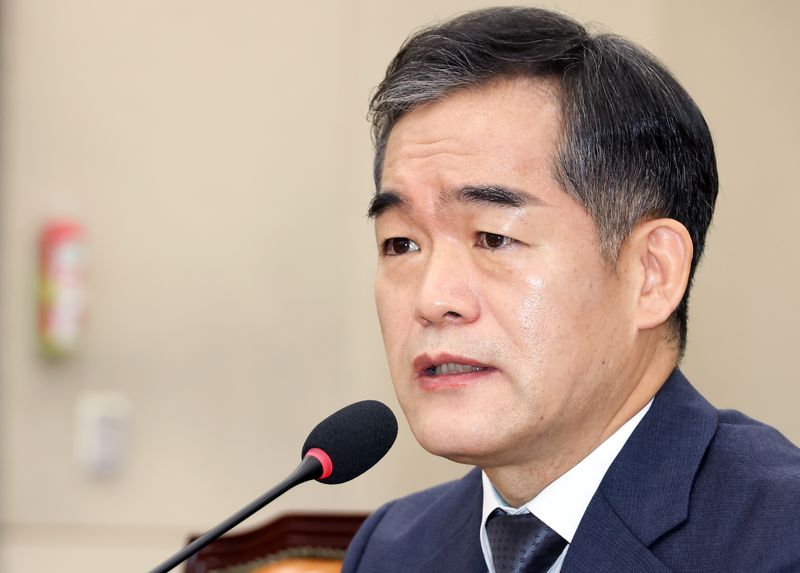
[Financial News] Kim Jongcheol, nominee to head the Korean National Police Agency, said police are investigating eight cases involving exam cheating using artificial intelligence (AI). Addressing allegations surrounding his family’s ownership of two redevelopment move-in rights, he denied using loopholes to secure additional housing rights but indicated that he would dispose of them promptly. The political neutrality of the police, in light of his attendance at State Council meetings chaired by the president, also emerged as a key issue at the confirmation hearing.
At a confirmation hearing held by the National Assembly’s Public Administration and Security Committee on the 18th, Kim responded to a question from People Power Party lawmaker Park Sang-ung about reports of and investigations into exam cheating using AI. “A total of 14 cases have been reported so far, and eight of them are currently under investigation,” he said.
However, no cases involving specific cheating or signs of equipment use related to the 2027 College Scholastic Ability Test (CSAT) are currently under investigation, according to the information available. Kim said that if cheating occurs on the CSAT, police would investigate not only those directly involved but also accomplices and helpers, as well as the manufacture, sale and distribution of related equipment. He added, “The National Office of Investigation (NOI) and each provincial and metropolitan police agency are operating task forces on exam cheating,” and pledged to “maintain a standing response system for various qualification exams as well as the CSAT.”
He said that in connection with allegations that the top scorer on the tax accountant exam cheated using AI, police questioned the suspect from the previous morning until late at night. He added that they would examine the entire case, including the circumstances of the suspect’s voluntary surrender and whether there were any accomplices, to ensure no questions remained.
Scrutiny also continued over how his wealth was accumulated. People Power Party lawmakers Kang Myung-gu and Seo Myeong-ok questioned how Kim’s family came to hold two redevelopment move-in rights in the Sangdaewon 2 District of Seongnam, Gyeonggi Province, as well as the inheritance shares involved.
Kim said, “I do not agree with the claim that this was a loophole to secure additional housing rights,” while acknowledging that “the outcome could leave room for misunderstanding.” He added, “As a candidate for high public office, I recognize that one household owning two homes does not meet the public’s expectations,” and pledged to consult with his older sister and dispose of the rights as soon as possible.
Kang, in particular, raised the possibility of a conflict of interest, pointing out that a motion on whether to reaffirm the appointment of the redevelopment association’s chair—who was under investigation on suspicion of bribery—had been considered at an extraordinary general meeting of the association for the redevelopment property in which Kim holds a 90% stake. Kim responded, “I don’t believe this falls under conflict-of-interest prevention,” but said he would review the relevant rules and check whether any measures were needed.
Political neutrality was also called into question. People Power Party lawmakers Park Sang-ung and Joo Ho-young, among others, noted that Kim had attended several State Council meetings chaired by the president while serving as acting head of the Korean National Police Agency, and voiced concern that the independence of investigations could be undermined.
Kim responded, “There are many areas of police work, such as tackling voice phishing, where police efforts alone have limits in eradicating the problem,” explaining the need for cooperation among relevant agencies. He also noted that he had personally briefed the State Council on police preparations for the reform of the criminal justice system and the direction of police reform. However, he did not say definitively whether he would stop attending future State Council meetings, answering instead, “I will carry out related duties fairly and objectively, with principle, in accordance with the law and my conscience.”
Ways to strengthen police investigative capabilities in response to the reform of the criminal justice system were also discussed. In response to a question from Democratic Party of Korea (DPK) lawmaker Lee Gwang-hui, Kim said, “We plan to recruit one outside legal expert per police station through an open hiring process.” When DPK lawmaker Lee Hae-sik raised the issue of reallocating personnel within the police, Kim said, “There are clear limits to simply reallocating existing staff,” adding, “We will assess staffing needs by function through an organizational review and actively consult with relevant ministries to secure a net increase in personnel.”
The transfer of cases between the Serious Crimes Investigation Agency and the police was also raised. When People Power Party lawmaker Jin Jong-oh criticized what he called “case ping-pong” between investigative agencies, Kim said, “I do not agree with the term ‘ping-pong,’” adding, “Until the Serious Crimes Investigation Agency requests a transfer, the police handle cases with a sense of responsibility.”
In his opening remarks that day, Kim said, “I will use multiple layers of transparent and robust review mechanisms to prevent cases from being buried or investigations from being unfair in the first place,” and pledged, “I will take an open-minded and active part in discussions on institutional reforms to disperse and oversee police powers.”
[email protected] Kim Ye-ji Reporter