“Head Throbbing Before Even Getting the Exam Paper”... Learn Acupressure Techniques to Ease Test-Taker Tension [Health Talk]
- Input
- 2026-11-18 11:18:58
- Updated
- 2026-11-18 11:18:58
“The CSAT is a day when psychological tension is concentrated among test-takers and physical fatigue among proctors,” said Lee Jin-ho, director of Jaseng Hospital of Korean Medicine. “Test-takers should get enough sleep, maintain their usual daily routines and pay attention to managing their condition. Proctors, too, should not dismiss persistent back or leg pain after the exam and should seek appropriate treatment.”
For a throbbing head, Baihui; for an upset stomach, Hegu... pack your lunch as usual
One of the most common symptoms test-takers experience is a tension headache. As anxiety and stress about the exam build, the muscles around the neck, shoulders and scalp can tense up and become more sensitive to pain, causing a tight, squeezing headache. The pain is typically a dull ache on both sides of the head or stiffness in the back of the neck. If test-takers sleep poorly the night before the exam, lack of sleep and fatigue can make the headache worse.
When tension reaches its peak, the stomach can easily be affected, too. The brain and gut are closely connected through the autonomic nervous system and hormones. As exam stress intensifies, changes in this interaction can alter stomach movement or make the intestines more sensitive. As a result, even test-takers who normally have no digestive problems may suddenly feel bloated or experience abdominal pain or diarrhea just before the exam. Korean medicine holds that excessive tension can block the flow of qi and affect the function of the spleen and stomach, causing indigestion.
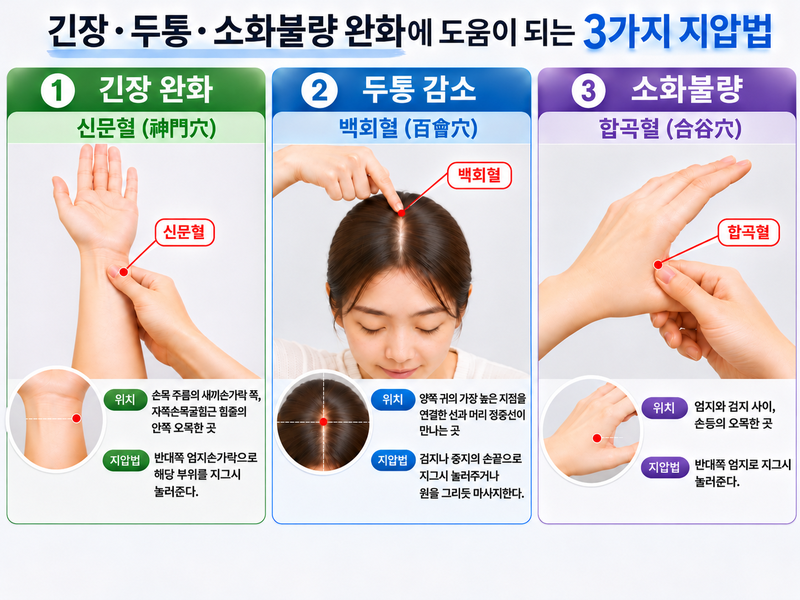
In these situations, acupressure techniques that are easy to follow at the test site can help. For severe tension and anxiety, press Shenmen, located at the little-finger end of the wrist crease. Using the thumb of the opposite hand, press gently but firmly for 3 to 5 seconds, then release; repeat 5 to 10 times. Exhaling slowly while pressing may enhance the effect.
For a headache, you can also apply acupressure to Baihui at the center of the crown. Baihui is where the line connecting the tips of both ears meets the midline running from the nose up over the head. Bring the tips of your index and middle fingers together and press lightly, or rub in small circles for about 30 seconds to help clear your head.
If your stomach feels bloated or you have indigestion, you can try pressing Hegu. It is on the back of the hand between the thumb and index finger, slightly ahead of the point where the two bones meet. With the thumb of your opposite hand, press Hegu on the back of the hand while supporting the palm side with your index finger, as if holding the area between them. Repeat this several times, pressing for 5 seconds each time until you feel a slight ache.
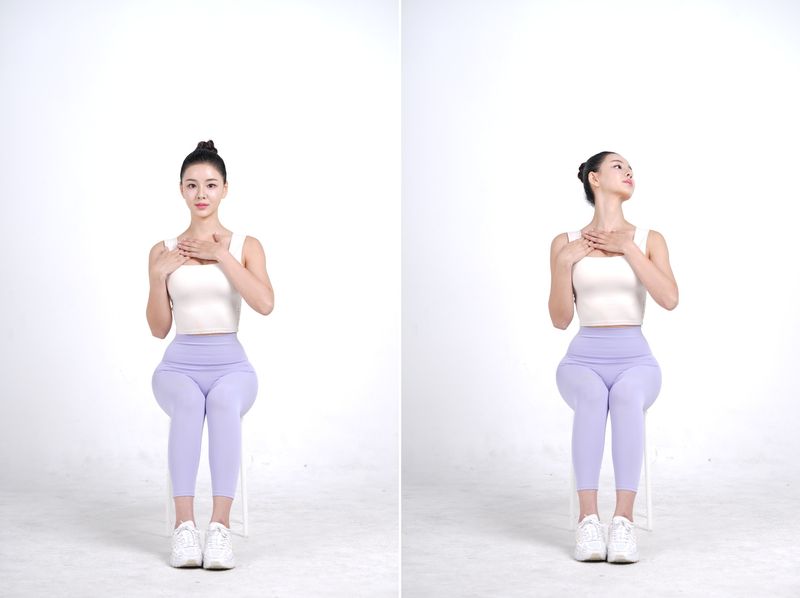
Stretching during breaks is also a good way to loosen the neck and shoulders, which can stiffen from tension. One easy exercise to do while seated is the “scalene muscle relaxation stretch.” The scalenes are muscles on either side of the neck that extend from the cervical vertebrae to the first and second ribs beneath the collarbone. They can easily tighten when you are tense or study for a long time with your head bent forward. This stretch may loosen tight muscles around the neck and help reduce stiffness in the neck and shoulders.
First, place one hand over the other on your right collarbone and hold them there. Exhale slowly and turn your head to the left, then tilt it back so that your collarbone and chin move farther apart. Keep the collarbone fixed, feel the muscle stretch, and hold the position for 15 seconds. Repeat the movement three times, then do the same on the other side.
If you tend to feel excessively nervous before exams, you could consider taking Woohwang Cheongsimwon. It is used to reduce heat and calm the mind, helping ease a racing heart. If you have tried it in advance, such as during a practice exam, and confirmed that it suits you, it is best to take it about an hour before the test. However, it may not suit everyone and can cause drowsiness, so if you have never taken it before, it is safer to take the exam in your usual condition rather than try it for the first time on CSAT day.
Given that tension can make the stomach more sensitive, what you eat on exam day is another important factor affecting your condition. But as the CSAT approaches, food-related superstitions inevitably appear at test-takers’ tables. Some avoid wakame soup because they believe it will make them “slip” on the exam, while taffy or glutinous rice cakes are often given as gifts to wish them success. These long-standing beliefs should be viewed differently from a nutritional perspective.
Wakame is a food ingredient containing a range of nutrients, including magnesium, iodine, iron and dietary fiber. Magnesium helps calm nerve activity and relax muscles. Iodine and iron support the body’s energy metabolism and help reduce fatigue, while alginate, a slippery, water-soluble dietary fiber, helps prevent sharp increases in blood sugar and maintain steady energy levels.
By contrast, taffy and glutinous rice cakes, eaten to wish test-takers success, can actually harm their condition if they have too much. Taffy is high in sugar, and eating a large amount at once can cause blood sugar to rise and fall sharply, potentially making test-takers drowsy during the exam. Glutinous rice is very sticky and can burden digestion if overeaten.
For that reason, it is best to pack a CSAT-day lunch with foods you are used to eating. A meal of warm rice with mild protein side dishes such as rolled omelet, beef bulgogi, grilled fish or braised tofu, along with cooked vegetables, can be filling while still being easy on the stomach. You can also bring radish soup or a clear doenjang (soybean paste) soup in a thermos. Avoid overly greasy or strongly seasoned foods, which can burden digestion.
Proctors on Their Feet All Day Should Ease Strain on Their Back and Legs With Heel Raises
Test-takers are not the only ones whose bodies are taxed on CSAT day. Proctors who staff the test sites also have to get through a long day. Proctoring the CSAT is considered one of the most dreaded assignments among teachers. They have to monitor cheating and supervise test-takers from the start of the exam to the end, and complaints can be lodged over even minor noises or movements.
The problem is that simply standing in the same position for a long time can put considerable strain on the lower back. The erector spinae muscles around the lower back support the spine and keep the body upright. But when you hold one position without moving, these muscles become fatigued. Unable to support the spine properly, they leave the strain to be borne by the spinal joints and discs. Proctors with a herniated disc or spinal canal stenosis should take extra care, as their symptoms may worsen.
The legs are affected, too. The calf muscles repeatedly contract and relax to push venous blood up toward the heart. When you stand for a long time, this action decreases and blood pools in the legs. This can cause the legs to swell or feel heavy, and in the long term may increase the risk of varicose veins.
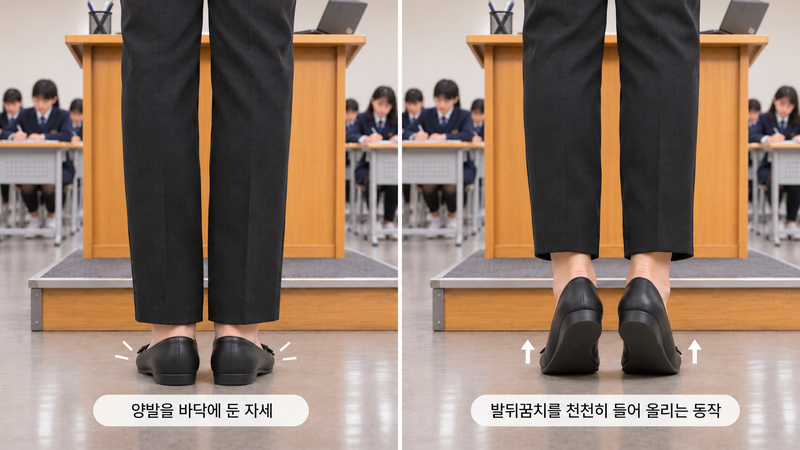
While proctoring, it is a good idea to change your posture from time to time, as long as you do not distract test-takers. Alternating your weight between your feet or slowly raising your heels can help reduce the strain on your lower back and calf muscles. During breaks, take a light walk or loosen up your leg muscles. If your legs often swell, wearing compression stockings may also help improve circulation.
If back pain continues after proctoring, it is best to get an accurate diagnosis and appropriate treatment. Treatment for back pain varies depending on its cause and symptoms. In Korean medicine, related conditions are treated with integrative care that combines acupuncture, pharmacopuncture and Chuna manual therapy.
Several studies have confirmed the effectiveness of Korean medicine integrative treatment for back pain. According to a paper published by Jaseng Hospital of Korean Medicine in the SCI(E)-indexed international journal Journal of Clinical Medicine, Korean medicine integrative treatment produced greater pain relief than conventional medication in patients with severe herniated discs. The treatment group’s Numeric Rating Scale (NRS) pain score, measured from 0 to 10, fell from 6.25 before treatment to 2.45 afterward, while the score in the conventional medication group decreased only from 6.65 to 4.33.
[email protected] Medical correspondent Jeong Myeong-jin Reporter