“2027 Shareholders’ Meetings: Start by Revising the Articles of Incorporation” ... Companies Scramble to Respond to Commercial Act Amendments
- Input
- 2026-11-18 11:09:07
- Updated
- 2026-11-18 11:09:07
[Financial News] As changes to corporate governance resulting from amendments to the Commercial Act gather pace, listed companies are also accelerating preparations for next year’s annual shareholders’ meetings. The need to respond to changes in cumulative voting and the appointment of audit committee members, while also reviewing in advance the legal and practical risks that may arise in operating electronic shareholders’ meetings, has been highlighted.
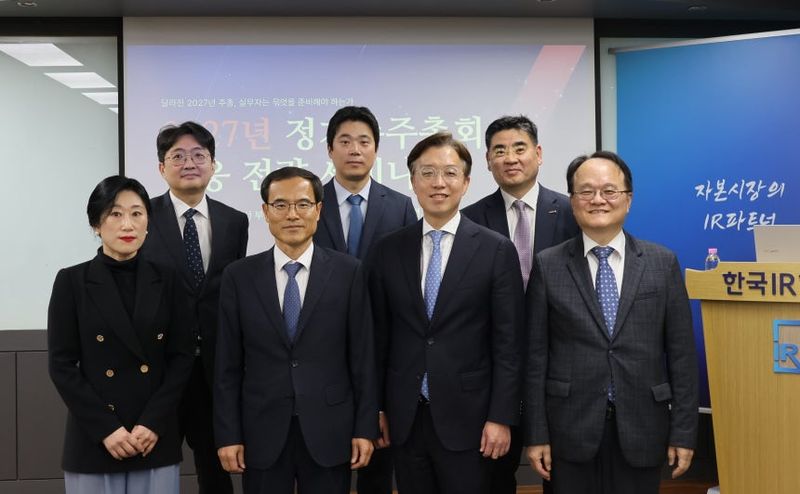
Legal sources said on the 18th that Barun Law LLC held the “2027 Regular Shareholders’ Meeting Strategy Seminar” the previous day in Yeouido, Seoul, jointly with Botu Lab and Korea Proxy Advisory. About 100 people, including investor relations (IR), disclosure and legal staff from listed companies, attended the event to discuss how to conduct shareholders’ meetings under the amended laws and regulations.
Updating the articles of incorporation was identified as a key task. Jin Seong-hun, head of the Research and Policy Group at KOSDAQ Listed Companies Association, outlined major changes to the Commercial Act and the Capital Markets Act and stressed that listed companies should start by reviewing their articles of incorporation.
In particular, the duty of loyalty of directors should not be assessed simply by whether dividends are increased or treasury shares are canceled, it was explained. The key is whether the board sufficiently considered the interests of all shareholders in its decision-making. It was noted that even if a company does not pay dividends, it is important to ensure the legitimacy of its decisions, for example by explaining reasonable grounds and alternatives at the shareholders’ meeting.
Caution was also urged over the procedure for appointing audit committee members. With a rule in place that caps the combined voting rights of the largest shareholder and specially related parties at 3%, the existing controlling shareholders’ influence could decline during the appointment process.
Strategies for communicating with institutional investors were also a key topic. Jeong Seok-ho, CEO of Korea Proxy Advisory (KORPA), said that under the Stewardship Code, revised last July, institutional investors’ stewardship responsibilities had expanded beyond shares to include bonds, real estate and infrastructure. As the code explicitly identifies financially material environmental, social and governance (ESG) factors, companies also need to review how they communicate with investors.
The meeting also discussed restrictions on voting rights regarding resolutions to approve limits on directors’ compensation. Han Tae-young, an attorney at Barun, cited a Supreme Court ruling from this year, explaining that a person who is both a shareholder and a director has a special interest in a resolution on a directors’ compensation limit that includes them, and therefore cannot vote on it. The shares in question are also excluded when calculating the quorum for the relevant resolution.
However, whether the restriction also applies to relatives of a shareholder who is a director or to corporations controlled by that shareholder requires a separate determination. The explanation was that lower courts do not recognize voting restrictions when the special interest is not objectively clear.
The need to manage technological risks associated with introducing electronic shareholders’ meetings was also emphasized. Kwon Jae-yeol, a professor at Kyung Hee University School of Law, proposed that operating rules clearly specify procedures for handling unexpected situations, such as connection failures or identity verification errors, and identify who is responsible.
Oh Yu-mi, a director at Botu Lab, advised companies to focus not only on securing votes but also on clearly communicating the purpose and expected effects of agenda items to shareholders. She added that clearly explaining how to exercise voting rights is also an important part of preparing for a shareholders’ meeting.
Through the seminar, Barun shared the legal challenges companies face in responding to the amended Commercial Act and practical considerations for holding shareholders’ meetings.
[email protected] Yu Seon-jun Reporter