"8 in 10 Koreans Head to the Forest"... Satisfaction at 89.6%, Spending 196,000 Won per Night
- Input
- 2026-11-18 10:51:39
- Updated
- 2026-11-18 10:51:39
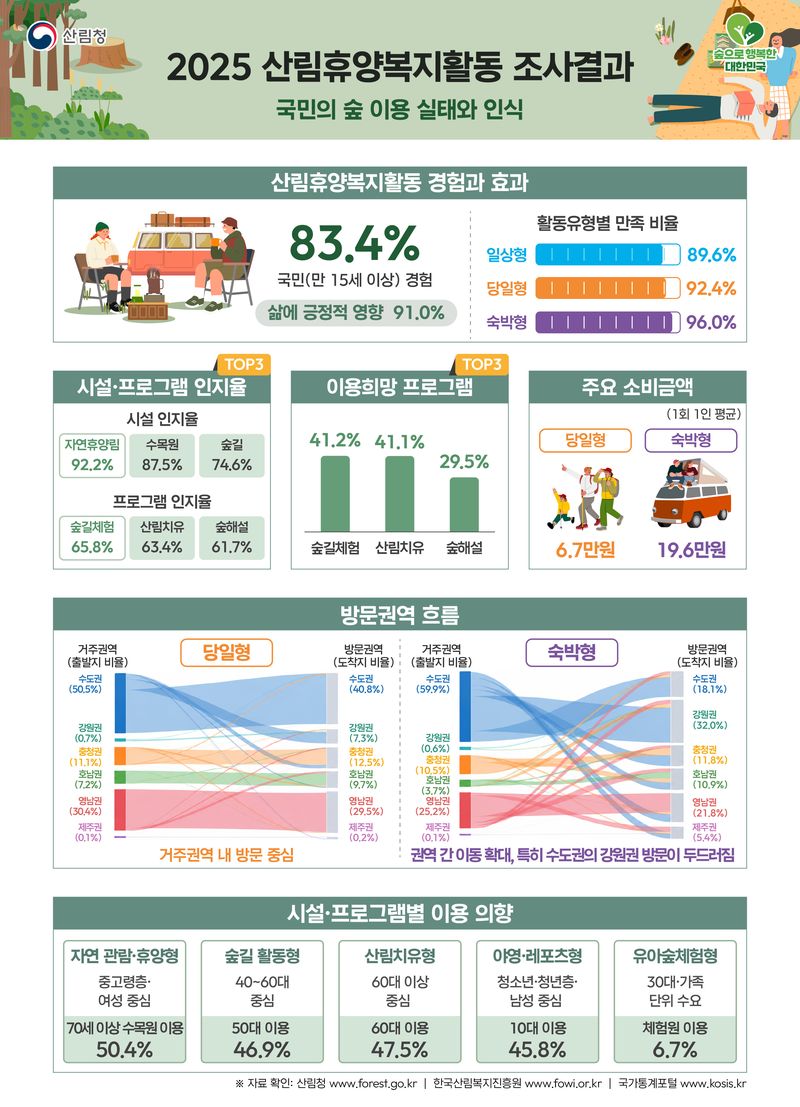
KFS announced the results of its 2025 Survey on Forest Recreation and Welfare Activities on the 18th. The survey covered 5,000 households and approximately 11,000 people nationwide. According to the findings, 83.4% of people aged 15 and over had engaged in forest recreation and welfare activities last year. The overall participation rate fell by 4.5 percentage points from the previous year (87.9%), but user satisfaction was very high. At least 89.6% of participants said they were satisfied with the activities. By type, satisfaction was 96.0% for overnight activities, 92.4% for day trips and 89.6% for everyday activities, with satisfaction rising as the length of stay increased. Some 91.0% of respondents said activities in forests had a positive effect on their lives.
Travel patterns and spending also differed markedly by type of activity. Day trips were mostly within the participants’ residential regions, while a greater share of overnight activities involved travel to other regions. In particular, about 45% of residents of the Seoul metropolitan area chose Gangwon State as their destination for overnight forest recreation, indicating a pronounced concentration there. Average spending per person per visit was 67,000 won for day trips and 196,000 won for overnight activities.
Awareness of facilities was highest for natural recreational forests (92.2%), arboreta (87.5%) and forest trails (74.6%), in that order. Among programs, the “forest trail experience program” (65.8%) was the best known. The programs respondents most wanted to use in the future were “forest trail experiences” (41.2%) and “forest therapy” (41.1%), which ranked first and second, respectively.
Preferences also varied clearly by age group and gender. Facilities for sightseeing and recreation, such as natural recreational forests and arboreta, were more popular among middle-aged and older adults and women. Demand for forest trails was especially strong among people in their 40s to 60s, while forest therapy drew particular interest from people aged 60 and over who prioritize health management and recovery. By contrast, camping and leisure sports were preferred by young people in their teens and 20s and by men, while forest-experience programs for young children attracted strong interest from family visitors in their 30s.
The findings show that public demand for forest visits is evolving beyond simple hikes and one-off outings toward “stay-based healing tourism” focused on relieving mental stress and promoting wellness. In particular, the fact that average spending per person on overnight forest recreation is nearing 200,000 won suggests that forest welfare infrastructure is becoming a key driver of domestic economic activity in mountain villages and non-metropolitan regions struggling with population decline and an economic downturn.
“The way people visit forests is shifting from casual walks in everyday life to taking time out to stay and rest,” said Cho Young-hee, director general of forest welfare at KFS. “We will reflect the findings of this survey in our policies and provide high-quality forest welfare services that meet the public’s expectations.” The survey results are available on the websites of KFS and the Korea Forest Welfare Institute, as well as on the Korean Statistical Information Service (KOSIS).
[email protected] Kim Won-jun Reporter