Nuri (KSLV-II)'s Fifth Launch: 'Current Error' Identified as Cause of Satellite's Failure to Eject... Electrical Signal System to Be Upgraded
- Input
- 2026-11-18 17:00:00
- Updated
- 2026-11-18 17:00:01
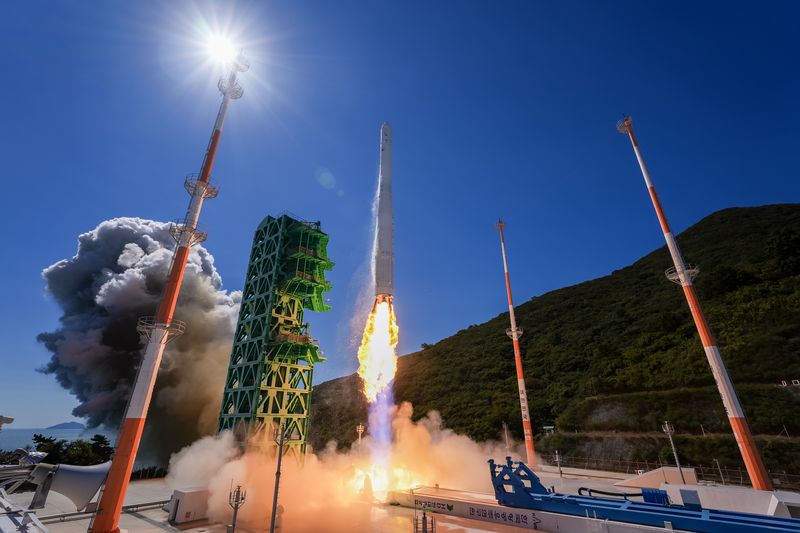
[Financial News] The cause of the failure to deploy one CubeSat, 'Quaternion Persat-2,' during Nuri (KSLV-II)'s fifth launch was identified as a lack of current to the motor that opens the deployment tube's cover. For the sixth launch, plans call for measures such as redundant electrical signals to improve the reliability of CubeSat deployment.
The Korea AeroSpace Administration and the Korea Aerospace Research Institute said they held the 'Nuri (KSLV-II) Fifth Launch Results Review Meeting' at the institute in Daejeon on the 18th and discussed these matters. At the meeting, they reviewed overall operational results and key technical issues from Nuri (KSLV-II)'s fifth launch, and discussed analysis of the cause of the CubeSat deployment failure and measures to improve reliability.
Launched successfully on the 7th of last month, Nuri (KSLV-II)'s fifth launch vehicle carried a total of 15 satellites, including five ultra-small cluster satellites and 10 CubeSats. Nuri (KSLV-II) carried out key flight procedures at their pre-set times after lifting off on schedule, including first-stage separation and second-stage ignition, fairing separation, and second-stage separation and third-stage ignition. It was ultimately determined that the vehicle then entered its target orbit and separated the ultra-small cluster satellites and CubeSats according to the planned sequence and timing.
Of the 10 CubeSats on this launch, nine were deployed normally, while the one named Quaternion Persat-2 was not. The analysis found that the deployment command was properly issued from the launch vehicle's upper stage, but the motor that opens the deployment tube's cover did not operate because no deployment actuation current flowed. However, insufficient telemetry signals made it impossible to determine whether the current failed to flow because of a problem in signal transmission from the launch vehicle to the deployment tube or because of a mechanical defect in the tube.
The Korea Aerospace Research Institute plans to strengthen pre-launch inspections of deployment-related components and their operating status to prevent similar cases from recurring, and to prepare supplementary measures, including improvements to redundancy in the electrical signal system, to increase the reliability of CubeSat deployment. These measures will be applied to the next launch.
Korea AeroSpace Administration Commissioner Oh Tae-seok said, "The fifth launch achieved multiple deployments of ultra-small cluster satellites and an on-time launch, while also identifying areas for improvement related to the CubeSat that failed to deploy." He added, "The Korea AeroSpace Administration, the Korea Aerospace Research Institute and the system integrator will share launch experience and technical expertise, address the improvements identified, and continue to enhance reliability."
Meanwhile, Hanwha Aerospace, the system integrator for Nuri (KSLV-II), also attended the meeting, following its participation in last year's review meeting for the fourth launch, and shared technical knowledge and operational experience accumulated during the launch process. The meeting was seen as an opportunity for the private company to deepen its understanding of launch operations as a whole.
[email protected] Yeon Ji-an Reporter