“This Is a Text Alert to Prevent Cheating on the College Scholastic Ability Test (CSAT)”... First Alarm Will Sound at 8:30 a.m. on the 19th
- Input
- 2026-11-18 10:25:24
- Updated
- 2026-11-18 10:25:24
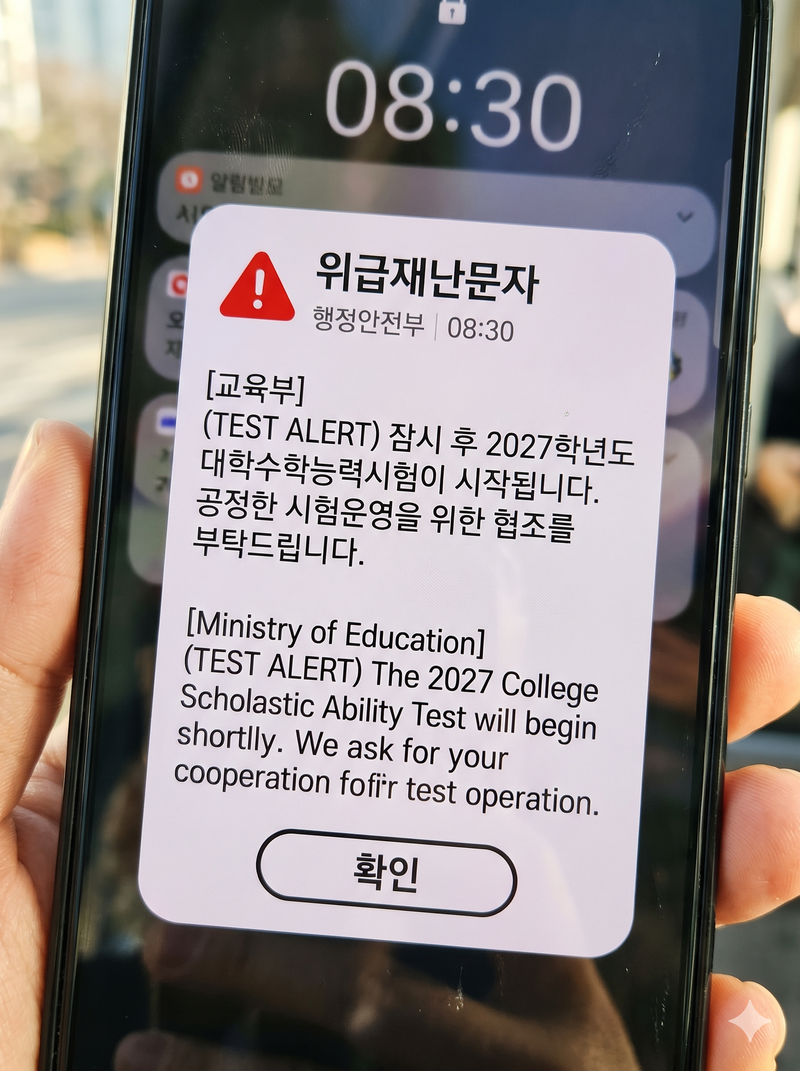
[Financial News] The Ministry of Education and the Ministry of the Interior and Safety said on the 18th that they would send an initial emergency alert nationwide at 8:30 a.m. on the 19th, the day of the 2027 College Scholastic Ability Test (CSAT), and send additional alerts without prior notice afterward.
The measure is intended to prevent in advance and catch cheating involving the use of AI through micro-cameras and smart devices, which has recently become an issue in exams such as the certified tax accountant exam, so that it does not occur on the CSAT. The first alert will read: “(TEST ALERT) The 2027 College Scholastic Ability Test (CSAT) will begin shortly. Please cooperate to ensure the fair administration of the test. [Ministry of Education]” The additional alert will read: “(TEST ALERT) This is a text alert to prevent cheating on the CSAT. Please do not be alarmed and continue with your daily activities. [Ministry of Education]”
Under the Standards and Operating Regulations for Disaster Alert Broadcasting, emergency alerts cannot be opted out of, and every mobile phone that is switched on will sound an alert for 10.5 seconds at a maximum volume of at least 40 dB. The government plans to take steps to ensure that invigilators’ phones do not sound emergency alerts at test centers, so that the proper administration of the exam for candidates inside is not disrupted.
Even if they have not used an electronic device at the test center, candidates will be immediately deemed to have cheated and barred from taking the test if they carry a smartphone or other smart device or keep one in their bag.
The emergency alert will be sent not only to candidates but also to the mobile phones of everyone nationwide and foreign nationals staying in the country. It will also be sent in English so foreign nationals can understand it, and will be available through the Emergency Ready App, a disaster and safety app for foreign nationals. Since the alert does not signal an actual disaster, no separate action such as evacuation is necessary even if people receive it. However, multiple phones may sound at once on public transit during the morning commute, at workplaces and in vehicles on the road, so the government asked for the public’s understanding in advance and urged people, especially those driving, not to be startled by the alert. To ease public inconvenience caused by the alerts, the government plans to strengthen advance publicity through TV caption broadcasts, disaster alert display boards and safety guidance text messages.
Education Minister Choi Kyo-jin said, “As emergency alerts are being sent to ensure the fairness of the College Scholastic Ability Test, all candidates who bring electronic devices into the test center must turn them off and hand them to an invigilator before the first test session begins,” and added, “Please check once again before the test to ensure that no one suffers unintended harm.” Interior and Safety Minister Yun Ho-jung also said, “Cheating using AI can undermine the foundation of fair competition and erode social trust, so a strong response is needed,” and added, “We ask the public for your understanding and cooperation regarding the emergency alerts, even if they inconvenience your daily lives, so that all candidates can take the CSAT in a fair environment.”
President Lee Jae-myung said in a social media post that day, “I reviewed the strengthened preventive measures and post-incident response measures at a video conference on emergency measures against admissions cheating using advanced technology,” and announced that he had ordered three additional measures.
President Lee additionally instructed officials to consider sending the highest-level disaster alerts—which sound even when the volume is turned down or muted—not only immediately before the exam but repeatedly during it as well. In addition to the plan to obtain from AI companies all cases in which users photographed exam papers and asked questions during test hours, he also ordered the drafting of legislation requiring the companies to submit, upon government request, cases involving unlawful requests for answers to exam questions.
As a post-incident response measure, he ordered the introduction of a system that would award at least 100 million won for each reported case of admissions cheating using advanced equipment, with the reward increased based on the number of people involved, and reduce penalties and sanctions for informants who report jointly committed cheating. President Lee said that asking AI for an answer and submitting it constitutes either obstruction of official duties or interference with business, both punishable by up to five years in prison, and indicated that measures revised and supplemented beyond those cited would be announced.
Earlier, in a public address on the 17th, the government announced plans to extend the period during which people who cheat on this year’s CSAT are barred from taking the exam from one year to 10 years, and to prohibit them from entering university for 10 years. It also said it would step up on-site checks, including requiring candidates to store their bags in the hallway outside classrooms and placing stickers on clothing buttons, deploy about 8,400 additional personnel, and work with global Big Tech companies and others to trace cheating after the fact.
[email protected] Kim Man-gi Reporter