Hyundai Engineering and Construction, Hyundai Steel Company Win Patent for HRT-Beam Composite Beam, Targeting Data Centers
- Input
- 2026-11-18 10:11:30
- Updated
- 2026-11-18 10:11:30
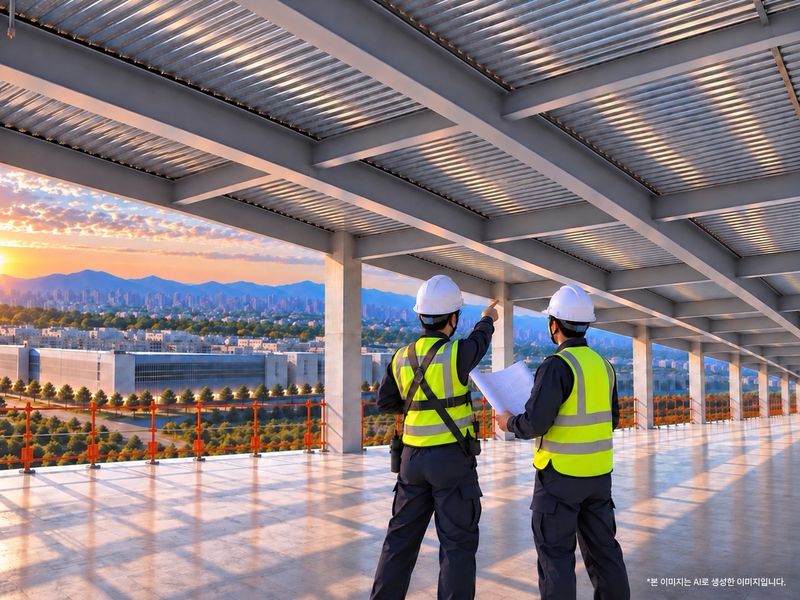
[Financial News] A composite-beam technology that can withstand heavier loads with fewer columns has emerged, targeting the data center market.
According to Hyundai Engineering and Construction on the 18th, the high-performance HRT-Beam composite beam it developed with Hyundai Steel Company has been patented, and a beam-column seismic connection technology using it has received technical certification from the Korean Society of Steel Construction. HRT-Beam is a composite beam that combines structural steel and concrete. Composite beams are used in large buildings that need to support heavy loads while spanning wide spaces between columns. As artificial intelligence (AI) expands, data centers are filling up with servers and power equipment, increasing the loads buildings must withstand. The company says HRT-Beam addresses this with a cross-sectional design that maximizes structural performance, whereas conventional composite beams require a larger cross-section or additional reinforcement when loads increase.
The key components are ribs on the inside of the steel plate and reinforcing bars. The ribs prevent the steel plate from bending, while the reinforcing bars help the steel and concrete move together as one. This enables the two materials to act together stably even under heavy bending and compressive loads. In an earthquake, the ribs and reinforcing bars absorb and distribute energy together, preventing sudden failure or excessive deformation.
The Korean Society of Steel Construction certified a seismic connection system combining HRT-Beam with steel-reinforced concrete (SRC) columns. Following performance verification, including full-scale seismic testing, the system was formally recognized for its structural safety and seismic performance. This means it has the reliability and basis for commercialization needed for use at actual construction sites.
The risks involved in construction have also been reduced. Less work is needed to install and dismantle shoring and formwork that support concrete until it hardens, reducing work at height and temporary construction work. Major components can be manufactured in factories, improving on-site quality and production efficiency.
Hyundai Engineering and Construction is expanding the use of factory fabrication in data center construction. The dedicated AI data center in Pohang, Gyeongsangbuk-do, which broke ground last September, will have a power density about 10 times that of a typical data center and a water-cooling system. At the site, the entire concrete structure, including slabs, walls and stairs, was built using precast (PC) construction, cutting structural-frame work that used to take about a year to two months. In March last year, the company became the first construction firm to receive certification from the Korean Society of Building Structural Engineers for a residential PC moment-frame beam-column connection technology.
The HMG Construction Technology Research Institute, which led the development of HRT-Beam, is an integrated research organization launched last June by combining the Hyundai Engineering and Construction Research Institute and Hyundai Engineering Co., Ltd.’s Future Technology Promotion Group. With more than 200 staff, it is the largest research organization among Korean construction companies and is expanding its off-site construction (OSC) technologies, including precast concrete (PC) moment-frame systems and structural wall systems.
A representative of the HMG Construction Technology Research Institute said, “HRT-Beam is a composite structural solution developed by combining the steel and structural engineering expertise of Hyundai Engineering and Construction and Hyundai Steel Company. By securing a patent and technical certification, we have built technological competitiveness across the entire lifecycle, from technology development through design, fabrication and construction. Building on the specialized capabilities of both companies, we will continue to advance structural solutions for high-performance buildings such as data centers and secure differentiated business competitiveness through synergies between construction and materials technologies.”
[email protected] Jeong Gyeong-su Reporter