"Is Fixing the Crooked Toe All It Takes?"... Callus Location on the Sole Matters, Too [Health Check]
- Input
- 2026-11-18 09:44:48
- Updated
- 2026-11-18 09:44:48
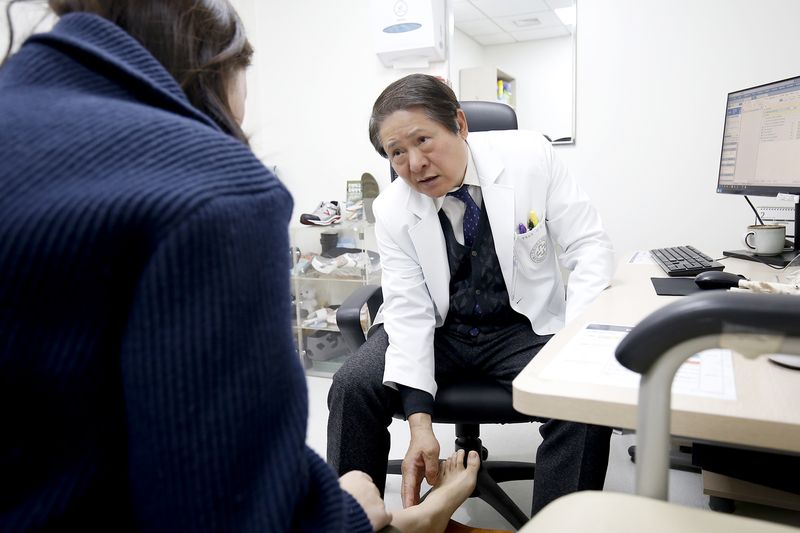
[Financial News] The disappearance of plantar calluses after hallux valgus surgery does not mean the problem is solved. Changes in how weight is distributed across the forefoot can lead to new calluses or pain in other areas. A study has found that surgeons should consider not only the crooked toe but also the location of calluses and how weight is borne when choosing a surgical method.
A team of professors Seo Jin-su and Choi Jun-young from the Department of Orthopedic Surgery at Inje University Ilsan Paik Hospital analyzed the outcomes of surgery for plantar calluses (plantar keratosis) accompanying hallux valgus and compared two surgical methods. Their study was published in the SCI-indexed journal Clinical Orthopaedics and Related Research (impact factor: 4.4).
Hallux valgus is a condition in which the big toe bends outward and the joint on its inner side protrudes. It affects not only the shape of the toes but also how weight is distributed across the forefoot. As weight that should be borne by the big toe shifts to the other toes, a callus can form on the sole beneath the second toe and cause pain.
Such calluses may be a sign not simply of thickened skin but of repeated pressure on a particular area. Shaving down the callus alone is unlikely to address the underlying problem; treatment should also take into account the alignment and height of the metatarsals and where weight is borne.
Lowering or shortening a metatarsal ... callus improvement rates of 87% and 90%
The research team analyzed medical records for 194 feet that underwent hallux valgus surgery between January 2017 and June 2024. Of these, they compared the treatment outcomes of two surgical methods in 72 of the 81 feet with painful calluses beneath the second toe that could be followed for at least one year.
The two methods compared were lowering the height of the first metatarsal (the height-adjustment group) and shortening the second metatarsal (the shortening group). Height-adjustment surgery corrects the hallux valgus while lowering the position of the first metatarsal, which connects to the big toe, thereby changing how weight is distributed across the forefoot. Shortening surgery corrects the hallux valgus while also shortening the second metatarsal, where the callus formed, to reduce pressure concentrated in that area.
Both surgical methods were effective in improving plantar calluses. After surgery, calluses disappeared in 26 of 30 feet (87%) in the height-adjustment group and 38 of 42 feet (91%) in the shortening group. The difference in improvement rates between the groups was not statistically significant, so neither method could be considered superior.
Locations of new calluses and pain vary by surgical method
However, the methods differed in how the heights of the bones in the forefoot changed and where postoperative discomfort occurred. In the height-adjustment group, the second and third metatarsals both became relatively higher. In the shortening group, the second metatarsal became higher, while the third became relatively lower.
These changes were also related to where new calluses or pain developed after surgery. In the shortening group, 4 of 42 feet (10%) developed a new callus beneath the third toe. In the height-adjustment group, 5 of 30 feet (17%) experienced pain on the sole beneath the big toe.
Both groups also showed improved function after surgery on the FAAM (Foot and Ankle Ability Measure), a patient-reported measure of foot and ankle function. Scores for exercise and sports-related function improved more in the height-adjustment group, but there was no clear difference between the two methods in overall outcomes, including daily functioning.
The research team said the study shows that when treating hallux valgus and plantar calluses together, it is necessary to comprehensively assess the overall structure of the foot and how weight is distributed.
Professor Choi Jun-young said, “Plantar calluses accompanying hallux valgus often develop because weight is not evenly distributed across the forefoot. Rather than deciding on a surgical method based only on the location of the callus, the length and height of the metatarsals, the overall alignment of the foot, and how weight is borne while walking should all be assessed comprehensively.”
Professor Seo Jin-su emphasized, “Both surgical methods are effective in improving calluses, but the location of new pain or calluses after surgery may vary depending on the method. Since each patient’s foot structure and degree of deformity differ, it is important to consider the individual’s condition and choose the appropriate surgical method.”
[email protected] Medical Correspondent Jung Myung-jin Reporter