Citizen Survey Team Finds 4 Insect Species Unrecorded in Korea in Forests Near Residential Areas
- Input
- 2026-11-18 09:59:06
- Updated
- 2026-11-18 09:59:06
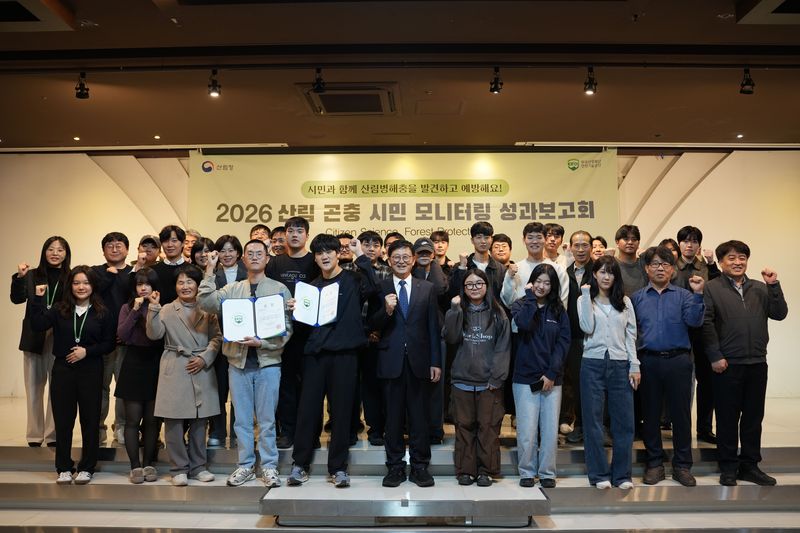
The Korea Forest Disaster Safety Technology Agency, a public institution under the Korea Forest Service, held the 2026 Forest Insect Citizen Monitoring Results Presentation at KW Convention in Daejeon on the 17th and announced that it had concluded the first cohort of Soopbom, its citizen-participation forest insect monitoring program. The event featured the sharing of key monitoring results and examples of outstanding work, as well as a special lecture on entomology and awards for 11 teams recognized for their outstanding activities.
Soopbom is a participatory program in which citizens observe insects in forests and near residential areas and collect information on their occurrence. This year, about 160 citizens selected from across the country used a nature observation platform over approximately five months, from June through October, to carefully record insect photos, observation locations and dates.
As a result, 26,873 observation records yielded a wealth of biodiversity information covering 3,267 species and 73,133 individual organisms. Among the many findings were four species not previously recorded in Korea with high academic value, six endangered wildlife species, 23 species on the National Red List, 41 species endemic to the Korean Peninsula and 17 climate-change bioindicator species. The project also gathered information on the occurrence of 16 alien and outbreak pest species that could disrupt ecosystems, building essential baseline data for the early detection and control of forest pests.
The citizen science model, in which members of the public without specialized training take part in scientific data collection, has recently drawn attention in the ecology and environmental fields as a key way to address the practical limits of professional survey teams. A small number of researchers face practical constraints in continuously surveying the extensive forests and urban green spaces across the country. Citizen monitoring groups spread throughout the country, however, can closely observe areas within their daily reach and quickly detect localized ecological changes or early signs of outbreak pests spreading—developments that administrative and academic surveys may easily miss.
“Field information recorded directly by citizens is a valuable foundation for conserving forest biodiversity and detecting pests and diseases early,” said Lee Im-young, the chairperson. “We will continue to expand citizen-participation monitoring and further strengthen our capacity to prevent forest disasters.”
[email protected] Kim Won-jun Reporter