71% of the Public Believe “Antibiotics Help With Colds”...A Misconception That Fuels Resistance
- Input
- 2026-11-18 12:00:00
- Updated
- 2026-11-18 12:00:04
[Financial News] If you have ever gone to a hospital with cold symptoms to ask for antibiotics, or left prescribed antibiotics unfinished because your symptoms improved, you should be cautious. If such habits build up, they can fuel “antibiotic resistance”—when medicine no longer works when it is actually needed.
The Korea Disease Control and Prevention Agency said on the 18th that it would run a campaign to prevent antibiotic resistance under the slogan “Proper Use Starts With Me, Resistance Prevention Is for All of Us!” to mark World Antimicrobial Resistance Awareness Week (November 18–24).
According to the “2026 Survey on Awareness of Antibiotic Resistance,” conducted online by the Korea Disease Control and Prevention Agency and the Ministry of Culture, Sports and Tourism’s Public Communication Office among 1,000 members of the public and 1,000 doctors, only 26.4% of members of the public correctly identified antibiotics as being used to treat bacterial infections. A further 71.4% mistakenly believed antibiotics help treat colds, while 66.2% had stopped taking prescribed antibiotics on their own after their symptoms improved.
Knowledge about antibiotic resistance was also lacking. Some 22.1% were unaware that antibiotics can also be present in foods such as meat and milk and in the living environment. Meanwhile, 39% did not know that antibiotic-resistant bacteria can spread from person to person.
WHO names antibiotic resistance one of its “top 10 public health threats”...people, animals and the environment must respond together
Antibiotic resistance is a phenomenon in which bacteria resist antibiotics, so the drugs no longer work effectively. If resistant bacteria increase because of inappropriate antibiotic use and other factors, infections become harder to treat, potentially having a serious impact on public health.
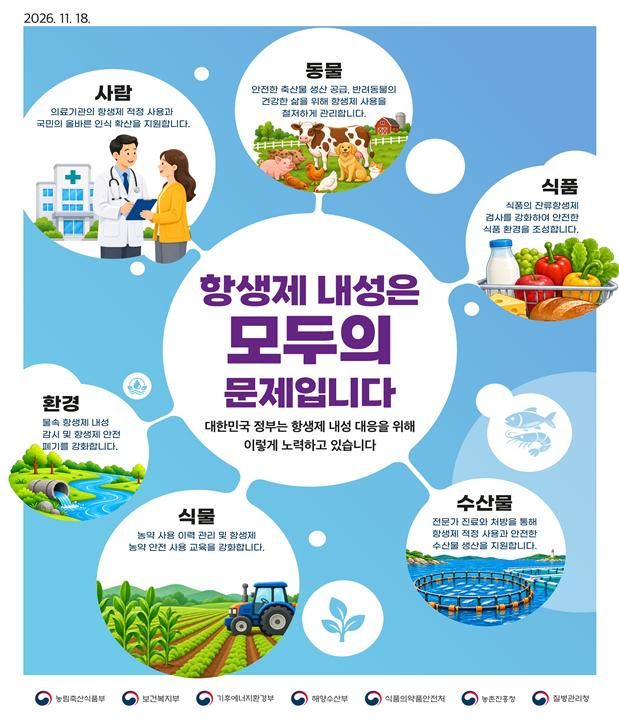
In 2019, the World Health Organization (WHO) named antibiotic resistance one of the top 10 public health threats facing humanity. It is also calling for joint action across sectors through the “One Health” approach, which recognizes that the health of people, animals, plants, food and the environment is interconnected. This year’s awareness week theme is also “One Health, one action: Prevent AMR now.”
Efforts to use antibiotics properly and prevent infections can reduce the risk of antibiotic resistance developing. It is therefore important to use antibiotics appropriately across multiple sectors—not only for people, but also for animals and plants—and to work together to prevent resistant bacteria from spreading through food and the environment.
Cross-ministerial posters to be distributed...pilot schools to be run at elementary schools
For this year’s awareness week, the Korea Disease Control and Prevention Agency is broadening its outreach from a One Health perspective and carrying out promotional and educational activities tailored to the needs of each sector.
First, it will jointly produce and distribute posters to prevent antibiotic resistance with the ministries involved in the “National Action Plan for Antibiotic Resistance Management (2026–2030)”: the Ministry of Agriculture, Food and Rural Affairs, the Ministry of Health and Welfare, the Ministry of Climate, Energy and Environment, the Ministry of Oceans and Fisheries, the Ministry of Food and Drug Safety, and the Rural Development Administration. The posters will carry the shared message, “Let’s work together to prevent the emergence and spread of resistance and build a healthy tomorrow.” They will also provide prevention guidelines tailored to different groups, including doctors, veterinarians, aquatic animal disease control professionals, workers in agriculture, livestock and fisheries, and consumers, highlighting the importance of a coordinated response across government agencies.
Posters, leaflets and banners will also be distributed to help the public follow prevention guidelines in their daily lives and enable healthcare institutions to use them. In particular, participating institutions in the pilot project for appropriate antibiotic use management will be encouraged to make active use of the materials for education and outreach to hospital staff, patients and caregivers. The agency also plans to ask relevant academic societies and associations to help publicize them. The materials are available on the Korea Disease Control and Prevention Agency’s official social media channels (SNS) and website.
In cooperation with the Ministry of Education and the school health teachers’ association, the agency will also send notices to families through elementary, middle and high schools nationwide. Five elementary schools in Seoul have been selected as pilot schools for antibiotic resistance prevention, where educational sessions and participatory activities will be held for students and teachers. The schools will also strengthen engagement with parents to encourage proper antibiotic use at home.
Korea Disease Control and Prevention Agency Commissioner Im Seung-kwan stressed, “Antibiotic resistance is a shared challenge that threatens people, animals, plants, food and the environment. To overcome it, attention, cooperation and active efforts from every member of society are essential.” He added, “I ask the public to use antibiotics properly, as prescribed, and only when they are truly necessary. The Korea Disease Control and Prevention Agency will also continue working with relevant agencies to prevent antibiotic resistance.”
[email protected] Jung Myung-jin, Medical Correspondent Reporter