SK Innovation Co., Ltd. Develops Catalyst to Produce Green Hydrogen, a Feedstock for e-SAF
- Input
- 2026-11-18 09:18:30
- Updated
- 2026-11-18 09:18:30
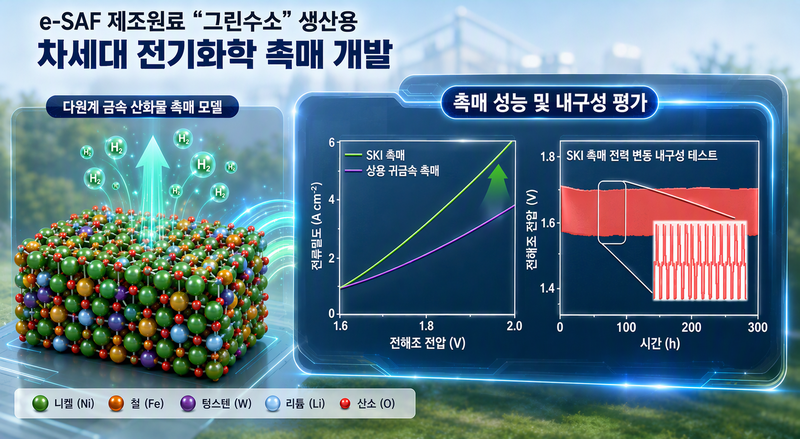
[Financial News] SK Innovation Co., Ltd. has developed water-electrolysis catalyst technology that can improve hydrogen production efficiency and catalyst durability even amid irregular power supply from renewable energy sources. The technology can be used to produce green hydrogen, a feedstock for next-generation sustainable aviation fuel (e-SAF).
SK Innovation Co., Ltd. announced on the 18th that research findings on water-electrolysis catalysts developed by the Environmental Science and Technology Institute were published in the Royal Society of Chemistry’s (RSC) international journal Journal of Materials Chemistry A.
Water electrolysis is a technology that uses electricity to split water into hydrogen and oxygen. When renewable energy sources such as solar and wind power are used to generate electricity, output can fluctuate, potentially reducing hydrogen production efficiency and catalyst durability.
SK Innovation Co., Ltd. researchers improved performance by adding a small amount of lithium (Li) to a nickel-iron-tungsten (Ni-Fe-W)-based catalyst. The approach increases oxygen reactivity inside the catalyst, and is designed to keep the catalyst structure stable even when the power supply fluctuates.
The newly developed catalyst can be used in the green hydrogen production process needed to manufacture e-SAF. e-SAF is synthetic aviation fuel made using green hydrogen produced with renewable energy and captured carbon dioxide. The carbon dioxide is converted into carbon monoxide, which is combined with hydrogen to produce syngas; the syngas then undergoes synthesis and purification.
SK Innovation Co., Ltd. said it had also secured patented technologies covering the entire manufacturing process, including water-electrolysis catalysts, carbon dioxide electrolysis, synthetic crude oil production, and e-SAF purification and conversion.
The International Air Transport Association (IATA) estimates that global sustainable aviation fuel (SAF) production will total about 2.4 million tonnes this year. That would represent 0.8% of total jet fuel consumption. IATA projects that the aviation industry will need an annual supply of about 500 million tonnes of SAF to meet its 2050 carbon-neutrality goal.
Philseok Kim, head of SK Innovation Co., Ltd.’s Environmental Science and Technology Institute, said, “We will continue to draw on our R&D capabilities in catalysis, processes, and synthesis to develop future clean-energy technologies and contribute to building the e-SAF ecosystem.”
[email protected] Kim Mi-hee Reporter