Ruling Party and Government Push to Move Korea Military Academy to Chungcheong ... Plan New Armed Forces Academy Main Campus in Daejeon
- Input
- 2026-11-18 09:15:59
- Updated
- 2026-11-18 09:15:59
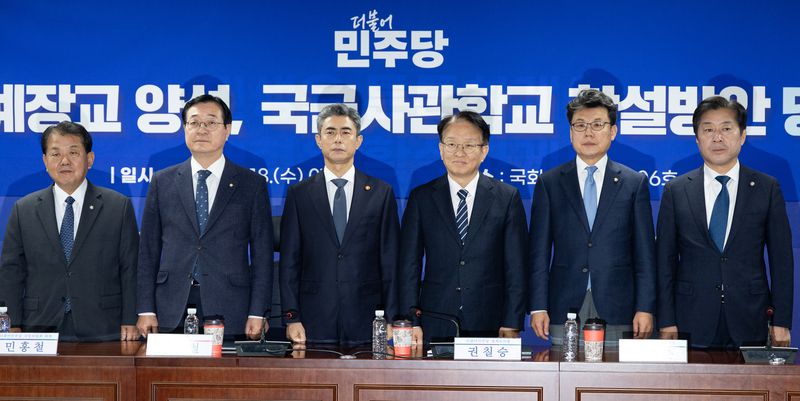
Democratic Party lawmaker Kim Byung-ju, a special adviser to the president on defense policy, told reporters after a party-government meeting at the National Assembly on the 18th to discuss plans for establishing an Armed Forces Academy to train future elite officers that a revised master plan for its creation had been discussed.
That day, the ruling party and government agreed to establish the Armed Forces Academy’s main campus, which will oversee integrated education, and a graduate school offering master’s programs in fields such as science and technology and strategy at Jaundae in Daejeon, while operating the Army, Navy and Air Force academies as regional campuses. As a result, the Korea Military Academy, currently located in Nowon-gu, Seoul, will move to the Chungcheong region. After the relevant legislation is passed, the Ministry of National Defense will review candidate locations and select a site for the relocation. By contrast, the Republic of Korea Naval Academy in Jinhae District, Changwon City, South Gyeongsang Province, and the Republic of Korea Air Force Academy in Cheongju, North Chungcheong Province, will continue using their existing facilities.
The education system will also be overhauled. The ruling party and government revised the master plan for establishing the unified Armed Forces Academy, announced on July 16, so that Army, Navy and Air Force cadets will study together in their first year, immediately after admission, and fourth year, just before graduation, while receiving specialized education tailored to each service in their second and third years.
Education in the second and third years, as well as summer military training, will be conducted under the leadership of each service. The naval curriculum will also include programs to train specialists in areas suited to the Marine Corps, such as amphibious operations.
New cadets will continue to be selected separately by each service, as under the current system, but the new ‘1+2+1’ integrated education system will apply starting with students entering in the 2029 academic year. The aim is to minimize confusion among applicants and their parents.
The revised plan reflects input gathered since the party-government meeting in July from officials at each service’s academy, cadets, reservists and civilian experts, with the Ministry of National Defense taking the lead. The ruling party and government also agreed to minimize the relocation of existing military units within Jaundae, where the Armed Forces Academy’s main campus and graduate school will be located.
Disagreements between the ruling and opposition parties over the integration of the Armed Forces Academy are expected to complicate the legislative process. The People Power Party has opposed the plan, saying it would undermine the expertise of each service and push ahead with integration without sufficient social consensus. In August, 42 conservative opposition lawmakers, led by People Power Party lawmaker Yoo Yong-won of the National Defense Committee of the National Assembly, also introduced a resolution condemning efforts to establish the Armed Forces Academy and calling for an officer-training system based on the expertise of each service.
The alumni associations of the Army, Navy and Air Force academies have also pushed back, raising concerns about the process for gathering opinions during the integration drive. In particular, the Korea Military Academy Alumni Association has opposed the revised plan to move only the Korea Military Academy to the Chungcheong region, so controversy is expected to continue during the legislative process for establishing the Armed Forces Academy.
[email protected] Jiwon Song Reporter