With Population Surpassing 50,000, South Chungcheong Innovation City Launches Full-Scale Push to Attract Public Agencies
- Input
- 2026-11-18 09:09:49
- Updated
- 2026-11-18 09:09:49
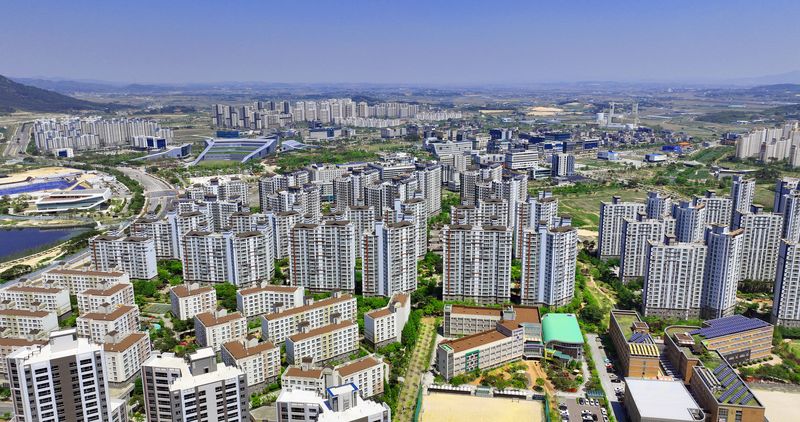
South Chungcheong Province and Hongseong and Yesan counties held a forum on strategies for attracting public institutions to South Chungcheong Innovation City at the provincial government’s main conference hall on the 18th, organized by the Chungnam Research Institute. They focused on developing differentiated arguments and implementation strategies for the second relocation of public institutions. About 150 people attended, including Governor Park Soo-hyun, Hongseong County Governor Park Jeong-ju, Yesan County Governor Choi Jae-gu, Chungnam Research Institute President Won Seong-su, the pan-provincial promotion committee and experts from various fields, reaffirming their determination to attract institutions.
The event was organized to highlight the rapid growth of Naepo New Town, which was belatedly designated an innovation city in October 2020, and to address the “reverse discrimination against South Chungcheong” it experienced after being excluded from the first relocation, partly because of the construction of Sejong City. In his opening remarks, Governor Park said, “Relocating public institutions is essential for South Chungcheong Innovation City, whose population has topped 50,000, to become a fully realized city,” adding, “We will foster it as a key hub for balanced national development by bringing anchor institutions aligned with South Chungcheong’s key industries and related institutions as a package.”
Experts from the Korea Research Institute for Human Settlements, the Korea Institute for Industrial Economics and Trade, and the Chungnam Research Institute, who gave presentations and took part in the panel discussion, focused on the case for prioritizing public institutions for placement because the city was excluded from the first relocation; attracting key institutions linked to the region’s main industries, including displays, semiconductors and future mobility; and plans for mutually beneficial regional development using the relocated institutions.
South Chungcheong Province’s greatest asset is that it is a “ready-to-go innovation city,” with administrative, educational, medical, cultural and transportation infrastructure already in place. Naepo New Town, whose population topped 50,000 on the 13th, has a young demographic, with 73% of its residents aged 49 or younger. Research capacity is also being expanded, including through the construction of CNU’s Naepo Campus and the KAIST Mobility AX Research Institute. Construction is progressing on a children’s specialty hospital with a 24-hour pediatric care center, targeted to open in 2028, as well as a general hospital with roughly 300 beds. When Naepo Station on the Seohae Line opens in the first half of 2028 and the direct KTX connection to the Gyeongbu Line is completed in 2033, Naepo will be brought within a roughly 40-minute living sphere of the Seoul metropolitan area, dramatically improving accessibility.
This approach is gaining traction because it could help Naepo avoid the experience of first-generation innovation cities, where inadequate residential infrastructure led to a proliferation of so-called “weekend couples” among employees transferred from the Seoul metropolitan area and made it difficult for them to settle quickly. In fact, educational, medical and cultural facilities—the areas of greatest concern to employees of relocating public institutions—are already in place to a considerable extent. The site is therefore seen as an ideal location for the government as well, as it can minimize upfront sunk costs and administrative missteps associated with building large-scale infrastructure.
A South Chungcheong Province official said, “We will actively incorporate the experts’ recommendations from the forum into our attraction strategy and strengthen cooperation with the government, the National Assembly and local political circles to make an all-out effort to attract public institutions in the second relocation.”
[email protected] Kim Won-jun Reporter