Hyundai Motor to Deploy Customized ST1 Vehicles in Fishing Villages... Signs Demonstration Agreement With Korea Fisheries Infrastructure Public Agency
- Input
- 2026-11-18 08:42:44
- Updated
- 2026-11-18 08:42:44
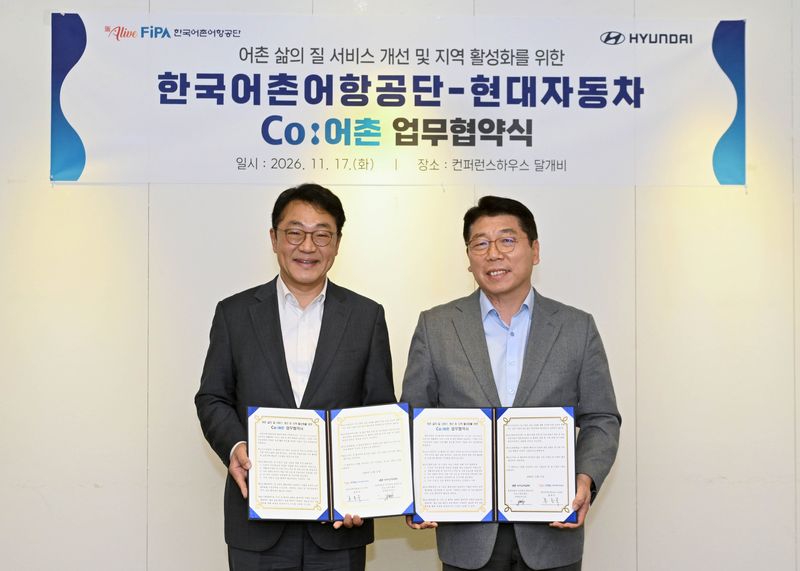
Hyundai Motor said on the 18th that it had signed a memorandum of understanding (MOU) with the Korea Fisheries Infrastructure Public Agency on the 17th at Conference House Dalgaebi in Jung District, Seoul, to advance the “Co: Fishing Village” project. Attendees at the signing ceremony included Hong Jong-uk, chairperson of the Korea Fisheries Infrastructure Public Agency, and Yeom Jae-seop, an executive director and head of Hyundai Motor’s domestic sales division.
Co: Fishing Village is a public-private partnership project that links corporate capabilities with fishing-village resources to promote sustainable development in communities facing population decline, an aging population and a shortage of everyday services. Under the agreement, the two organizations will identify demand for everyday services related to mobility, convenience and safety in fishing villages, and jointly plan and field-test PBV-based mobility services tailored to local needs.
The roles are divided. The Korea Fisheries Infrastructure Public Agency will identify participating communities and provide support for field tests. Hyundai Motor will tailor the ST1 to demand in each area and provide operator training and on-site maintenance and repairs. Hyundai Motor described the ST1 as a business-platform vehicle based on a Chassis-Cab that can be outfitted for different uses.
The two organizations plan to select target communities and pilot projects based on the local issues and service needs of each fishing village, then deploy custom-developed vehicles on site. Actual users and service operators will also take part in the pilot projects to assess user convenience, the impact on addressing local issues and the feasibility of sustained operations.
The service models under consideration include: mobile pop-up stores offering ready-to-eat meals and lodging amenities; heated rest areas offering care for haenyeo divers, to help them rest and look after their health after fishing; private car-camping services for fishing-village tourism; and fishing-village tour buses. Specific project offerings will be finalized after local demand and operating conditions are assessed.
Hyundai Motor plans to proceed in stages, from identifying local issues to providing services, running pilot programs and assessing their impact. Based on the field-test results, it will develop a model that can be applied to other fishing villages.
A Hyundai Motor representative said, “We are pursuing customized mobility services that address problems faced by customers and local communities.” The representative added, “Together with the Korea Fisheries Infrastructure Public Agency, we will develop services to address issues in fishing villages, assess their impact on site and expand them as a sustainable model of mutual growth.”
[email protected] Kim Dong-chan Reporter