They Say Private Education Spending Fell by 1.7 Trillion Won... Is My Family the Only One Spending More? [Atongjin]
- Input
- 2026-11-21 06:00:00
- Updated
- 2026-11-21 06:00:08
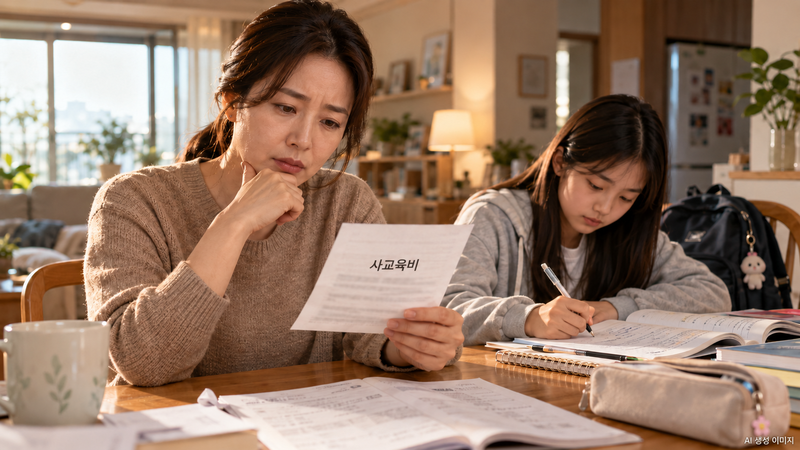
“I studied mainly from textbooks.” It was once a familiar line in interviews with the nation’s top scorers and students who earned perfect scores on the CSAT. They had gotten enough sleep, hadn’t attended private academies, and had kept up with their school classes. To parents listening, it was an admirable yet irritating thing to hear. Some were breaking their backs paying for English and math academies, not to mention online lectures, while others got perfect scores just by studying from their textbooks.
“Couldn’t my child study mainly from textbooks, too?” Easy to say. By the time students reach high school, a single subject can cost hundreds of thousands of won. In a month with even a vacation intensive course, the first digit on the credit card bill can change.
And yet, private education spending nationwide for elementary, middle and high school students reportedly fell last year. By nearly 1.7 trillion won, no less. Is my family the only one spending more? A closer look shows that what declined was a little different from what one might expect.
24 Out of 100 Spend Zero on Private Education
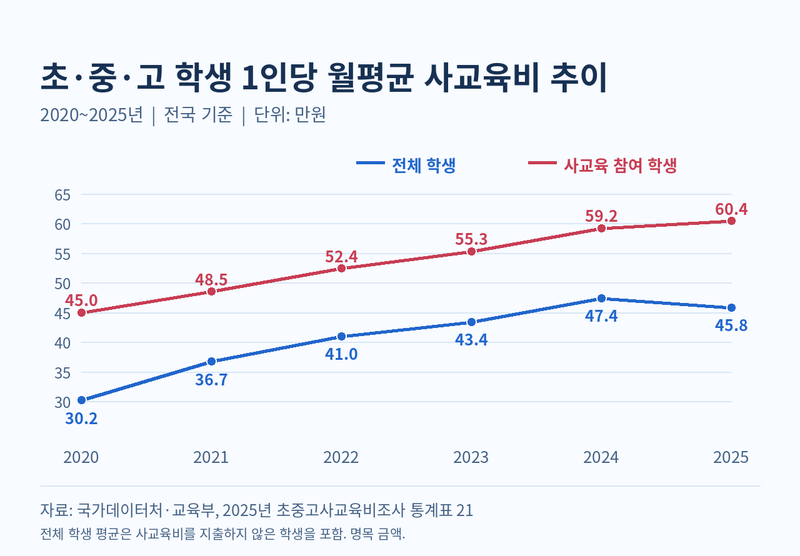
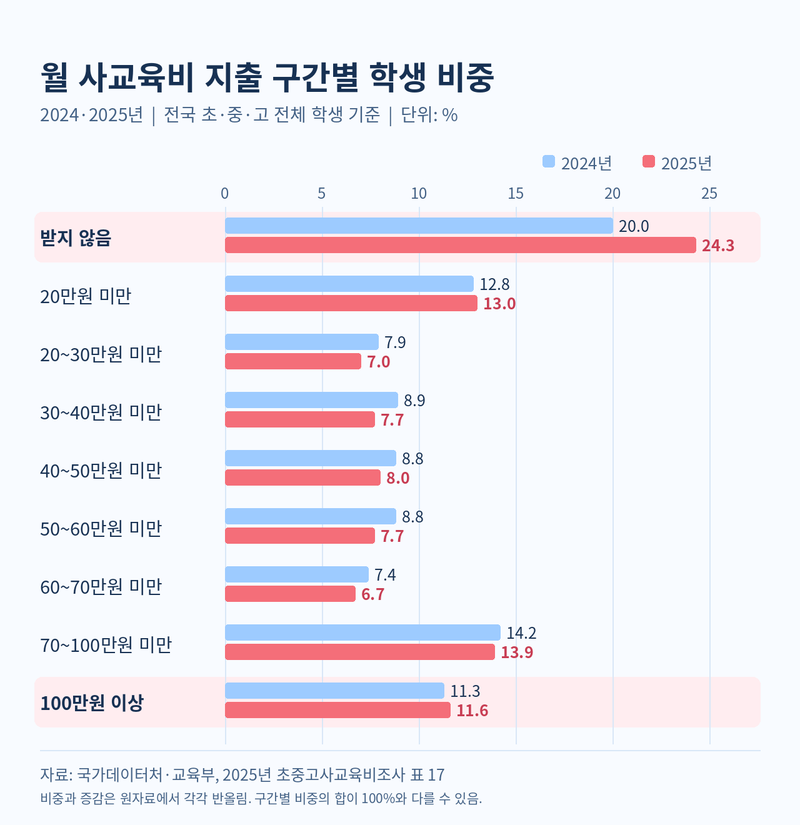
Imagine shrinking all elementary, middle and high school students in the country into a classroom of 100. About 76 students in that room receive private education, whether at an academy or through tutoring. The remaining 24 or so do not. A year earlier, 80 out of 100 students in the classroom received private education.
According to the “2025 Elementary, Middle and High School Private Education Expenditure Survey,” released in March by the Ministry of Data and Statistics and the Ministry of Education, students who received private education spent an average of 604,000 won a month last year. Multiplied by 12 months, that comes to about 7.25 million won. A year earlier, the monthly average was 592,000 won, so spending rose by 12,000 won a month, or 144,000 won over 12 months.
It was the first time since these figures began to be published in 2017 that the average monthly private education spending of participating students exceeded 600,000 won.
But when the children in the same classroom who do not receive private education are included, the average drops to 458,000 won.
The term “zero” private education spending refers to the expenses covered by the survey. These include private academies, individual or group tutoring, home-delivered workbooks, and paid online courses. Music, art, physical education, hobbies and liberal arts are also included.
However, fees for Neulbom School and after-school programs, Educational Broadcasting System (EBS) textbook costs, and language-study-abroad expenses are surveyed separately. This does not mean the 24 students in the classroom spent nothing at all on education.
Fewer Students Received Private Education... but the Share Spending at Least 1 Million Won a Month Rose
Total private education spending last year was 27.5351 trillion won, down 5.7% from the previous year.
The total number of students fell from about 5.13 million to 5.02 million, and the share receiving private education also declined.
In middle schools, the number of students actually increased, but the share receiving private education fell, as did total spending. That cannot be explained by a decline in student numbers alone.
But the share of all students who spent an average of at least 1 million won a month rose from 11.3% to 11.6%. Meanwhile, the shares in every spending bracket from 200,000 won up to, but not including, 1 million won a month declined.
One in Four in Seoul, but Fewer Than One in 20 in Towns and Townships
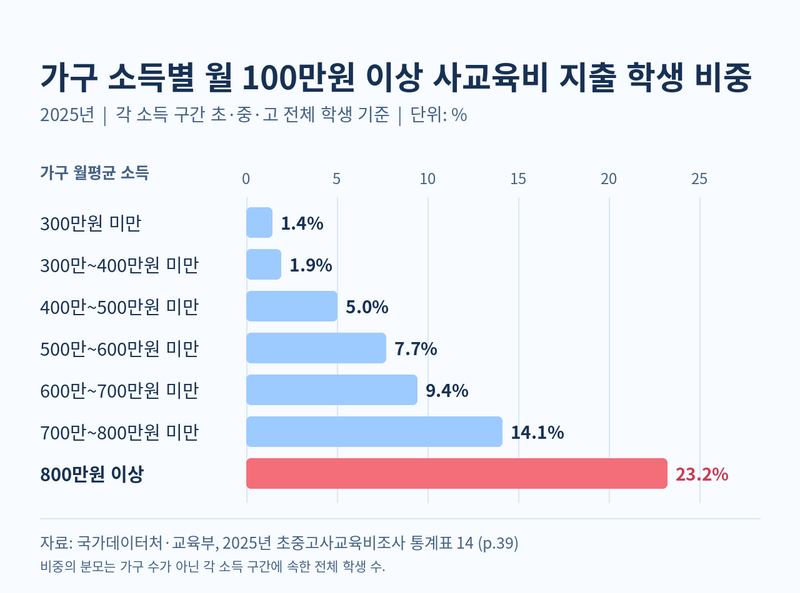
The difference was also clear by household income. Among students from households with monthly incomes of at least 8 million won, 23.2% spent an average of at least 1 million won a month. The figure was 1.4% for students from households with monthly incomes below 3 million won.
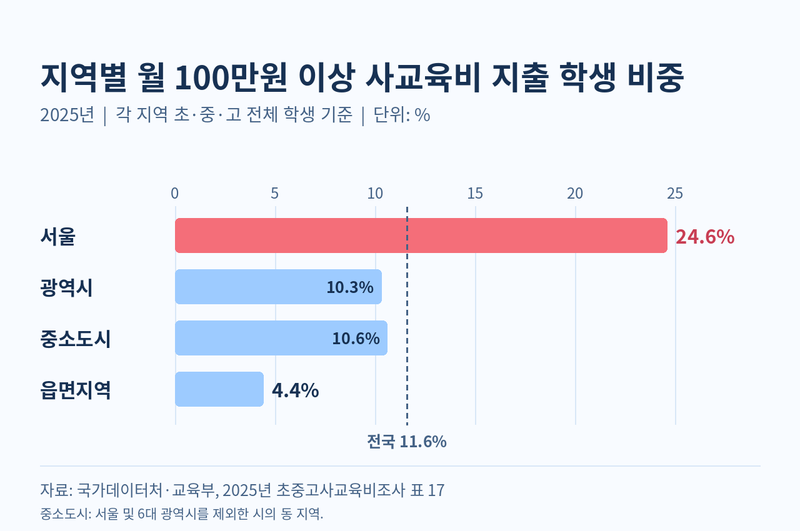
Spending also varied by where students lived. Last year, 24.6% of students in Seoul spent an average of at least 1 million won a month on private education. The share was 10.3% in metropolitan cities, 10.6% in small and medium-sized cities, and 4.4% in towns and townships. Seoul’s share was about 5.6 times that of towns and townships.
In Seoul, it was about one in four, but in towns and townships, it was fewer than one in 20.
High School Freshmen Spend More Than Seniors
In a classroom of 100 elementary school students, about 84 received private education, spending an average of 512,000 won a month each. In a middle school classroom, about 73 participated and spent 632,000 won; in a high school classroom, about 63 participated and spent 793,000 won.
Nearly four out of 10 high school students did not receive private education, while those who did spent an average of 281,000 won more per month than elementary school students who participated.
You might expect students in their final year of high school, who take the CSAT, to spend the most. But among high school students, those in their first year spent the most. Among students receiving private education, first-year high school students spent an average of 806,000 won a month, second-year students 797,000 won, and third-year students 774,000 won. Sixth-graders spent the most in elementary school, at 583,000 won, and third-graders spent the most in middle school, at 645,000 won.
Let’s return to our classroom of 100. About 24 students receive no private education. The 76 or so who do spend an average of 604,000 won a month—the highest figure on record. Put both groups in one classroom, and the average comes to 458,000 won. There might not be a single student in that room who actually spends exactly 458,000 won.
The news that private education spending has declined is accurate. Whether our family’s academy fees have fallen, too, is another matter. A credit card statement will tell you that more accurately than the national average. The CSAT for the 2027 academic year was held on the 19th. I hope all test-takers get the results they want.
[email protected] Kim Ki-seok Reporter