KOSPI Falls Below 5,000... Samsung and SK hynix Are Down by Half From Their Peaks as 'Sell' Fears Spread
- Input
- 2026-11-18 07:49:11
- Updated
- 2026-11-18 07:49:11
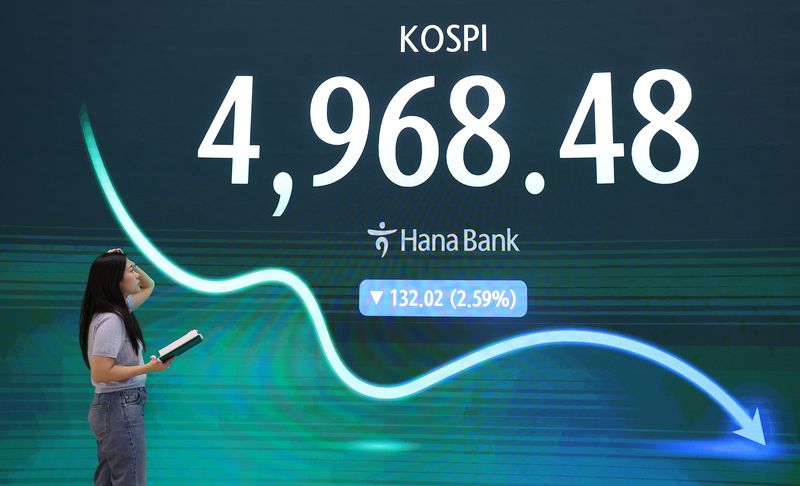
[Financial News] With the KOSPI falling below 5,000 for the first time in nine months, attention is focused on how far the declines in Samsung Electronics and SK hynix will continue. With the two stocks down an average of 55% from their peaks, KB Securities said concerns over a leadership change at NVIDIA and U.S. regulation of artificial intelligence (AI) had fueled selling, pushing the gap between share prices and earnings power to its widest level ever. As NVIDIA reported better-than-expected results on the 18th, whether foreign investors’ selling would ease became the first test for a rebound.
According to the Korea Exchange (KRX), the KOSPI closed at 4,968.48 the previous day, down 132.02 points (2.59%) from the previous trading day. It was the first time the index had closed below 5,000 in about nine months, since February 2. Samsung Electronics closed at 190,300 won, down 3.30%, while SK hynix finished at 1,098,000 won, down 1.96%. The KOSDAQ Index also ended the session at 650.06, down 2.34%. Foreign investors were net sellers of more than 1.4 trillion won on the main board.
KB Securities cited policy uncertainty and worsening supply-demand conditions as the reasons for the recent steeper declines in semiconductor stocks. The firm said uncertainty over NVIDIA’s leadership transition and the U.S. approach to AI regulation had fueled concerns that growth in AI investment could slow after 2028. It also said downward pressure on share prices had intensified as global hedge funds cut their exposure to AI semiconductor stocks and short-selling volumes approached their highest level in about 10 years, since 2016.
Kim Dong-won, head of research at KB Securities, said, “This is a time to distinguish short-term supply-demand imbalances from the structural direction of earnings.” He stressed, “Concerns that the pace of investment growth could slow do not mean memory orders will immediately decline.”
Demand for server DRAM and enterprise solid-state drives (SSDs) is expected to grow by 56% and 54%, respectively, next year. Memory supply in 2027–2028 is expected to meet only 60–70% of customer demand. This is because expanded production of high-bandwidth memory (HBM) is constraining increases in commodity DRAM production, while the amount of memory used in AI data centers is growing.
NVIDIA’s results are the first indication of how resilient demand for AI semiconductors is. Revenue for the third quarter of fiscal 2027, which NVIDIA reported that morning, was $115.8 billion, up 103% from the same period a year earlier. Data center revenue rose 110% to $107.6 billion. Its fourth-quarter revenue forecast was $126 billion to $134 billion, with even the low end exceeding the market estimate of about $125 billion.
Kim said, “Fear is reflected in share prices first, while earnings are expected to prove value,” and predicted, “Given that too much uncertainty has been priced into the recent share-price correction, the likelihood of a rebound will increase as growth in memory demand is confirmed by earnings.”
[email protected] Choi Doo-seon Reporter