Chun Ha-ram: “Thermal Cameras Can’t Detect AI Cheating ... CSAT Must Be Postponed”
- Input
- 2026-11-18 06:48:48
- Updated
- 2026-11-18 06:48:48
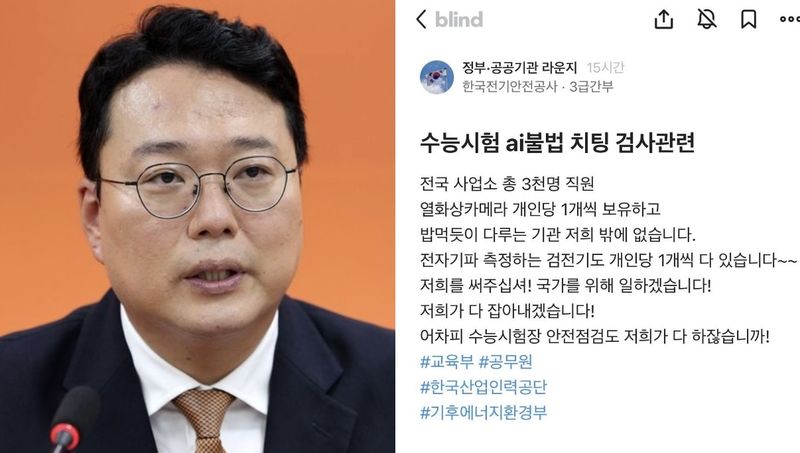
[Financial News] A claim that thermal imaging cameras and voltage detectors could catch AI cheating ahead of the College Scholastic Ability Test (CSAT) prompted Reform Party lawmaker Chun Ha-ram to push back, saying they were “highly ineffective.”
On the 17th, Reform Party lawmaker Chun Ha-ram said on Facebook, “After a claim emerged that the Korea Electrical Safety Corporation could be used to stop AI cheating on the CSAT, our office checked immediately and found that the likelihood of catching AI cheating with thermal imaging cameras and voltage detectors is very low.”
The previous day, a post by an employee of the Korea Electrical Safety Corporation, identified as A, drew attention on Blind, an anonymous online community for office workers. A wrote, “The 3,000 employees at our branches nationwide each have a thermal imaging camera and handle them as routinely as they eat. We also each have a voltage detector for measuring electromagnetic waves. After all, we carry out all the safety inspections at CSAT test sites, don’t we? We’ll catch them all.”
Chun posted a screenshot of the post, saying, “Tiny cameras and earbuds are small and generate little heat, so they are difficult to identify with thermal imaging cameras, especially when inside clothing. Voltage detectors are also not suited to identifying wireless signals or the presence of cameras. Ultimately, minimum measures are needed to prevent electronic devices from being brought in at all, using security screening checkpoints and metal detectors.”
He added, “Taking a cue from China’s college entrance exam, the Gaokao, basic safety measures should include metal-detector screening and checks of personal belongings, and the CSAT needs to be postponed to put these measures in place. Even metal-detector screening and checks of personal belongings alone would clearly increase the psychological fear among those who cheat and the deterrent effect.”
Chun criticized Minister of Education Choi Kyo-jin and Kim Moon-soo, a Democratic Party of Korea (DPK) lawmaker on the Education Committee, saying, “The education minister and the DPK both admit they are at a loss for measures to stop AI cheating, but the CSAT must not be pushed ahead recklessly without effective measures.”
He continued, “There are precedents for postponing the CSAT by one or two weeks because of the 2017 Pohang earthquake and COVID-19 in 2020. The current situation, in which confidence in fairness is fundamentally shaken, is a greater crisis than it was then.”
He added, “The Ministry of Education and the DPK have already decided that postponing the CSAT is absolutely out of the question, for fear of facing even more criticism if they still fail to come up with measures after a postponement. If an AI cheating scandal occurs as a result of pushing ahead with the CSAT without measures, the government and ruling party will have to take the serious responsibility they deserve.”
[email protected] Kim Su-yeon Reporter