'Putin’s Pride,’ the Crimean Bridge, Suffers Its First Total Collapse as Clashes Escalate Ahead of U.S.-China-Russia Summit
- Input
- 2026-11-17 23:40:42
- Updated
- 2026-11-17 23:40:42
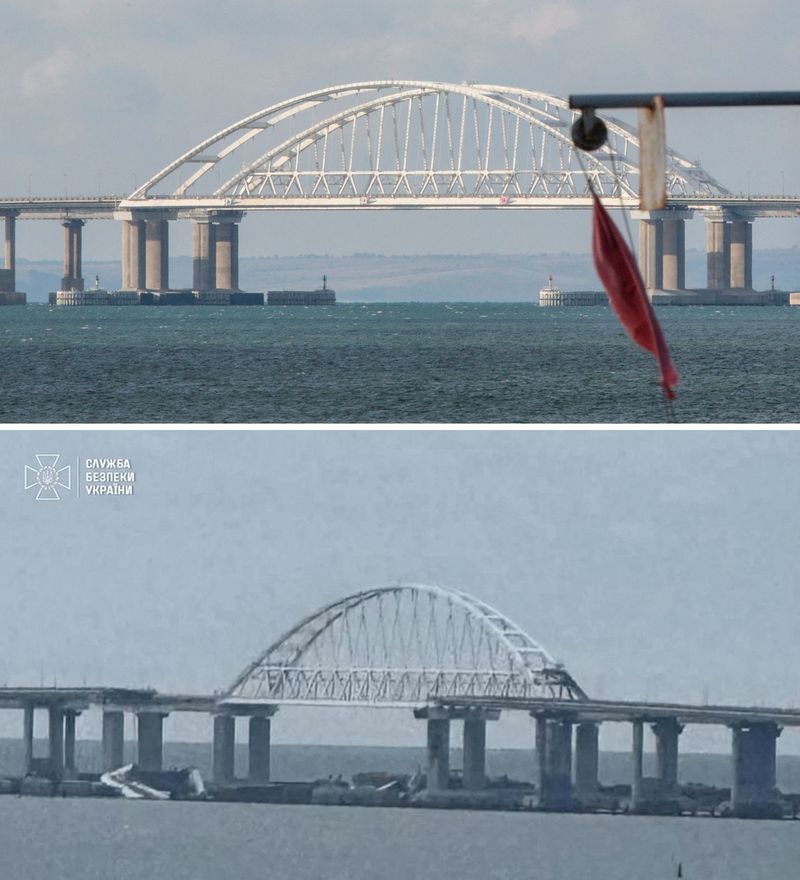
[Financial News] With a U.S.-China-Russia summit set to take place on the sidelines of the Asia-Pacific Economic Cooperation (APEC) meeting, armed clashes between Ukraine and Russia are escalating to a peak. In particular, one section of the Crimean Bridge, described as Russian President Vladimir Putin’s “pride,” has completely collapsed for the first time since it opened in 2018.
According to foreign media outlets, including The Associated Press, on the 17th (local time), part of the 19-km Crimean Bridge—a key link between mainland Russia and the Crimean Peninsula, forcibly annexed in 2014—sank to the seabed in an overnight attack the previous night. It had been damaged in several attacks before, but this is the first time an entire section has collapsed. Ukrainian aviation experts estimated that the collapsed structure weighed about 6,000 tons and predicted that repairs would take anywhere from several months to a year or more.
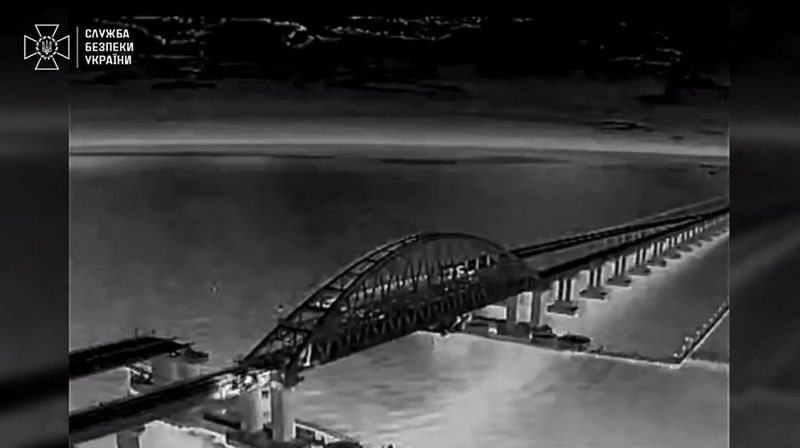
Ukrainian President Volodymyr Zelenskyy said on the social media platform X that “we carried out an unprecedented operation as the result of a seven-stage operation conducted over several weeks,” officially confirming his role in leading the attack. President Zelenskyy said, “We reminded Russia, which attacks our infrastructure, that ‘war returns to where it began,’” and gave details of the weapons used, including the domestically developed Flamingo cruise missile, Palianytsia (for strikes on roads), and Neptune, Ruta and FP-5 (for strikes on railways). Ukraine’s Security Service (SBU) also weighed in, saying, “The myth of the Russian Federation’s greatness has also been shaken.”
Caught off guard, Russia immediately formed an emergency government commission, chaired by Deputy Prime Minister Marat Khusnullin, to manage the response and described the incident as terrorism. It retaliated by attacking two bridges in northern and southern Kyiv, Ukraine’s capital, with ballistic missiles on the night of the 16th. The strikes killed two civilians and left 700,000 households affected by power outages. Russia’s Defense Ministry also announced that it had intercepted 1,441 Ukrainian drones within Russia—the largest number for the second day in a row.
The prevailing view is that Ukraine’s large-scale offensive is a show of force aimed at the trilateral U.S.-China-Russia summit scheduled for the 19th in Shenzhen. As negotiations to end the war, resumed in the United Arab Emirates (UAE) on the 10th and 11th, make little headway, the move is seen as an attempt to counter a “second Yalta Conference”—a secret deal among the great powers alone, with Europe and Ukraine’s positions excluded, in which decisions such as territorial partition would determine their fate—and to demonstrate Ukraine’s military presence.
[email protected] Park Ji-hyun Reporter