“Household Burden to Rise by 760.9 Billion Won if Cable TV Disappears”... Local News and Jobs Also at Risk
- Input
- 2026-11-18 08:00:00
- Updated
- 2026-11-18 08:00:03
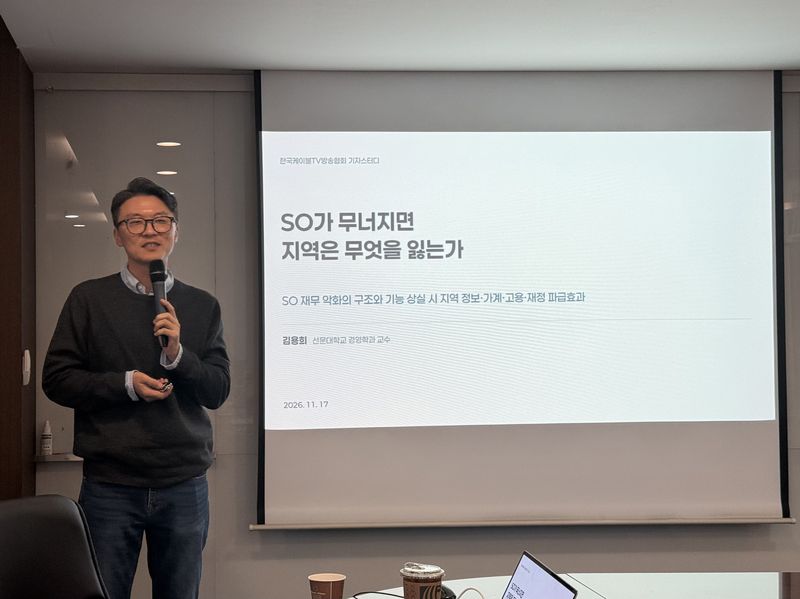
Kim Yong-hee, a professor in the Department of Business Administration at Sun Moon University, presented these findings on the 17th at the main conference room of the Korea Cable TV Association (KCTA) in Seodaemun District, Seoul, under the title “What Will Local Communities Lose if SOs Collapse?”
SOs Post Net Losses for Fourth Straight Year; Low-Cost TV Users Bear the Brunt
According to Professor Kim, the 90 system operators (SOs) recorded a sharp 89% drop in operating profits from broadcasting operations, from 405.6 billion won in 2015 to 45.5 billion won last year. The industry as a whole has posted net losses for four consecutive years since 2022. Over the same period, subscription-fee revenue fell 41%, while program-usage fees declined by just 5%, sending the ratio of usage fees to subscription-fee revenue soaring from 55% to 88%.
If SOs suspend services due to deteriorating profitability, low-cost TV users will be the ones affected. As of the end of 2024, there were about 5.59 million subscriptions to unidirectional digital broadcasting (8VSB), which can be watched without a set-top box, accounting for 46% of all SO broadcasting subscriptions. The monthly fee is around 4,400 won. Professor Kim estimated that 8VSB users switching to internet protocol television (IPTV) would incur an additional 100,000 to 198,000 won per subscription in the first year. If 85% of individual-use 8VSB subscriptions moved to IPTV, the burden on households would increase by 385.1 billion to 760.9 billion won a year.
The transfer of services is also uncertain, as IPTV operators have little incentive to take on low-cost subscribers who generate low profits. Professor Kim said, “We need to consider who would take over the subscribers and bear the costs if a cable TV operator became unable to continue operating.”
The system for delivering local information could also be weakened. Cable TV local channels in 78 broadcast areas nationwide produce an average of 223 local news stories a day. Disaster broadcasts totaled 6,115 last year, and broadcasts for this year’s local elections reached 7,010. Meanwhile, direct production spending on local programs fell 23%, from 60.5 billion won in 2023 to 46.4 billion won last year. Professor Kim stressed, “If local information and public-service functions disappear, restoring or replacing them will cost astronomical sums.”
Establish a Content-Usage Fee Negotiation Body and Cut Fund Contributions
To address SOs’ financial difficulties, Professor Kim recommended establishing a standing body to support negotiations over content-usage fees and the resolution of disputes, as well as reducing contributions to the Broadcasting and Communications Development Fund.
Professor Kim said, “We need a standing body that can continuously analyze broadcast-market data and conditions to support negotiations and intervene in cases of improper influence,” and proposed setting up a body tentatively called the “Broadcasting Expert Committee,” among other options.
Professor Kim also proposed reducing contributions to the Broadcasting and Communications Development Fund in line with the scale of investment in local content production. Although the competitive landscape has changed with the emergence of IPTV and online video services (OTT), SOs’ fund contribution rate has remained at 1.5% of broadcasting-business revenue since 2017. Critics note that SOs are still required to operate local channels, while support for production costs remains inadequate. Professor Kim said, “If SOs are required to continuously develop local content, the government should guarantee their investment costs in some form,” adding, “Fund contributions or taxes should be cut in proportion to the amount invested.”
The Korea Cable TV Association (KCTA) also called for standards for calculating content fees, stronger dispute-resolution functions, and expanded public support for local channels. The association stressed, “These policies are not measures to protect a particular industry, but a societal choice to safeguard the right to access affordable broadcasting services, local news, and disaster information.”
[email protected] Choi Hye-rim Reporter