Canada, Facing 'Trump Tariff Pressure,' Draws Closer to China, Agrees to Further Tariff Cuts and Expanded Economic Cooperation
- Input
- 2026-11-17 22:12:47
- Updated
- 2026-11-17 22:12:47
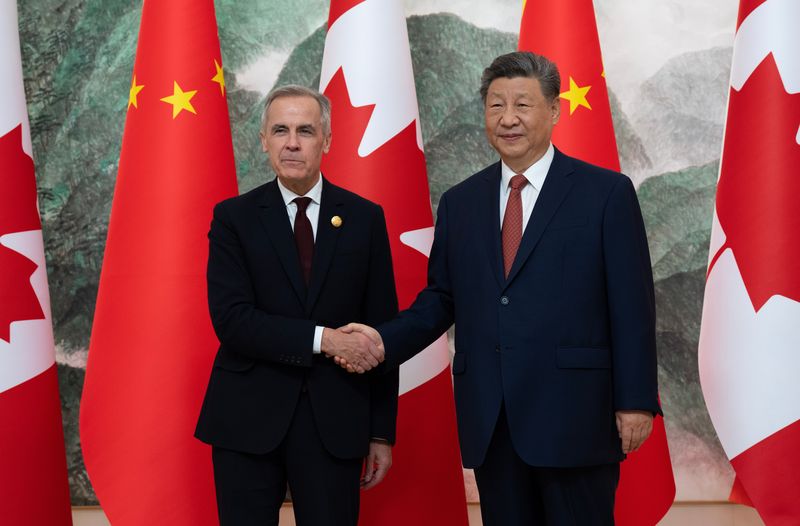
[Financial News] Canada, under economic pressure from U.S. President Donald Trump's repeated imposition of tariffs and threats of annexation, is accelerating efforts to draw closer to China to reduce its dependence on the United States. Taking the Asia-Pacific Economic Cooperation (APEC) summit as an opportunity, Canada and China agreed to expand economic and trade cooperation and make further tariff cuts.
China's Xinhua News Agency and other foreign media reported on the 17th (local time) that Chinese President Xi Jinping and Canadian Prime Minister Mark Carney held a summit in Shenzhen ahead of the APEC summit, which is scheduled to take place there in Guangdong Province on the 18th and 19th. This was their second meeting since Carney made a surprise visit to Beijing in January—Carney's first visit to Beijing in eight years—which formally marked the normalization of bilateral relations.
At the meeting, the two countries agreed to additional tariff cuts worth 400 million Canadian dollars (about 370 billion won). China agreed to provide further tariff relief on key Canadian products, including frozen pork and seafood such as halibut, shrimp and sea cucumbers. In response, Canada agreed to extend by two years tariff relief on some Chinese steel and aluminum products that was due to expire at the end of this year, and to expand the list of eligible products to 32 related items that are in short supply domestically.
The Canadian prime minister's office said, “Since the two countries agreed in January to ease trade barriers worth 7.5 billion Canadian dollars (about 7 trillion won), 90% or more of Canadian exports have regained market access,” and said the latest measures would further expand trade between the two countries.
At the meeting, President Xi said, “Stronger communication and improved relations between China and Canada serve not only the interests of both countries but also help safeguard world peace and prosperity,” emphasizing the development of a strategic partnership based on mutual respect and trust. He also proposed expanding cooperation in traditional areas such as trade and energy, as well as in the green and digital economies, international cooperation on artificial intelligence (AI), and people-to-people and cultural exchanges.
Prime Minister Carney welcomed the move, saying, “These tariff cuts have increased the predictability and stability of relations between the two countries.” He also said, “We will reduce points of friction and broaden areas of cooperation,” and emphasized practical cooperation across a wide range of fields, including conventional and clean energy, customs and border security, and promoting tourism and study abroad through more direct flights.
Relations between the two countries hit their lowest point in 2018, when Canada arrested Huawei Vice Chair Men Wanzhou, the daughter of the company's founder, at the request of the United States, and China detained two Canadians. But with the Trump administration's aggressive tariff policies putting him under pressure, Prime Minister Carney has been seeking to diversify trade with major Indo-Pacific countries. The previous day, he referred in particular to agreements with ASEAN countries, including the Philippines, and publicly said, “We will build a network with reliable countries and reduce our dependence on the United States.”
[email protected] Park Ji-hyun Reporter